

Available 24/7 at
+86 13632816717

What is the Best Power Management IC?
Power management integrated circuits (PMICs) are essential components in modern electronic systems, responsible for regulating, converting, and distributing power efficiently across multiple devices. As electronic products become more compact and power-sensitive, selecting the right PMIC has become increasingly important for optimizing performance and energy efficiency. Understanding what does a power management ic do helps engineers and designers make informed decisions for advanced applications.
What is Power Management Integrated Circuit?
Power Management Integrated Circuit (PMIC) is a chip whose core function is to integrate various power control functions into a single device. If a power supply system for portable smart devices were built using discrete components, it would require multiple separate chips to perform different functions. These would include voltage conversion, voltage regulation modules supporting multi-channel outputs, battery charging units, and monitoring components used to detect voltage levels, all of which would need to be configured individually.
The best power management IC integrates various power control functions into a single device. If a power supply system for portable smart devices were built using discrete components, it would require multiple separate chips to perform different functions. These would include voltage conversion, voltage regulation modules supporting multi-channel outputs, battery charging units, and monitoring components used to detect voltage levels.
How Power Management IC Works?
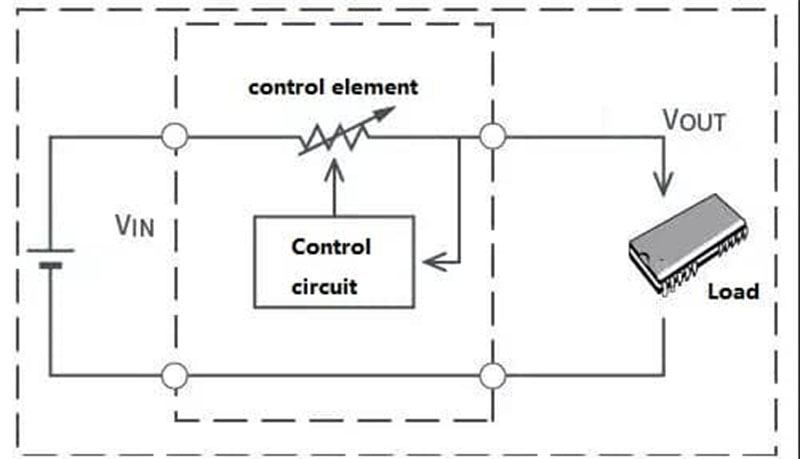
A PMIC is an all-in-one integrated chip that governs the delivery, transformation, regulation, protection and distribution of power to every component inside an electronic device.
Voltage transformation and stabilization
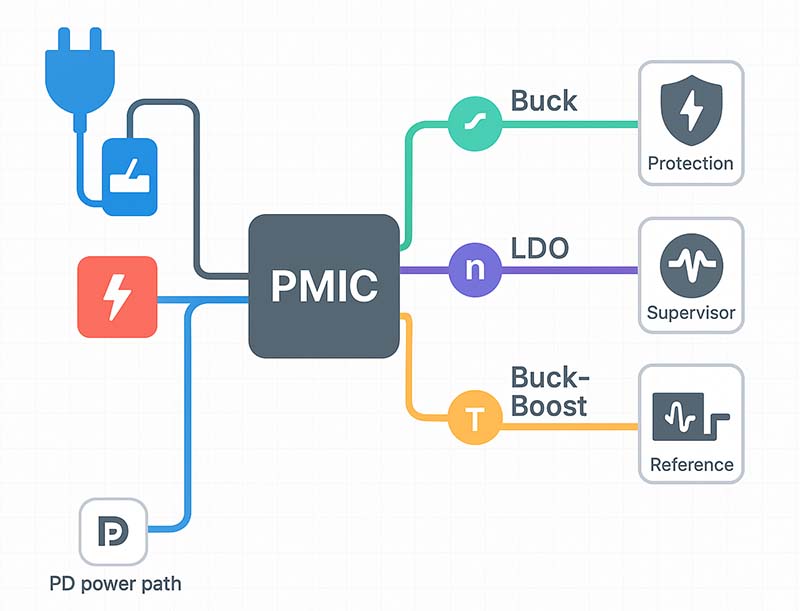
It accepts raw power input from batteries or adapters. Built-in buck, boost and buck-boost converters adjust voltage to match the exact requirements of processors, memory and sensors. Internal LDOs filter voltage ripples, delivering clean, precise power to noise-sensitive circuits.
Battery charging and power path switching
For portable battery-powered equipment, the PMIC manages complete charging cycles: constant-current fast charging for low batteries, constant-voltage maintenance near full capacity, and auto-stop to prevent overcharging. It also automatically switches power supply between external adapters and internal batteries without system interruption.
Ordered power delivery and energy saving
The PMIC follows programmable power sequencing to turn on or shut down voltage rails in a designated order, avoiding hardware faults caused by mismatched startup timings. Independent load switches cut power to idle modules, significantly reducing standby power consumption.
Real-time monitoring and safety protection
Internal detectors constantly monitor voltage, current and temperature across all power channels. When risks like overvoltage, overcurrent, short circuits or overheating occur, the PMIC rapidly restricts output or disconnects faulty rails to shield chips and batteries from permanent damage.
Digital interactive control and auxiliary functions
Via I2C/SPI interfaces, the main processor can send commands to dynamically adjust output voltage and switch operating modes for heavy loads or sleep states. Many PMICs also embed auxiliary modules including RTC, LED drivers and reset circuits under unified control to minimize discrete external parts.
What are the Advantages of Power Management Integrated Circuits?
Thanks to their highly integrated design, PMICs offer comprehensive advantages over traditional discrete power supply solutions, achieving significant improvements in size, power consumption, development and manufacturing efficiency, and power supply reliability.
Smaller Device Size
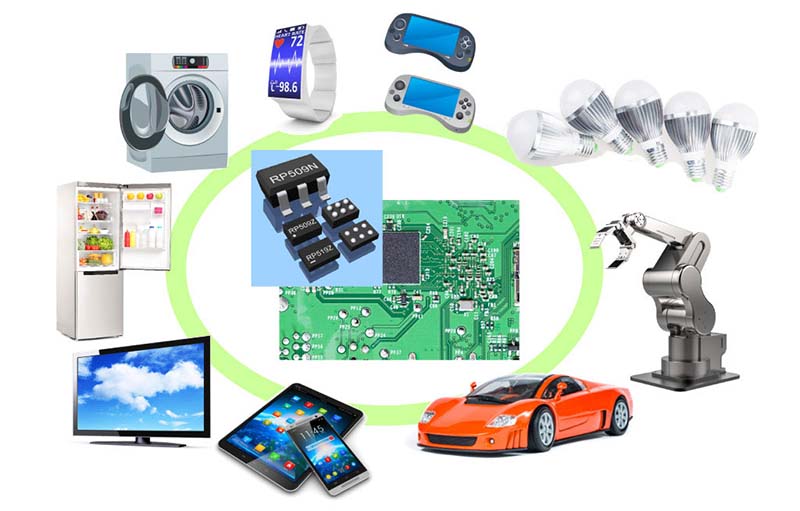
PMIC integrates multiple circuits such as voltage regulation, charging, and voltage monitoring into a single unit, replacing numerous discrete chips and peripheral components. This greatly reduces PCB space usage, making them ideal for compact portable devices such as smartphones and wearable.
Lower Overall Power Consumption
With internally optimized circuit coordination, PMIC achieves higher conversion efficiency and lower quiescent power loss compared to multiple standalone ICs, effectively extending battery life.
Simplified Hardware Design and Routing
There is no need to design separate peripheral circuits and routing for multiple power chips, which reduces design complexity, shortens development cycles, and lowers debugging difficulty.
Reduced Material and Manufacturing Costs
Fewer types and quantities of components are required, and SMT assembly processes are simplified, resulting in lower overall BOM (bill of materials) and production costs.
Improved Power Stability
Internal power modules are centrally coordinated with built-in protection mechanisms such as over-voltage, over-current, and over-temperature protection. Multiple voltage rails also exhibit lower fluctuation, ensuring more stable system operation.
Enhanced Intelligent Power Management
Most PMICs integrate digital control interfaces, allowing dynamic adjustment of output voltage and power switching in coordination with the main processor, enabling efficient operation across standby, full-load, and sleep modes.
What Does a Power Management IC Do?
A power management chip can manage multiple power supply rails. Compared with traditional discrete component solutions, it significantly reduces component count and saves PCB layout space. In addition to its compact size, the chip integrates comprehensive protection, thermal management, and noise reduction designs, improving overall system efficiency and stability. Its typical integrated functions include voltage conversion and regulation, battery charging, LED driving, real-time clock (RTC), power sequencing control, circuit monitoring, and power switch control modules.
Voltage Conversion and Regulation
It integrates step-up/step-down converters and LDO (low-dropout) linear regulators to provide accurate voltage levels for different devices such as processors, sensors, and memory. It ensures stable output voltage and suppresses fluctuations caused by load changes.
Battery Charging and Discharging Management
It includes built-in charging control circuits designed for lithium-ion and other rechargeable batteries, managing constant current (CC) and constant voltage (CV) charging processes. It also monitors discharge current and remaining battery capacity to prevent over-discharge and protect battery cells from damage.
Electrical Safety Protection
It integrates multiple protection mechanisms, including over-voltage, under-voltage, over-current, short-circuit, and over-temperature protection. When abnormal conditions occur, it quickly shuts down the corresponding power path to protect the battery and motherboard components.
Voltage and Current Monitoring
It continuously measures output voltages, battery voltage, and circuit current in real time, and feeds this data back to the main controller for power consumption analysis, energy statistics, and fault detection.
Power Path and Load Switching
It integrates multiple load switches that can independently control different power rails. Unused branches can be shut down to reduce power consumption, while also managing switching between external adapter power and battery power supply modes.
Intelligent Power Control
With digital communication interfaces such as I²C and SPI, it receives commands from the main processor to dynamically adjust voltage, frequency, and operating modes. This allows the system to adapt to different conditions such as standby, light load, and full load, enabling overall power efficiency optimization.
What Are the Different Types of Power Management IC?
Multi-rail PMICs (Full-featured System PMIC)
The most comprehensive type integrating buck/boost converters, LDOs, chargers, load switches and monitoring circuits. Designed for complete systems like smartphones, MPUs, automotive ECUs and industrial SoCs. One chip supplies all voltage rails for processors, memory and peripherals, supporting power sequencing and digital I2C/SPI control.
Low-Dropout Regulators (LDOs)
Simple linear regulators for low-noise, low-current power supply. They deliver stable precise voltage with minimal output ripple, ideal for sensitive analog circuits, sensors and radio modules.
DC-DC Switching Regulators
High-efficiency conversion chips divided into three sub-types:
- Buck (step-down): Drops high input voltage for core chips;
- Boost (step-up): Raises low battery voltage to drive LEDs or displays;
- Buck-boost: Maintains steady output whether input is higher or lower, perfect for fluctuating battery power.
Battery Management ICs (BMIC)
Specialized for lithium-ion battery control. They govern constant-current/constant-voltage charging, track battery capacity, prevent overcharge, overdischarge and short circuits. Some integrate power-path management to run devices while charging.
Load Switch ICs
Compact single-channel power switches that remotely turn power rails on/off under MCU signals. They cut power to unused subsystems to reduce standby drain, widely used in IoT, portable electronics and automotive accessory circuits.
Automotive Safety PMICs
Grade-qualified (AEC-Q100, ISO 26262 ASIL-B/D) chips built for vehicles. Equipped with enhanced fault detection, thermal protection and window watchdogs, tailored for ADAS, cockpit controllers and powertrain MCUs.
Specialized Function PMICs
Application-specific single-purpose power chips: LED driver ICs for lighting/displays, RTC power supply ICs, USB power delivery (PD) controllers, and hot-swap ICs for server/industrial hot-plug hardware.
Different components have different power requirements in terms of voltage levels, power consumption, integration complexity, and performance expectations. Therefore, learning how to choose the PMIC helps ensure optimal system efficiency, stability, and cost control when designing modern electronic products.
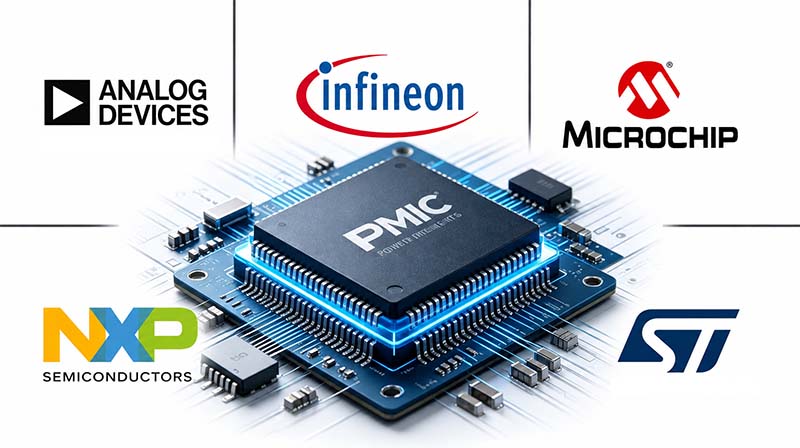
Leading Brand Power Management Integrated Circuit Manufacturers
As a professional power management integrated circuit (PMIC) distributor, we supply a wide range of power management solutions from the world's leading semiconductor manufacturers. PMICs play a critical role in modern electronic systems by regulating voltage, managing power distribution, improving energy efficiency, and extending battery life. Whether for industrial automation, automotive electronics, telecommunications, data centers, or power equipment, the top PMIC manufacturers continue to deliver highly integrated and reliable power management solutions.
LTC3376
Multi-output high-current universal PMIC supporting 3V–20V wide input, integrating 4 independent buck regulators and 8 configurable 1.5A power stages, total output current up to 12A. It achieves peak 96% conversion efficiency, ±1% precise output voltage accuracy, and supports parallel inductors for simplified PCB layout. Ideal for industrial control, telecom and multi-rail embedded systems, with built-in flexible power sequencing and full fault monitoring.
Automotive ASIL-D–capable power management IC designed for ADAS and zonal ECU applications. It integrates multiple high-efficiency step-down (buck) converters and low-dropout (LDO) regulators to support multi-rail power architectures for advanced automotive SoCs, cameras, sensors, and high-speed communication interfaces.
2. Infineon Technology
TLF35585
OPTIREG™ flagship functional safety PMIC matching Aurix™ automotive MCUs, 3V–40V wide battery input with integrated buck-boost pre-regulator. Features dedicated LDO rails for MCU, CAN communication and precision reference, plus dual sensor voltage trackers. Supports ASIL D certification, built-in window watchdog, self-test and safe-state control, perfect for powertrain and autonomous driving ECUs.
TLF30682QV
ADAS-specialized compact PMIC optimized for vision sensors and radar modules. Integrates multi-step regulated power rails, low quiescent current standby LDO and SPI digital control. Strong load-dump transient resistance, minimal PCB footprint, stable power supply for high-speed image signal processors in vehicle perception systems.
3. Microchip Technology
MCP16701
High-density PMIC for FPGA, high-end MPU and industrial AI computing. Equipped with eight 1.5A buck channels, four high-precision 300mA LDOs and one SerDes dedicated LDO controller. Reduces BOM count by over 60% and PCB area by 48% vs discrete designs, tightly compatible with PolarFire FPGA and PIC64GX 64-bit MPUs, with I2C programmable power sequencing.
MCP16501
Cost-effective compact PMIC tailored for SAMA5/SAM9/SAMA7 embedded MPUs. Three 1A buck converters + one 300mA auxiliary LDO, ±1% DDR/core voltage precision, preset power-up sequence for Microchip MPUs. Ultra-low 6µA shutdown current, enhanced ESD protection, ideal for low-cost industrial HMI, IoT gateways and battery-powered embedded devices.
4. NXP Semiconductors
PF8200
12-channel high-performance automotive PMIC for i.MX 8 and S32V ADAS processors. Contains 7 high-efficiency bucks and 4 LDOs; PF82 variant supports ASIL B functional safety while PF81 is for non-safety high-end industrial/machine vision. Delivers scalable high current for multi-core application processors, integrated RTC backup and comprehensive fault diagnostics.
PCA9452
AEC-Q100 Grade 2 automotive PMIC exclusively optimized for i.MX 93x low-power processors. Multi-rail regulated outputs with ultra-low idle power consumption, built-in battery charger path and precise voltage monitoring. Compact QFN package, simplified circuit design for smart cockpit, vehicle edge computing and low-power automotive control units.
5. Renesas Electronics
DA9063
17-channel high-current PMIC for quad-core application processors and industrial edge computing. Six buck converters, multiple LDOs, 10-bit ADC, DDR reference power and coin-cell RTC charger. Supports I2C/SPI dual control, fully programmable power sequencing and dynamic load adjustment, capable of sustaining 12A continuous total output for high-load SoC systems.
DA9072
Ultra-small wearable/IoT PMIC with integrated 500mA power-path lithium charger. Combines low-IQ buck, three load-switch LDOs, watchdog and reset circuit, WLCSP tiny packaging (2.97×2.66mm). Nanoamp-level quiescent current extends battery runtime for smart watches, wireless earbuds and portable medical sensors.
6. STMicroelectronics (ST)
STPMIC25
Flagship high-integration PMIC perfectly paired with STM32MP2 multi-core MPUs. 7 DC-DC buck converters, 7 configurable LDOs and DDR voltage reference, total 18 regulated power rails. High conversion efficiency across light/heavy loads, I2C programmable low-power sleep modes, robust overvoltage/thermal protection for factory automation, POS and medical monitoring hardware.
STPMIC07M
SSD storage dedicated PMIC compatible with 3.3V/5V input rails. Four bucks + three precision LDOs, PMBus/I2C dual interface for independent rail tuning and power sequence setup. Low ripple noise stable power for flash controllers and high-speed memory chips, simplifies solid-state drive hardware layout and improves long-term operational reliability.
7. Texas Instruments (TI)
LP8762
Top-tier ASIL D multi-phase automotive PMIC for high-power ADAS SoCs. Four multi-phase buck channels supporting peak 12A total output current, wide 2.7V–5.5V input range. Supports factory/software/user three-way configuration, integrated thermal monitor, watchdog and fault error signal, built for vehicle central computing and high-performance perception chips.
TPS650330
Miniature automotive camera module PMIC with three 1.5A bucks + one low-noise LDO. 18V wide input tolerant for vehicle battery systems, ultra-low EMI switching architecture, compact footprint matching compact camera PCBs. Optimized for CMOS image sensors, ISP and serial communication peripherals in automotive surround vision systems.
Last but not least, selecting the right PMIC depends on understanding system power requirements, efficiency targets, and application-specific constraints. By evaluating how power management IC works and what they are designed to achieve, engineers can make more informed decisions for different electronic systems. Insights into the top PMIC manufacturers also help identify reliable solutions that ensure stable performance, optimized power delivery, and long-term design efficiency across modern applications.
Related information
- 2026.09.20 What is Ceramic Packaging Chip?
- 2026.09.13 What is SMD Resistor?
- 2026.09.06 What is Bus Interface IC?
- 2026.08.30 How to Select Supercapacitor?