

Available 24/7 at
+86 13632816717

What is a Ceramic Capacitor?
Capacitor is a passive electronic component used to store and release electrical energy. It consists of two conductive electrodes separated by an insulating dielectric material and is widely applied in electronic circuits for filtering, decoupling, signal coupling, and energy storage. Based on the dielectric material used, capacitors can be divided into several types, including ceramic capacitors, electrolytic capacitors, and film capacitors. Among them, the ceramic capacitor is one of the most widely used capacitor types.
What is a ceramic capacitor? It uses ceramic materials as the dielectric layer and offers advantages such as compact size, high reliability, low equivalent series resistance (ESR), and excellent high-frequency performance. These characteristics make the ceramic capacitor in electrical circuits especially suitable for applications such as power filtering, chip decoupling, and high-frequency signal processing in modern electronic devices.
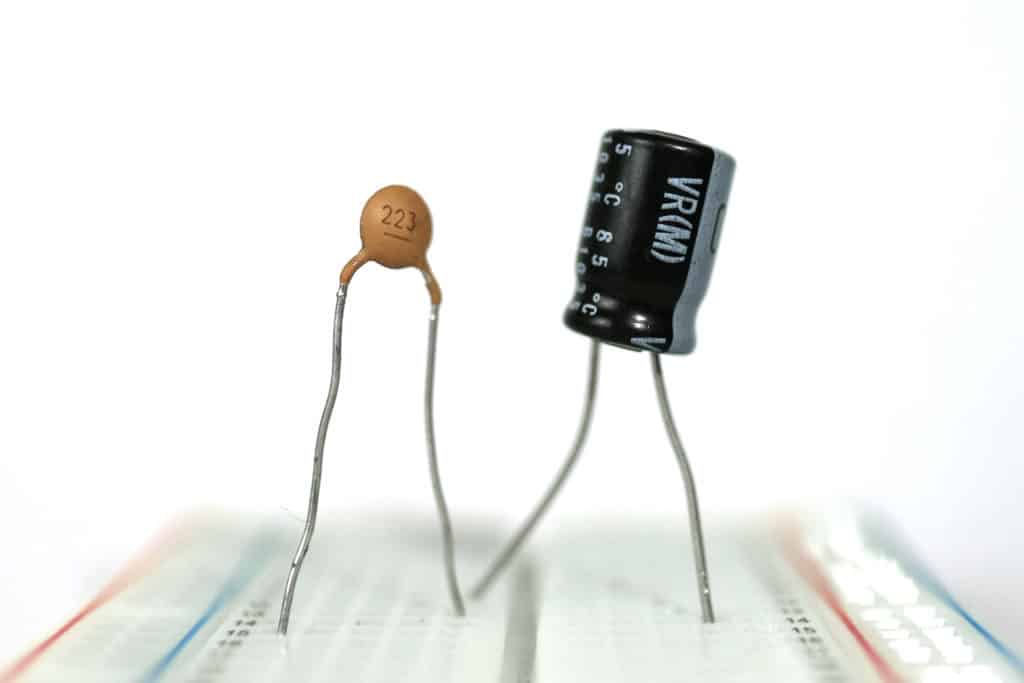
What are the Advantages of Ceramic Capacitor?
Ceramic capacitors have become one of the most widely used types of capacitors, mainly because they achieve an excellent balance between size, performance, reliability, cost, and application range.
1. Small Size, Ideal for Miniaturized Electronic Devices
Ceramic capacitors, especially MLCCs (Multilayer Ceramic Capacitors), use a multilayer structure composed of ceramic dielectric materials and metal electrodes, enabling high capacitance values within extremely small package sizes. For example, miniature packages such as 0201, 0402, and 0603 are widely used in portable electronic devices. This high level of integration meets the space-saving requirements of products such as smartphones, wearable devices, and AI equipment.
2. Excellent High-Frequency Performance
Ceramic capacitors feature low equivalent series resistance (ESR) and equivalent series inductance (ESL), allowing them to quickly respond to current changes in circuits and effectively suppress high-frequency noise. Therefore, they are highly suitable for power decoupling, bypass filtering, and signal processing in high-speed digital circuits, especially for high-performance semiconductor devices such as CPUs, GPUs, and communication chips.
3. High Reliability and Long Service Life
Unlike electrolytic capacitors, ceramic capacitors do not contain liquid electrolytes, eliminating aging issues such as electrolyte drying and leakage. As a result, they offer longer service life and higher stability. In addition, some high-performance ceramic capacitors can withstand wide temperature ranges, making them suitable for demanding applications in automotive, industrial, and aerospace environments where high reliability is required.
4. Low Cost and Suitable for Mass Production
Ceramic materials are widely available, and manufacturing processes are highly mature. In particular, MLCCs are produced through automated mass production methods, enabling lower unit costs.
5. Diverse Product Types and Wide Application Range
Ceramic capacitors are available in various dielectric types:
- C0G/NP0 ceramic capacitors: Provide extremely high stability and are suitable for precision circuits, RF circuits, and clock circuits.
- X7R and X5R ceramic capacitors: Offer a good balance between capacitance and stability, making them the most commonly used types in electronic devices.
- Y5V and Z5U high dielectric constant ceramic capacitors: Provide higher capacitance values and are suitable for cost-sensitive applications.
In addition, ceramic capacitors are available in different package sizes, voltage ratings, and capacitance ranges, covering a wide variety of applications from compact consumer electronics to industrial equipment.
6. Excellent Temperature and Environmental Adaptability
Some ceramic capacitors can maintain stable performance across a wide temperature range. For example, automotive-grade MLCCs typically need to meet strict temperature cycling and reliability requirements. Therefore, they are widely used in new energy vehicles, battery management systems (BMS), engine control units (ECUs), and other demanding applications.
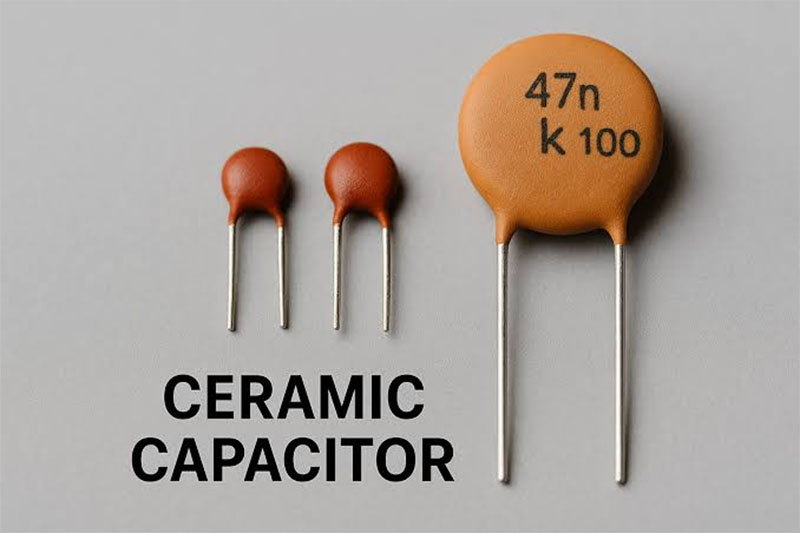
Ceramic Capacitor vs. Electrolytic Capacitor
Ceramic capacitors use ceramic materials as the dielectric layer, while electrolytic capacitors use an electrolyte as part of their construction. Ceramic capacitors are preferred for high-frequency, compact, and high-reliability applications, whereas electrolytic capacitors are commonly used for large-capacitance energy storage and power smoothing. The key factor in choosing a capacitor is the required capacitance value. Electrolytic capacitors are the best choice if a large energy reserve is needed. Ceramic capacitors are generally more suitable for smaller tasks or high-frequency applications.
Advantages of Ceramic Capacitors over Electrolytic Capacitors
Smaller size: Ceramic capacitors, especially MLCCs, can provide high capacitance in extremely compact packages.
Better high-frequency performance: Their low ESR and low inductance make them ideal for high-speed digital circuits.
Longer lifetime: They do not contain liquid electrolyte, avoiding drying and leakage issues.
Higher reliability: Suitable for automotive, industrial, and high-reliability applications.
Advantages of Electrolytic Capacitors over Ceramic Capacitors
Higher capacitance values: Electrolytic capacitors can store much more energy, making them suitable for bulk filtering.
Cost-effective for high capacitance: They provide large capacitance at a lower cost compared with equivalent ceramic solutions.
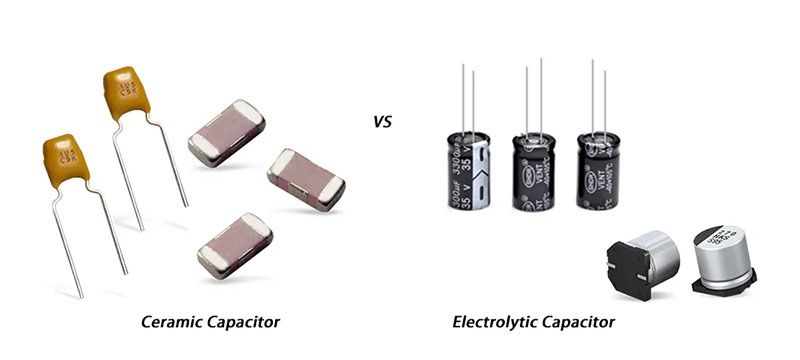
Ceramic Capacitor vs. Tantalum Capacitor
Ceramic capacitors, especially MLCCs, offer excellent high-frequency performance and miniaturization, while tantalum capacitors provide stable capacitance, high volumetric efficiency, and reliable performance in power management circuits.
Advantages of Ceramic Capacitors over Tantalum Capacitors
Better high-frequency characteristics: Lower ESR and ESL make ceramic capacitors ideal for fast switching circuits.
Non-polarized operation: They can be installed in either direction, simplifying circuit design.
Lower cost: MLCCs are generally more economical for mass production.
Advantages of Tantalum Capacitors over Ceramic Capacitors
Higher capacitance stability: Tantalum capacitors maintain capacitance better under DC voltage compared with many Class 2 MLCCs.
Higher capacitance density: They can provide larger capacitance in a smaller package than many ceramic capacitors.
Low leakage current: Suitable for applications requiring stable power filtering.
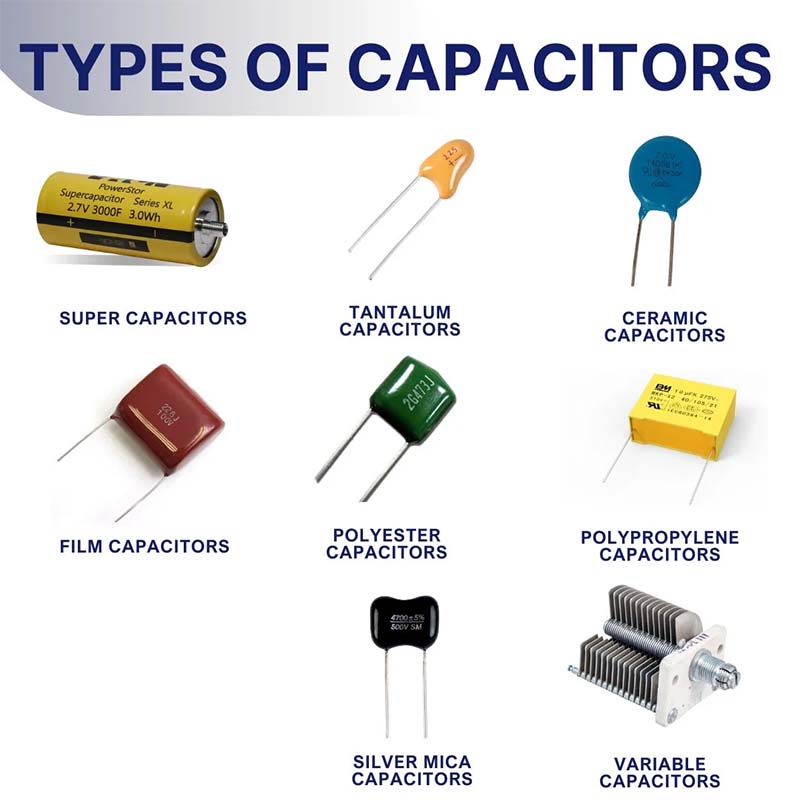
What Are the Types of Ceramic Capacitors?
Ceramic capacitors can be classified based on their dielectric materials, electrical characteristics, and construction methods. The most common types include Class 1 ceramic capacitors, Class 2 ceramic capacitors, Class 3 ceramic capacitors, multilayer ceramic capacitors (MLCCs), and ceramic disc capacitors. Among them, MLCCs are currently the dominant type used in modern electronic devices due to their compact size and high performance.
1. Class 1 Ceramic Capacitors
Class 1 ceramic capacitors are high-precision ceramic capacitors that typically use dielectric materials such as C0G (NP0). They are designed for applications requiring excellent stability and accuracy, with very low changes in capacitance caused by temperature, voltage, or aging. Compared with other ceramic capacitors, Class 1 capacitors have lower capacitance values but provide superior electrical performance, low dielectric loss, and high reliability. They are widely used in RF circuits, oscillators, timing circuits, and precision measurement equipment where stable capacitance is critical.
2. Class 2 Ceramic Capacitors
Class 2 ceramic capacitors use high dielectric constant materials, such as barium titanate, to achieve higher capacitance values in a smaller package. Compared with Class 1 capacitors, they provide greater capacitance density and are more suitable for general electronic applications. However, their capacitance can vary with temperature, applied voltage, and aging effects. Common dielectric types include X7R, X5R, and Y5V, which are widely used for power filtering, noise suppression, bypassing, and decoupling applications in consumer, industrial, and automotive electronics.
3. Class 3 Ceramic Capacitors (Z5U)
Z5U dielectric delivers high capacitance density at low cost. Working temperature range is +10°C ~ +85°C, capacitance variation +22%/-56%. It suffers heavy DC bias degradation, obvious temperature drift and significant aging. Due to narrow operating temperature range and poor stability, Z5U has been gradually phased out in modern electronic designs and rarely seen in new schematics.
4. Multilayer Ceramic Capacitors (MLCCs)
Multilayer ceramic capacitors (MLCCs) are the most widely used ceramic capacitors in modern electronics. It uses a multilayer structure, where multiple layers of ceramic dielectric material and internal metal electrodes are alternately stacked and connected to form a compact capacitor with high capacitance density, allowing manufacturers to achieve high capacitance values in extremely small packages. MLCCs offer low equivalent series resistance (ESR), excellent high-frequency performance, high reliability, and miniaturized size, making them ideal for high-density circuit designs.
5. Ceramic Disc Capacitors
Ceramic disc capacitors use a disc-shaped ceramic dielectric with metal electrodes coated on both sides. Compared with MLCCs, they have a simpler structure and are typically used in applications requiring high voltage endurance and cost efficiency. Ceramic disc capacitors can provide good stability and insulation performance, making them suitable for power supply circuits, EMI suppression, safety circuits, and high-voltage electronic equipment.
Comparison of Different Types of Ceramic Capacitors
|
Type |
Main Dielectric Materials |
Features |
Advantages |
Limitations |
Applications |
|
Class 1 Ceramic Capacitor |
C0G (NP0) |
High precision, low loss, excellent stability |
Extremely stable capacitance, low temperature coefficient, reliable performance |
Lower capacitance values and higher cost |
RF circuits, oscillators, timing circuits, precision equipment |
|
Class 2 Ceramic Capacitor |
X7R, X5R, Y5V |
Balanced capacitance and stability |
High capacitance density, compact size, widely available |
Capacitance changes with voltage, temperature, and aging |
Power filtering, decoupling, automotive electronics, consumer devices |
|
Class 3 Ceramic Capacitor |
Z5U |
Very high dielectric constant, high capacitance density |
Provides large capacitance in a small package, low cost |
Poor temperature stability, strong voltage dependency, higher aging effects |
General-purpose filtering, low-cost consumer electronics |
|
MLCC (Multilayer Ceramic Capacitor) |
C0G, X7R, X5R, Y5V, etc. |
Multi-layer ceramic and electrode structure |
Small size, high reliability, low ESR, excellent high-frequency performance |
Some types suffer from DC bias capacitance loss |
Smartphones, servers, automotive electronics, AI systems |
|
Ceramic Disc Capacitor |
Ceramic dielectric materials |
Disc-shaped structure, suitable for high voltage |
High voltage endurance, simple structure, economical |
Larger size, limited miniaturization |
EMI suppression, safety circuits, power electronics |
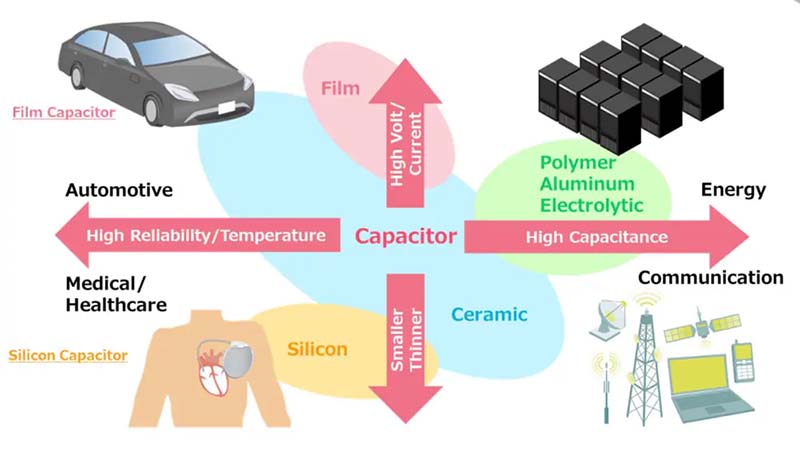
What Are Ceramic Capacitors Used For?
Ceramic capacitors are widely used in electronic circuits for storing energy, filtering signals, suppressing noise, and stabilizing voltage.
1. Decoupling and Bypass Applications
One of the most common uses of ceramic capacitors is decoupling and bypassing, especially in circuits containing integrated circuits (ICs). They are placed close to the power pins of chips to provide a stable voltage supply by quickly supplying transient current when the IC switches between operating states. At the same time, they help reduce high-frequency power supply noise and prevent voltage fluctuations from affecting circuit performance.
2. Power Supply Filtering
Ceramic capacitors are widely used in power management circuits to filter unwanted voltage ripple and electrical noise. They smooth unstable DC voltages and improve the efficiency and reliability of power supplies, voltage regulators, and battery-powered devices. Due to their low ESR and fast response, MLCCs are commonly used in switching power supplies and DC-DC converter circuits.
3. Noise Suppression and EMI Filtering
Ceramic capacitors are effective in reducing electromagnetic interference (EMI) and high-frequency noise generated by electronic circuits. They are often used in noise suppression circuits, input/output filtering, and safety applications to prevent interference between different components and improve overall system stability.
4. Signal Coupling and Filtering
In analog and communication circuits, ceramic capacitors are used for signal coupling and filtering. They allow AC signals to pass while blocking DC components, helping separate different stages of a circuit. High-stability ceramic capacitors such as C0G/NP0 types are commonly used in RF circuits, oscillators, and timing applications where accurate signal processing is required.
5. Automotive Electronics
Ceramic capacitors play an important role in automotive electronic systems due to their reliability and ability to operate in harsh environments. They are used in engine control units (ECUs), advanced driver assistance systems (ADAS), electric vehicle (EV) battery management systems, sensors, and infotainment systems for power filtering, signal processing, and voltage stabilization.
6. Consumer Electronics and Mobile Devices
Modern consumer electronics rely heavily on multilayer ceramic capacitors (MLCCs) because of their extremely small size and high capacitance density. Smartphones, tablets, laptops, smartwatches, and other compact devices may contain hundreds or even thousands of MLCCs for power regulation, processor decoupling, RF signal filtering, and circuit protection.
7. Industrial and High-Performance Applications
Ceramic capacitors are also widely used in industrial equipment, telecommunications systems, servers, and AI computing hardware. Their high reliability, low losses, and fast response make them suitable for applications requiring stable operation, including data centers, networking equipment, industrial controllers, and high-frequency circuits.
The Best Multilayer Ceramic Capacitors
Murata GRM188C80E107ME – 0603 100μF 2.5V MLCC
Murata GRM188C80E107ME is a high-capacitance multilayer ceramic capacitor (MLCC) featuring a 0603 (1608 metric) compact package, 100μF capacitance, and 2.5V rated voltage. Based on X6S dielectric characteristics, it offers excellent capacitance density and low impedance performance in a very small footprint. This capacitor is designed for power supply smoothing, decoupling circuits, and compact electronic devices, making it suitable for applications such as smartphones, servers, and advanced computing systems.
KYOCERA AVX KGM15CS60E107MT – 0603 100μF 2.5V MLCC
KYOCERA AVX KGM15CS60E107MT is a high-density X6S multilayer ceramic capacitor in a 0603 package, providing 100μF capacitance with a 2.5V rated voltage. It combines compact size, low ESR characteristics, and reliable temperature performance from -55°C~+105°C, making it ideal for power management, decoupling, and filtering applications in portable electronics, industrial equipment, and low-voltage circuits.
Murata GRM188R60E106ME – 0603 10μF 2.5V MLCC
Murata GRM188R60E106ME is a compact 0603 X5R ceramic capacitor with a capacitance of 10μF and a rated voltage of 2.5V. It provides a good balance between capacitance, size, and cost, making it one of the commonly used MLCC solutions for decoupling, noise filtering, and power supply stabilization in mobile devices and embedded systems.
Samsung CL10A106MQ8NNNC – 0603 10μF 6.3V MLCC
Samsung CL10A106MQ8NNNC is a widely used 0603 multilayer ceramic capacitor featuring 10μF capacitance and 6.3V voltage rating. With a compact SMD package and reliable X5R dielectric characteristics, it is commonly selected for consumer electronics, IoT devices, power circuits, and general-purpose decoupling applications.
TDK C1608X7R1A106K080AC – 0603 10μF 10V MLCC
TDK C1608X7R1A106K080AC is an X7R dielectric MLCC designed for applications requiring better temperature stability. It provides 10μF capacitance, 10V rated voltage, and 0603 package size, making it suitable for automotive electronics, industrial control systems, and power supply circuits where reliability and stable performance are important.
KEMET C0603C104K5RACTU – 0603 0.1μF 50V MLCC
KEMET C0603C104K5RACTU is a popular general-purpose ceramic capacitor featuring 0.1μF capacitance and 50V rated voltage in a compact 0603 package. It is widely used as a decoupling and bypass capacitor for integrated circuits, helping suppress high-frequency noise and maintain stable power delivery in digital and analog circuits.
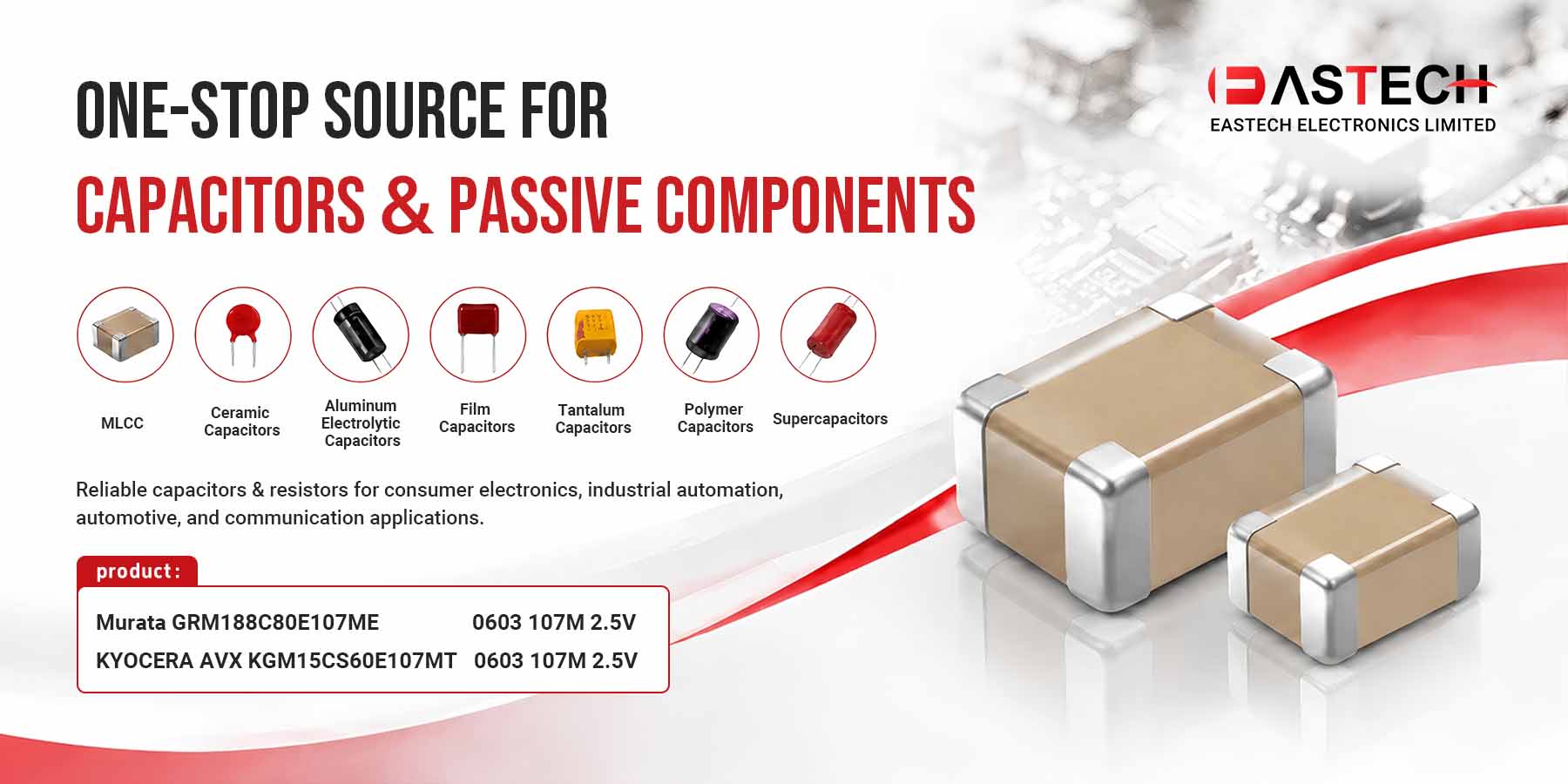
One-Stop Source for Capacitors & Passive Components - Eastech provides a comprehensive selection of high-quality capacitor solutions for diverse electronic applications, including MLCC (Multilayer Ceramic Capacitors), Ceramic Capacitors, Aluminum Electrolytic Capacitors, Film Capacitors, Tantalum Capacitors, Polymer Capacitors, and Supercapacitors. With access to leading capacitor manufacturers and a wide range of specifications, we help customers source reliable passive components for consumer electronics, automotive systems, industrial equipment, power supplies, communication devices, and other advanced electronic applications.
Summary, ceramic capacitors are among the most commonly used passive components in modern electronic designs due to their compact size, stable performance, and excellent electrical characteristics. The applications of ceramic capacitors cover a wide range of fields, including power management, signal processing, automotive electronics, communication systems, and consumer devices. As electronic technologies continue to evolve toward higher performance and smaller form factors, ceramic capacitors will remain a key solution for achieving stable and efficient circuit system.
Related information
- 2026.09.20 What is Ceramic Packaging Chip?
- 2026.09.13 What is SMD Resistor?
- 2026.09.06 What is Bus Interface IC?
- 2026.08.30 How to Select Supercapacitor?