

Available 24/7 at
+86 13632816717

What is Inductor and Inductance?
Inductors are fundamental components in electronic circuits, playing an essential role in power conversion, filtering, and energy storage. By storing energy in a magnetic field and controlling current variations, inductors help maintain stable circuit operation and improve system efficiency. This article explains how inductors work, what inductance means, and what does an inductor do in different electronic applications.
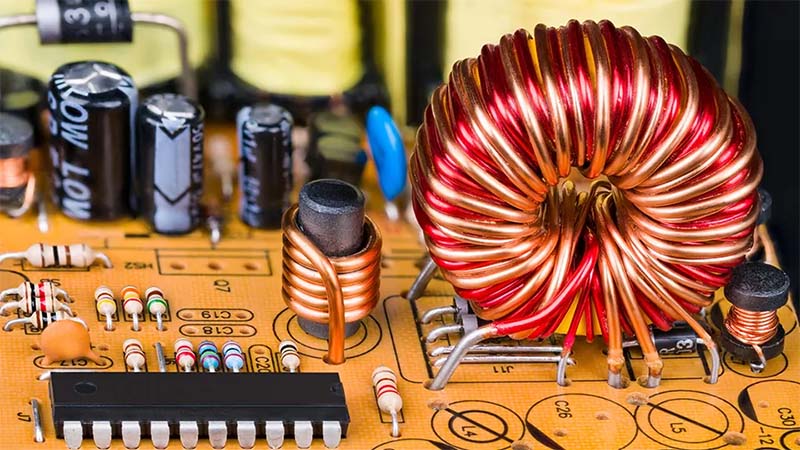
What is Inductor and Inductance?
An inductor is an electronic component typically made by winding a conductive wire into a coil. When current flows through the coil, it generates a magnetic field that stores energy and resists sudden changes in current. As one of the three fundamental passive components in electronic circuits (along with resistors and capacitors), inductors play an important role in various applications.
Inductors are widely used in power management circuits to store and regulate energy, in filtering circuits to reduce electrical noise and electromagnetic interference (EMI), and in RF and signal processing circuits to achieve resonance, frequency selection, and impedance matching.
What is Inductance?
Inductance is a physical parameter that describes the ability of a conductor or coil to oppose changes in current and store energy in the form of a magnetic field.
It is usually represented by the letter L.
The unit of inductance is:
Henry (H)
Common smaller units include:
mH (millihenry) = 10⁻³ H
μH (microhenry) = 10⁻⁶ H
nH (nanohenry) = 10⁻⁹ H
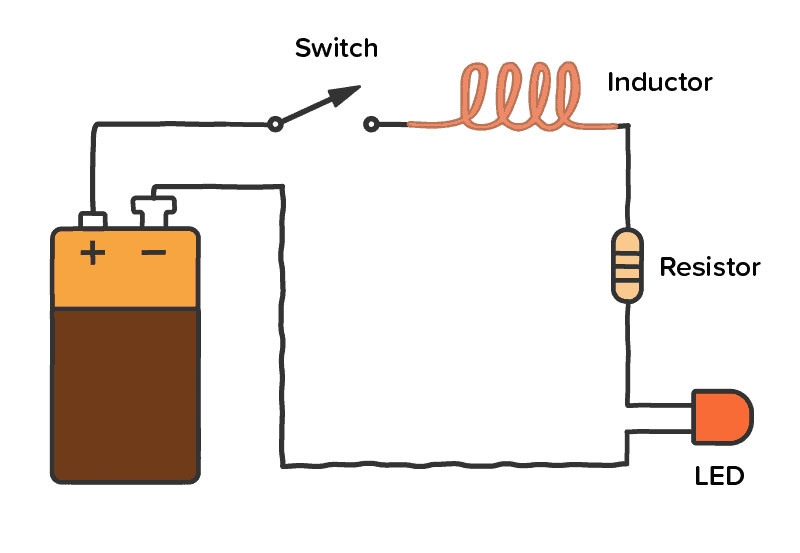
How Inductance Works?
- When current flows through a coil, it generates a magnetic field. Any change in current will alter this magnetic field.
- In accordance with Faraday's law of electromagnetic induction, the varying magnetic field induces a voltage within the coil. Per Lenz's law, this induced voltage always opposes changes in the current.
- Crucially, an inductor does not resist current itself - it resists the change of current.
If current rises rapidly: the inductor creates a reverse voltage to slow the increase.
If current falls rapidly: the inductor releases its stored energy to sustain the current.
Factors Affecting Inductance
The inductance value of a coil is influenced by its physical structure. Factors such as the number of turns, coil size, core material, and total coil length all affect the final inductance value.
- Number of coil turns: The more turns in the coil, the higher the inductance.
- Cross-sectional area of the coil: A larger cross-sectional area results in higher inductance.
- Coil length: With the same number of turns, a longer coil has lower inductance.
- Core material: Adding a ferrite core or iron core can significantly increase inductance.
- Magnetic permeability (μ): A higher permeability material produces greater inductance.
What Does an Inductor Do?
Stores Energy:
Temporarily stores energy in a magnetic field and releases it when needed.
Regulates Current:
Helps smooth current changes and stabilizes power flow in electronic circuits.
Filters Noise:
Reduces electrical noise and electromagnetic interference (EMI) in power and signal lines.
Supports Signal Processing:
Works in RF and resonant circuits for frequency selection, impedance matching, and signal shaping.
Improves Power Conversion:
Plays a key role in DC-DC converters, switching power supplies, and voltage regulators for efficient energy transfer.
Inductors are essential passive components that help manage energy, stabilize current, filter signals, and improve the performance and reliability of modern electronic circuits.
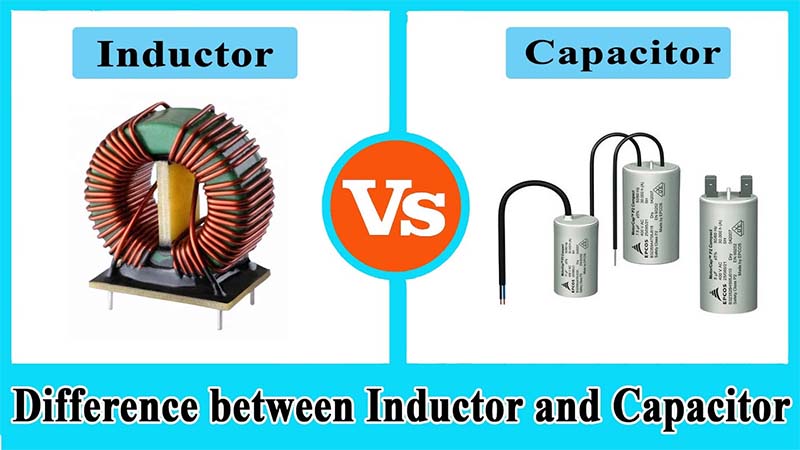
What Does an Inductor Do vs Capacitor?
Both inductors and capacitors are passive electronic components used to store energy in circuits, but they store energy in different ways and behave differently when dealing with DC (direct current) and AC (alternating current) signals.
Inductor
An inductor stores energy in the form of a magnetic field when current flows through its coil. Its main function is to oppose changes in current.
When current increases, the inductor generates a counter-electromotive force (back EMF) to resist the change.
When current decreases, the stored magnetic energy is released to maintain current flow.
Inductors allow DC current to pass after a short settling time but resist high-frequency AC signals.
Capacitor
A capacitor stores energy in the form of an electric field between two conductive plates. Its main function is to oppose changes in voltage.
When voltage is applied, the capacitor charges and stores electrical energy.
When voltage drops, the capacitor releases stored energy to maintain voltage stability.
Capacitors block DC current after charging but allow AC signals to pass.
|
Feature |
Inductor |
Capacitor |
|
Main function |
Stores energy and resists changes in current |
Stores energy and resists changes in voltage |
|
Energy storage method |
Magnetic field |
Electric field |
|
Basic structure |
Coil of wire |
Two conductive plates separated by dielectric material |
|
DC behavior |
Passes DC after steady state |
Blocks DC after fully charged |
|
AC behavior |
Blocks high-frequency AC |
Passes high-frequency AC |
|
Low-frequency signals |
Allows low-frequency signals |
Blocks low-frequency signals |
|
High-frequency signals |
Resists high-frequency signals |
Allows high-frequency signals |
|
Current response |
Current cannot change instantly |
Voltage cannot change instantly |
|
Common materials |
Copper wire coil, ferrite core |
Metal plates, ceramic, electrolytic materials |
|
Typical applications |
Filters, chokes, transformers, converters |
Filtering, bypassing, coupling, timing circuits |
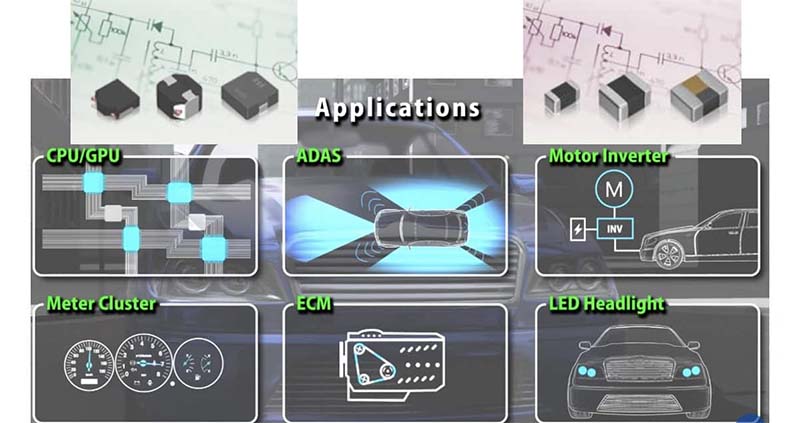
Applications of Inductors in Electronic Systems
Inductors use their ability to store magnetic energy, resist sudden current changes, and block high-frequency signals to perform key functions in power management, filtering, communication, and energy conversion systems.
1. Power Conversion and Voltage Regulation
Inductors are widely used in DC-DC converters to store and release energy for voltage conversion. In devices such as smartphones, laptops, servers, GPUs, and electric vehicles, inductors help convert input voltage into a stable output voltage through circuits like Buck and Boost converters, improving power efficiency and stability.
2. Power Filtering and Noise Reduction
Inductors are commonly used in power filtering circuits to reduce current fluctuations and high-frequency noise. Together with capacitors, they form LC filters that smooth power output and provide stable power for sensitive components such as CPUs, FPGAs, and communication devices.
3. RF and Wireless Communication
In RF systems such as smartphones, WiFi devices, Bluetooth modules, and 5G equipment, inductors are used for impedance matching, frequency tuning, and signal filtering. Combined with capacitors, inductors help optimize signal transmission and improve communication performance.
4. EMI Suppression
Inductors, especially common mode chokes, are used to reduce electromagnetic interference (EMI) in electronic systems. They are commonly found in USB, HDMI, Ethernet interfaces, and power input circuits, helping block unwanted noise while allowing normal signals to pass.
5. Motors and Electromagnetic Devices
Inductors are essential components in motors, transformers, and relays. Motor windings act as inductors to generate magnetic fields and convert electrical energy into mechanical energy, while transformers and relays use electromagnetic induction for voltage conversion and switching control.
6. LED Driver Systems
In LED driver circuits, inductors regulate current by storing and releasing energy, ensuring stable LED operation and improving efficiency. They are widely used in automotive lighting, display back-lights, and smart lighting systems.
7. Automotive Electronics and EV Systems
Inductors play an important role in automotive electronics, including battery management systems (BMS), onboard chargers, motor controllers, and power modules. They help manage current flow, stabilize power delivery, and improve system reliability in electric and intelligent vehicles.
Frequently Asked Questions About Inductors
1. Where are inductors commonly used?
Inductors are widely used in DC-DC converters, power supplies, RF communication circuits, EMI filters, LED drivers, automotive electronics, and industrial control systems.
2. Why are inductors used in power supplies?
Inductors help store and release energy during voltage conversion, allowing DC-DC converters to efficiently step voltage up or down while maintaining a stable power output.
3. Do inductors allow DC current to pass?
Yes. After reaching a steady state, an ideal inductor allows DC current to pass with very low resistance. However, it opposes rapid changes in current and blocks high-frequency AC signals.
4. Why are inductors used with capacitors?
Inductors and capacitors are often combined to create LC filters. The inductor reduces current noise, while the capacitor smooths voltage fluctuations, providing cleaner and more stable power.
5. What are the main types of inductors?
Common types of inductors include power inductors, RF inductors, common mode chokes, coupled inductors, and air-core or ferrite-core inductors.
6. How does an inductor reduce electromagnetic interference (EMI)?
An inductor blocks high-frequency noise currents while allowing normal signals or power currents to pass. Common mode chokes are widely used in electronic devices to reduce electromagnetic interference.
7. What factors should be considered when selecting an inductor?
Key factors include inductance value, rated current, DC resistance (DCR), operating frequency, saturation current, size, and application requirements. Choosing the right inductor ensures efficiency and prevents overheating or performance issues.
How to Choose an Inductor?
Choosing the right inductor depends on the circuit application and electrical requirements. The key factors to consider include inductance value, rated current, saturation current, DC resistance (DCR), operating frequency, and size.
First, select the appropriate inductance value (µH or mH) based on the circuit design, as it determines the energy storage capability and filtering performance. For power applications such as DC-DC converters, the inductor should have a suitable rated current and saturation current to handle the expected load without overheating or losing performance.
The DC resistance (DCR) of the inductor is also important because lower resistance reduces power loss and improves efficiency. For high-frequency applications, such as RF circuits and EMI filters, choose an inductor with suitable frequency characteristics and low signal loss.
Finally, consider the physical size, operating temperature, and reliability requirements of the system.
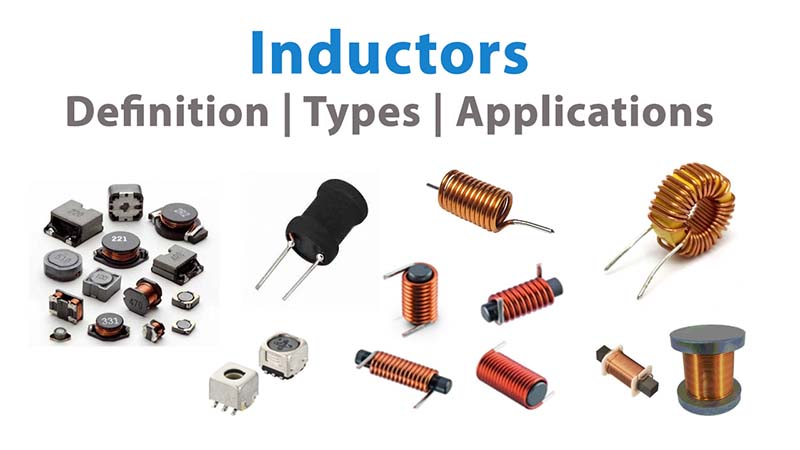
Inductors | Electronics Distributor
At Eastech, we support customers in sourcing inductors and other semiconductor components for various electronic applications by providing component matching, alternative solutions, and supply chain assistance. Whether for power management modules, communication equipment, automotive electronics, or industrial systems, we help engineers and purchasing teams find suitable components that meet both technical requirements and project needs.
In summary, selecting the right component requires a clear understanding of circuit requirements, including frequency, power handling, size limitations, and design goals. When comparing different passive components, knowing what does an inductor do vs capacitor helps engineers make better choices based on their unique electrical characteristics and application needs. These two components are often used in combination in modern electronic products to achieve optimal performance.
Related information
- 2026.09.20 What is Ceramic Packaging Chip?
- 2026.09.13 What is SMD Resistor?
- 2026.09.06 What is Bus Interface IC?
- 2026.08.30 How to Select Supercapacitor?