

Available 24/7 at
+86 13632816717

What are Programmable Logic Controllers?
Programmable Logic Controllers (PLCs) are essential components in modern industrial automation, helping manufacturers control machines, monitor processes, and improve production efficiency. This post introduces what are PLCs used for in industry helps explain their important role in manufacturing, especially in electronics production, PCB assembly, semiconductor equipment, and automated testing systems.
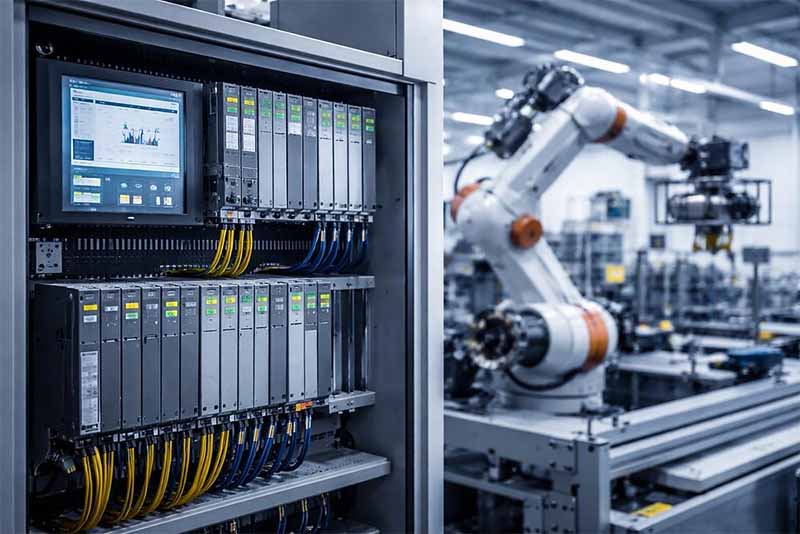
What Are Programmable Logic Controllers?
Programmable Logic Controllers (PLCs) are specialized industrial computers designed to automate and control machines, production lines, and industrial processes. They receive signals from sensors, process the data according to a programmed logic, and send commands to control devices such as motors, valves, robots, and actuators.
Features
Industrial-hardened hardware
Built to withstand harsh factory environments: wide temperature range, vibration, dust, humidity and electrical interference. Ordinary computers cannot operate reliably under these conditions.
Custom programmable control logic
Engineers write control programs to define equipment behaviour. Logic can be modified without rewiring hardware. Common programming standards include IEC 61131-3, supporting ladder diagram (LD), function block diagram (FBD), structured text (ST), instruction list.
Digital input/output (I/O) system
Input modules collect signals from sensors, switches, proximity detectors.
Output modules send commands to actuators: motors, valves, contactors, ligh
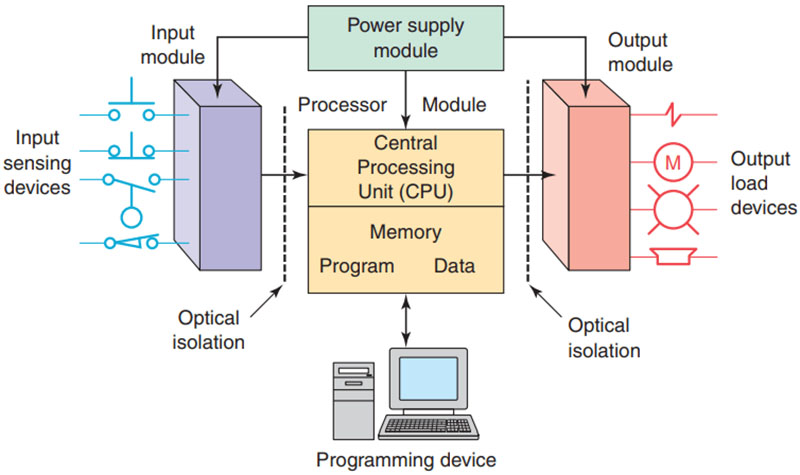
Main Components of a programmable logic controller
A PLC system consists of multiple coordinated hardware modules to complete signal collection, logic computation and field equipment control.
1. CPU (Central Processing Unit)
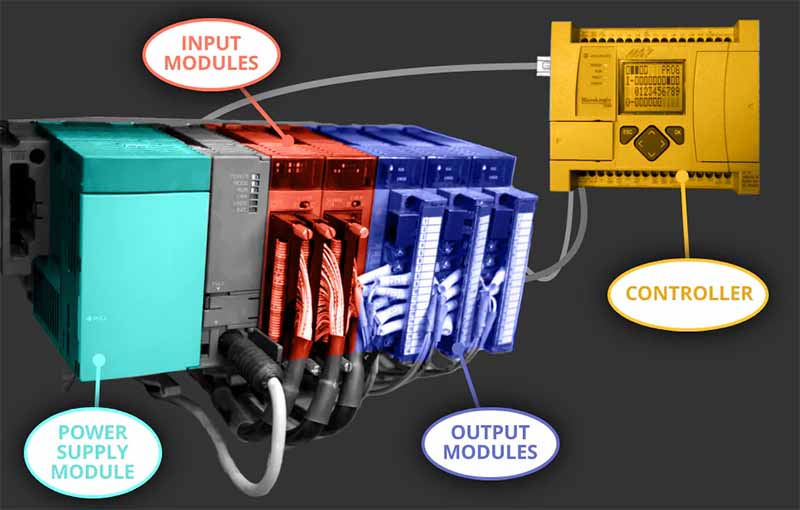
The core processor that executes the control program, processes input data, calculates logic and sends output instructions. It also handles communication and fault detection.
2. Memory Unit
System memory: Stores PLC operating firmware, non-modifiable by users.
User memory: Holds downloaded control programs, setpoints and data registers.
3. Input/Output (I/O) Modules
Interface between the PLC and field devices.
Input modules: Receive signals from sensors, pushbuttons and switches.
Output modules: Drive actuators such as motors, solenoid valves and indicators.
I/O can be digital (on/off) or analogue (continuous voltage/current signals).
4. Power Supply Module
Converts industrial AC or DC mains power into stable low-voltage DC power to feed the CPU and all internal modules.
5. Communication Interfaces
Ports for connecting HMIs, other PLCs, industrial robots, computers and sensors. Common protocols: Modbus, Profinet, Ethernet/IP.
6. Programming Port
Used to connect a laptop or programming software for uploading, downloading and debugging control logic.
7. Rack / Chassis (Backplane)
The hardware frame with an internal bus. CPU, power supply and I/O modules plug into the rack for data exchange.
8. Optional Accessories
- Expansion I/O modules for extra signal points
- HMI (Human-Machine Interface): Separate touchscreen for operators to monitor and adjust equipment
- Special function modules: high-speed counters, motion control, analogue processing modules
How Does a PLC Work?
A Programmable Logic Controller (PLC) operates by collecting input signals, processing data through its internal electronic circuits, and sending control commands to connected devices. At the core of every PLC is a combination of semiconductor components and integrated circuits (ICs) that enable fast processing, reliable communication, and precise control.
Input signal processing: The PLC receives signals from sensors, switches, and industrial devices through input modules. These modules rely on components such as analog-to-digital converters (ADCs), signal conditioning ICs, and isolation components to convert real-world signals into digital data that the PLC can process.
Data processing and control logic: The PLC's CPU module uses a microcontroller (MCU), microprocessor (MPU), memory chips, and power management ICs (PMICs) to execute programmed instructions and make real-time control decisions.
Output signal control: After processing the input data, the PLC sends commands to external equipment such as motors, valves, and actuators. Output circuits typically use driver ICs, interface chips, and power semiconductor devices to safely control high-voltage or high-current industrial loads.
Communication and system integration: Modern PLCs require high-speed communication with industrial networks and other automation equipment.
Continuous operation: A PLC continuously repeats the cycle of reading inputs, executing programs, and updating outputs. The performance and stability of its internal ICs, processors, memory devices, and electronic components directly affect the efficiency and reliability of industrial automation systems.
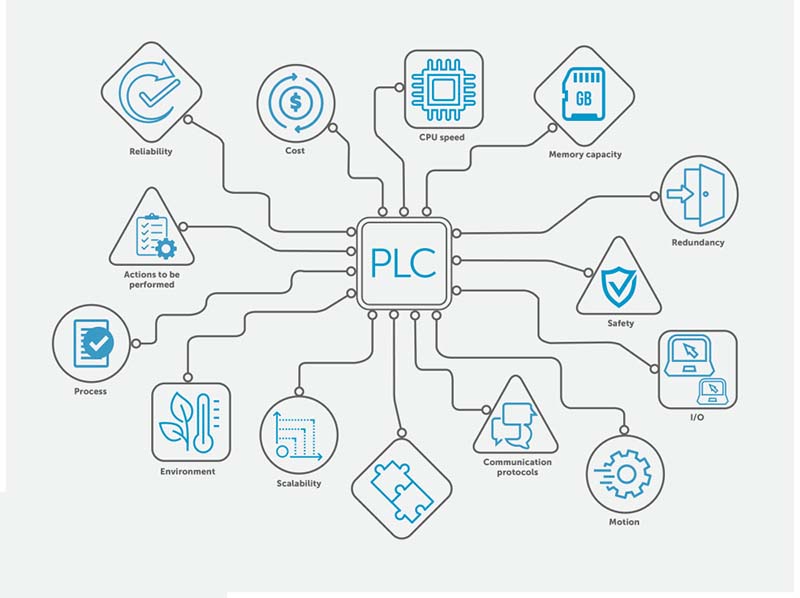
What Are PLCs Used for in Industry?
What does a programmable logic controller do in industrial system? PLCs carry out diverse automation tasks to run manufacturing equipment reliably.
Signal Processing
PLCs receive digital and analogue signals from field sensors. They filter noise signals, convert data, count pulses and process sensor feedback to judge equipment status and trigger corresponding control actions.
Sequence & Logic Control
This is the most fundamental application of PLCs. PLCs execute predefined logic rules to manage the sequential operation of machines. They handle interlocks, start-stop logic and conditional triggering for conveyors, assembly stations and packaging equipment, replacing traditional relay control circuits.
Timing Control
PLCs provide flexible software timers to manage delayed actions, dwell times and cyclic operations. Timing functions control processes such as delayed valve switching, temporary machine pause and timed material feeding without separate timing relays.
Process Control
PLCs continuously track and adjust real-time physical production conditions such as temperature, pressure, flow rate and liquid level. Equipped with analogue modules, they automatically adjust pumps, heaters and valves to keep production parameters stable.
Motion Control
PLCs coordinate servo motors and stepper motors to deliver precise movement. Functions include positioning, speed regulation, linear and rotary motion. It is widely used in CNC machines, cutting equipment, robotic handling and automated assembly.
Communication Integration
PLCs connect with HMIs, other controllers, sensors and upper-level industrial computers via industrial communication protocols. Data exchange enables system monitoring, remote parameter adjustment and the construction of interconnected factory automation networks.
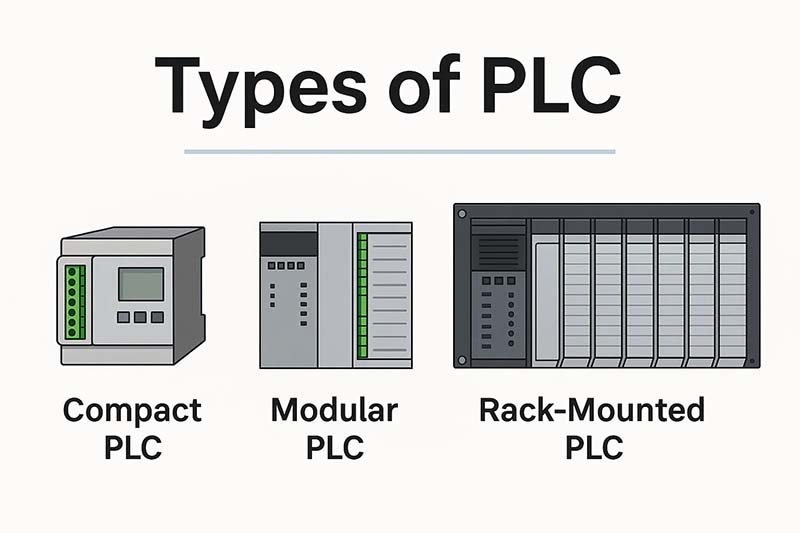
What are the Different Types of PLC in Manufacturing Industry
Programmable Logic Controllers (PLCs) are available in different types to meet the control requirements of various manufacturing applications. In electronics manufacturing and industrial automation, PLC selection usually depends on such as the input/output points, processing speed, communication requirements, and system complexity.
1. Micro PLC
Micro PLCs are the smallest programmable controllers, equipped with 15 to 128 I/O points. It features tiny size, low power consumption and low cost. It has almost no expansion function and only supports extremely simple logic control. It is mainly used for small single machines and simple auxiliary automation equipment in manufacturing.
2. Mini PLC
An upgraded version of micro PLCs, Mini PLCs provide 128 to 512 I/O points alongside basic expansion options. It can handle relatively complex sequential control tasks compared with micro PLCs. It is widely applied in small packaging machines, simple conveyor systems and small processing equipment.
3. Fixed PLC
Also known as integrated PLC, Fixed PLC integrates CPU, power supply and fixed I/O points into one integral unit. Its I/O quantity is fixed and cannot be expanded freely. It has stable performance and simple installation. It is suitable for standardized small and medium-sized automation equipment with fixed control demands in factories.
4. Modular PLC
Modular PLC adopts a split rack-mounted. CPU, power supply, I/O modules and communication modules are independent and can be freely combined and expanded according to production needs. It supports a large number of I/O points and complex control logic. It is applied to medium and large production lines, multi-station automation systems and complex mechanical processing equipment.
5. Safety PLC
Safety PLC is a special industrial controller that meets international industrial safety standards. It is designed for safety-related control rather than ordinary production control. It realizes functions such as emergency stop protection, safety door monitoring and equipment fault safety protection. It is commonly used in high-risk manufacturing scenarios such as robotic production lines, laser equipment and automated welding workshops.
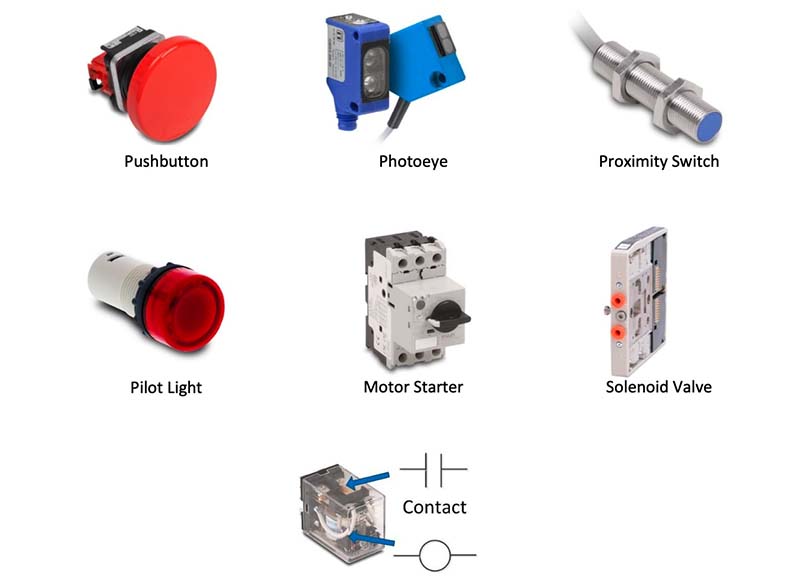
Different Types of PLC Input
Digital Inputs
Receive discrete ON/OFF signals from field devices.
Sink Input (NPN): Load current flows into the PLC terminal, common in Asian equipment.
Source Input (PNP): Load current flows out of the PLC terminal, widely used in European systems.
Typical devices: pushbuttons, limit switches, proximity sensors, photoelectric sensors.
Analogue Inputs
Receive continuous variable signals to measure physical values.
Typical devices: temperature transmitters, pressure sensors, flow sensors.
Different Types of PLC Output
Analogue Output
Output continuous voltage or current signals (4–20mA, 0–10V). Used to adjust variable-frequency drives, proportional valves and regulators.
Relay Output
Electromechanical contact switch. Supports AC/DC loads, wide voltage range. Slow switching speed, limited service life, suitable for low-frequency on/off loads.
Triac Output (Bidirectional Thyristor)
Solid-state AC-only switch. Fast switching, long lifespan, no contact spark. Only works for alternating current loads.
Transistor Output
Solid-state DC-only switch. High-speed switching, ideal for pulse signals, servo/stepper control. Supports high-frequency operation, only compatible with DC loads.
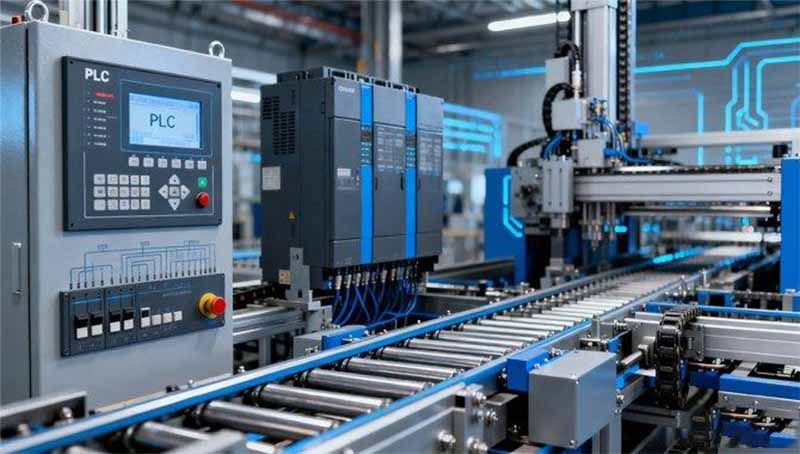
What are the Applications of Programmable Logic Controllers?
Programmable Logic Controllers (PLCs) are widely used in industrial automation to control machines, manage production processes, and improve manufacturing efficiency.
Electronics Manufacturing
They are commonly used in PCB assembly lines, SMT machines, semiconductor equipment, component testing systems, and automated inspection equipment. PLCs help control machine movements, production sequences, and communication between different devices to ensure stable and efficient manufacturing.
Packaging and Assembly Lines
Many factories use PLCs to control automated packaging and assembly equipment. For example, PLCs can manage conveyor belts, product positioning, labeling machines, filling machines, and sorting systems.
Industrial Machinery
PLCs are widely integrated into equipment such as CNC machines, laser cutting machines, laser welding machines, and other manufacturing systems. They control machine operation, motor movement, safety functions, and production cycles, allowing operators to achieve accurate and repeatable processing.
Automotive Manufacturing
In automobile factories, PLCs control production equipment such as robotic welding machines, assembly lines, and inspection systems. They coordinate different machines to ensure vehicles are manufactured accurately and efficiently.
Material Handling Systems
PLCs are commonly used in systems that move products or materials inside factories and warehouses. They control conveyor systems, elevators, automatic storage equipment, and sorting machines to improve transportation efficiency and reduce manual work.
PLCs provide reliable, real-time control for modern automated systems. Their flexibility, durability, and easy programming make them essential components in factories ranging from electronics manufacturing and machinery production to packaging and logistics.
Programmable Logic Controller Component Supplier
EASTECH offers a comprehensive range of programmable control components, including PLC controllers, PAC systems, I/O modules, and automation control solutions from leading manufacturers. These products are widely used in automated manufacturing equipment, electronics production lines, and industrial control systems. With expertise in electronic component sourcing, EASTECH helps customers find reliable automation components for various industrial applications.
The Bottom Line
Programmable Logic Controllers (PLCs) have become an essential part of modern industrial automation, enabling manufacturers to achieve precise control, higher efficiency, and more reliable production. From PCB assembly and electronic component manufacturing to automated testing and smart factory systems, the applications of programmable logic controllers continue to expand across various industries. By sourcing reliable PLC components, manufacturers can achieve more stable equipment performance, improve production efficiency, and optimize automation processes with greater flexibility and accuracy.
Related information
- 2026.09.20 What is Ceramic Packaging Chip?
- 2026.09.13 What is SMD Resistor?
- 2026.09.06 What is Bus Interface IC?
- 2026.08.30 How to Select Supercapacitor?