

Available 24/7 at
+86 13632816717

Digital vs Analog Integrated Circuit - What is the Difference?
In modern electronics, there are different types of integrated circuits, such as digital and analog integrated circuits. What is a digital integrated circuit, and how does it differ from analog solutions used in real applications? This article explores the concept of digital vs analog integrated circuits, explains their functions, and highlights the difference between analog IC and digital IC in practical use cases. We will also introduce ADC and DAC, and show how electronics with digital and analog integrated circuits work together in modern systems.
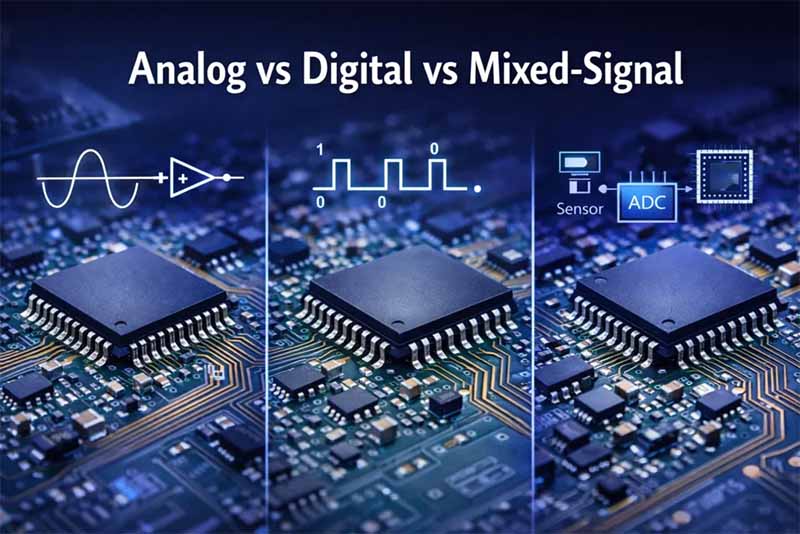
Digital vs Analog Integrated Circuit
Digital signal integrated circuits and analog signal integrated circuits are two core categories of semiconductor chips, differentiated fundamentally by their signal processing mechanisms and practical functional orientations.
What is a Digital Integrated Circuit?
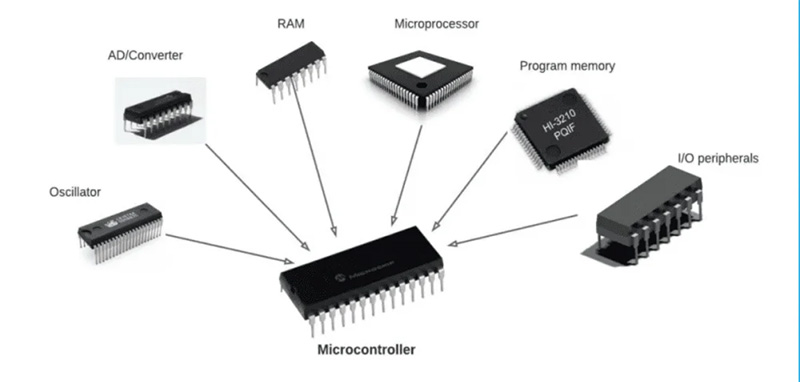
A digital integrated circuit (digital IC) is a semiconductor chip that integrates a large number of transistors and logic components on a single substrate to process binary digital signals (0 and 1). It operates by using high and low voltage levels to perform logic operations, data processing, and control functions, forming the core of modern digital electronic systems.
Applications include computers, smartphones, communication equipment, automotive electronics, industrial control systems, and various smart devices such as CPUs, memory chips, microcontrollers, and digital control circuits.
Microprocessor (CPU IC): Serves as the central processing unit of a computer or embedded system, responsible for executing instructions, performing arithmetic and logic operations, and controlling the overall operation of the system.
Microcontroller (MCU IC): An integrated chip that combines a CPU, memory, and peripheral interfaces on a single chip. It is designed for embedded control applications such as household appliances, automotive electronics, and industrial automation systems.
Random Access Memory (RAM IC): A high-speed volatile memory chip used to temporarily store data and program instructions during operation.
Read-Only Memory / Flash Memory (ROM / Flash IC): A non-volatile memory chip used to permanently store firmware, boot programs, or system data.
Logic Gate IC (e.g., 74-series ICs): Contains basic digital logic functions such as AND, OR, NOT, NAND, and NOR gates. These chips are used as fundamental building blocks for constructing more complex digital systems.
Field-Programmable Gate Array (FPGA IC): A highly flexible digital chip that can be programmed after manufacturing to implement custom hardware logic. It is widely used in high-speed parallel processing, prototyping, and specialized computing tasks.
Application-Specific Integrated Circuit (ASIC): A custom-designed chip optimized for a specific application, offering very high performance and energy efficiency. It is commonly used in telecommunications, cryptocurrency mining, and AI acceleration.
Digital Signal Processor (DSP IC): A specialized processor designed for real-time processing of digital signals such as audio, image, and communication data, enabling fast mathematical operations like filtering, compression, and transformation.
Interface IC (e.g., USB, Ethernet Controller IC): Used to manage data communication between digital systems by implementing standard protocols, enabling reliable and efficient data transfer between devices and networks.
What is a Analog Integrated Circuit?
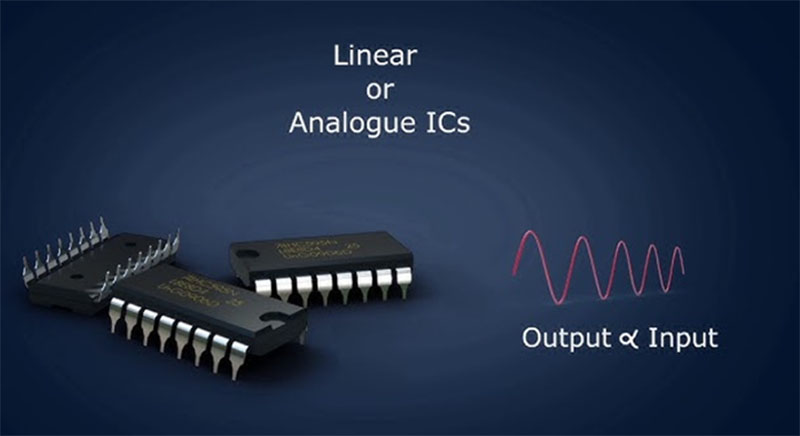
An analog integrated circuit (analog IC) is a semiconductor chip that integrates electronic components to process continuous (non-binary) signals, such as voltage or current that vary smoothly over time. It is used to amplify, filter, regulate, or convert analog signals while preserving their waveform characteristics.
Applications include audio amplifiers, power management circuits, sensor signal conditioning, radio frequency (RF) systems, and communication devices.
Operational Amplifier (Op-Amp IC): Used to amplify weak analog signals with very high gain, it is a core component in analog signal processing. By adding external resistors and capacitors, it can also perform filtering, integration, differentiation, addition/subtraction, and signal comparison, making it widely used in sensor interfaces and audio processing circuits.
Power Management IC (PMIC): Used to manage power distribution and conversion in electronic systems. It typically integrates multiple regulated outputs, voltage regulation, charging control, and power efficiency management functions, providing stable and efficient power supply for CPUs, memory, and peripheral devices.
Low Dropout Regulator (LDO Regulator IC): Converts a higher input voltage into a stable lower output voltage. It is characterized by simple structure, low noise, and fast transient response, and is commonly used to power noise-sensitive analog circuits and RF modules.
Switch-Mode Power Supply Controller (SMPS Controller IC): Controls power switching devices to operate at high frequency, enabling highly efficient voltage conversion such as step-down, step-up, or inversion. It is widely used in power systems requiring high efficiency and high power handling capability.
Audio Power Amplifier IC: Amplifies low-level audio signals to a level sufficient to drive speakers. It typically features low distortion, high fidelity, and good noise immunity, and is widely used in audio systems, mobile phones, and multimedia devices.
Instrumentation Amplifier IC: Designed for weak differential signal amplification, it offers very high input impedance and excellent common-mode rejection ratio (CMRR), allowing accurate signal acquisition in noisy environments. It is commonly used in medical instruments and industrial measurement systems.
Analog Multiplier IC: Performs multiplication of two analog input signals, producing an output proportional to their product. It is commonly used in modulation/demodulation, signal processing, and automatic gain control circuits.
Comparator IC: Compares two analog input voltages and outputs a corresponding high or low digital signal. It is widely used in threshold detection, overvoltage protection, and waveform shaping applications.
What Are Difference Between Analog IC and Digital IC?
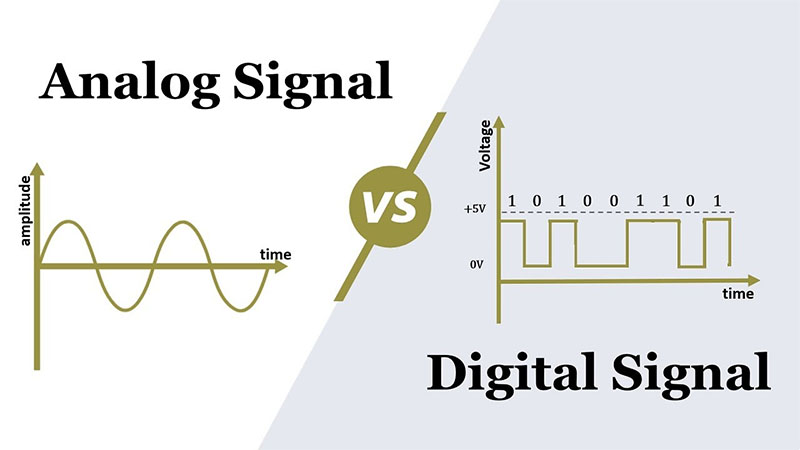
Analog integrated circuits are designed to process continuous electrical signals that mirror real-world physical phenomena. Natural signals such as sound, light, temperature, pressure, and voltage vary smoothly and continuously without abrupt breaks. Analog ICs can capture, amplify, filter, convert and stabilize these uninterrupted analog signals with high precision. Function of analog integrated circuits is to perceive, adjust and transmit real-time physical signal data, adapting to the gradual changes of natural signals. Common applications include audio amplifiers, sensor signal processors, power management chips, and radio frequency (RF) circuits in communication devices.
In contrast, digital integrated circuits exclusively handle discrete binary signals, which only consist of two fixed states: 0 (low voltage/off) and 1 (high voltage/on). Unlike analog signals with infinite variable values, digital signals are segmented and standardized, eliminating ambiguous intermediate states. The core role of digital ICs is to perform logical judgment, arithmetic computation, data storage, and signal coding/decoding based on binary rules. They excel at processing, analyzing and transmitting digital data with ultra-high stability and anti-interference capability. Typical applications cover microprocessors, memory chips, logic control units, and digital signal processors used in computers, smartphones, and digital control systems.
What is ADC and DAC?
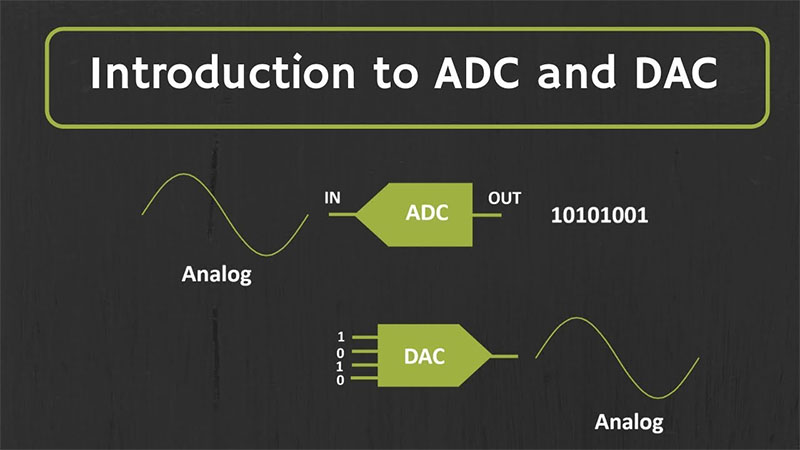
ADC (Analog-to-Digital Converter) is an electronic circuit or integrated chip that converts a continuous analog signal (such as voltage, sound, or temperature) into a digital signal (binary data: 0s and 1s) so it can be processed by digital systems like microcontrollers or processors.
DAC (Digital-to-Analog Converter) is the opposite: it converts digital data (binary signals) back into a continuous analog signal, such as voltage or current, so it can drive real-world outputs like speakers, motors, or display systems.
ADC (Analog-to-Digital Converter) and DAC (Digital-to-Analog Converter) are essential because real-world physical signals such as sound, temperature, and light are continuous analog signals, while modern electronic systems are mainly based on digital circuits for processing. The ADC converts these analog signals into digital data so that chips can perform computation, storage, and logic operations. The DAC, on the other hand, converts processed digital data back into analog signals, enabling devices to drive speakers, motors, or other physical actuators. Together, they form a critical bridge between the analog physical world and digital electronic systems, making it possible for modern electronics to sense, process, and control real-world environments.
How Does it Work? - Electronics with Digital and Analog Integrated Circuits
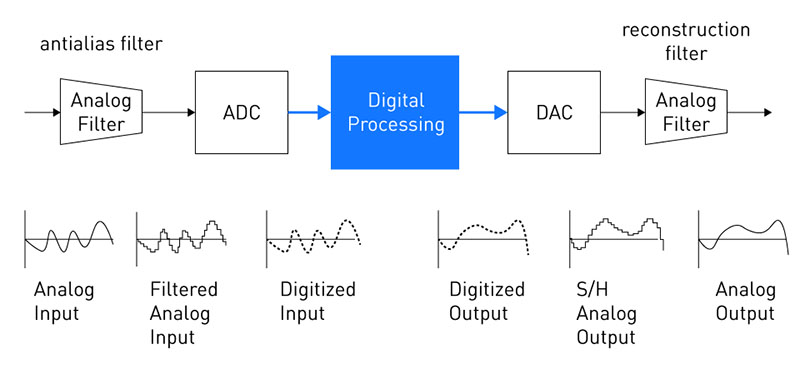
In modern electronic systems, analog ICs and digital ICs work together to bridge the real world and digital processing.
Most physical signals in the real world-such as sound, temperature, light, or pressure-are analog signals. An analog integrated circuit first handles these signals by amplifying, filtering, or conditioning them to make them usable and accurate. It may also convert them into digital form using an ADC (Analog-to-Digital Converter).
Once converted, the digital integrated circuit takes over. It processes the data using binary logic for tasks like computation, control, storage, or communication.
After processing, if the output needs to interact with the physical world (for example, sound from a speaker or motor control), a DAC (Digital-to-Analog Converter) and analog ICs convert the digital signals back into continuous analog form.
In short, analog ICs interface with the real world, while digital ICs perform computation and decision-making, and they continuously cooperate through signal conversion in electronic systems.
The Best Analog to Digital Converter IC Recommendation
1. Texas Instruments – ADS1256
The ADS1256 is a 24-bit delta-sigma ADC designed for ultra-high precision low-frequency signal acquisition. It delivers extremely low noise and high resolution, making it ideal for precision measurement systems. Typical applications include industrial weighing systems, medical instrumentation, and high-accuracy sensor interfaces.
2. Analog Devices – AD7606
The AD7606 is a 16-bit, 8-channel simultaneous sampling ADC that can capture multiple analog inputs at the same time. It is designed for robust industrial environments with strong noise immunity and stable performance. It is widely used in power monitoring, motor control, and multi-channel data acquisition systems.
3. Texas Instruments – ADS1115
The ADS1115 is a widely used 16-bit I²C ADC with an integrated programmable gain amplifier, offering simple integration and flexible signal conditioning. It is popular in embedded systems due to its ease of use and low power consumption. Common applications include IoT devices, Arduino-based projects, and sensor data acquisition.
4. Microchip – MCP3208
The MCP3208 is an 12-bit, 8-channel SAR ADC with SPI interface, offering a cost-effective solution for multi-channel data acquisition. It provides good performance for general-purpose embedded applications. It is commonly used in microcontroller systems, industrial monitoring, and hobby electronics projects.
5. STMicroelectronics – STM32 Internal ADC (e.g., STM32F4 series)
Many STM32 microcontrollers integrate a built-in 12-bit ADC with multiple channels, enabling direct analog signal acquisition without external chips. It supports moderate-speed sampling and is tightly integrated with MCU peripherals. It is widely used in embedded control systems, IoT devices, and smart sensors.
6. Maxim Integrated (ADI) – MAX11613
The MAX11613 is a 12-bit multi-channel SAR ADC designed for low-power portable and battery-operated systems. It features an I²C interface and simple integration with microcontrollers. It is commonly used in portable medical devices, handheld instruments, and industrial monitoring equipment.
7. NXP Semiconductors – PCF8591
The PCF8591 is an 8-bit ADC/DAC combo chip with I²C interface, offering basic analog signal conversion in low-cost systems. Although resolution is limited, it is widely used in simple embedded applications. Typical uses include educational kits, simple sensor reading, and low-cost control systems.
8. Renesas Electronics – ISL267450
The ISL267450 is a 16-bit SAR ADC designed for industrial and precision measurement applications. It offers good accuracy, low noise, and stable performance under harsh conditions. It is commonly used in factory automation, instrumentation, and industrial control systems.
The Best DAC Integrated Circuit Guide
1. Texas Instruments – DAC8562
The DAC8562 is a 16-bit dual-channel precision DAC designed for high-accuracy analog output generation. It provides excellent linearity and low noise performance, making it suitable for industrial control and instrumentation systems. It is widely used in programmable voltage sources, calibration equipment, and sensor excitation circuits.
2. Analog Devices – AD5686
The AD5686 is a 16-bit quad-channel nanoDAC+ device offering high precision and low drift performance. It supports multiple output channels in a compact solution, ideal for systems requiring simultaneous analog control. Typical applications include automated test equipment, process control, and multi-channel industrial systems.
3. Microchip – MCP4728
The MCP4728 is a low-power 12-bit quad-channel DAC with I²C interface and built-in EEPROM for storing output values. It is easy to integrate into embedded systems and provides flexible analog voltage output control. It is commonly used in portable devices, sensor calibration, and microcontroller-based control systems.
4. Maxim Integrated (ADI) – MAX5216
The MAX5216 is a 16-bit single-channel DAC designed for high-precision voltage output with ultra-low noise. It offers excellent stability and accuracy, making it suitable for industrial and medical applications. It is widely used in programmable power supplies, calibration systems, and precision instrumentation.
5. STMicroelectronics – DAC80501
The DAC80501 is a 16-bit single-channel precision DAC with SPI interface and low power consumption. It delivers stable analog output with good linear performance, suitable for compact embedded systems. It is commonly used in industrial automation, control loops, and portable measurement devices.
6. NXP Semiconductors – PCF8591 (DAC function included)
The PCF8591 is an 8-bit ADC/DAC combo chip with I²C interface, providing basic analog output functionality along with input conversion. Although its resolution is limited, it is widely used in simple control systems and educational projects. Typical applications include basic signal generation and low-cost embedded control systems.
7. Analog Devices – AD5628
The AD5628 is a 12-bit octal-channel DAC offering multiple outputs in a single compact device. It provides good accuracy and low power consumption, suitable for multi-channel analog control systems. It is widely used in industrial automation, instrumentation, and multi-axis control systems.
8. Texas Instruments – DAC70501
The DAC70501 is a 14-bit precision DAC designed for low power and high accuracy analog output. It offers stable performance with minimal noise, making it suitable for portable and industrial applications. It is commonly used in sensor calibration, signal generation, and precision control systems.
Eastech provides a wide range of analog and digital integrated circuits covering mainstream applications, including ADCs, DACs, power management ICs, MCUs, as well as various interface and memory devices, meeting the needs of industrial control, communication equipment, and consumer electronics. Relying on a stable supply chain and multi-brand channel resources, we offer customers cost-effective one-stop electronic component solutions.
Summary, the digital and analog integrated circuits in electronics falls into three main segments. High-performance models target industrial and precision measurement, featuring low noise, high resolution and outstanding stability for instruments, power monitoring and precision sensors. General-purpose chips for embedded and consumer electronics prioritize low power, easy integration and cost efficiency, serving IoT hardware, portable devices and basic control systems. High-speed RF converters cater to communication and radio frequency systems with ultra-high sampling rates for wide band signal processing. The industry evolves toward balanced performance across precision, speed and power consumption, alongside multi-channel integration and system-level solution development.
Related information
- 2026.09.20 What is Ceramic Packaging Chip?
- 2026.09.13 What is SMD Resistor?
- 2026.09.06 What is Bus Interface IC?
- 2026.08.30 How to Select Supercapacitor?