

Available 24/7 at
+86 13632816717

How to Choose an Operational Amplifier 2026?
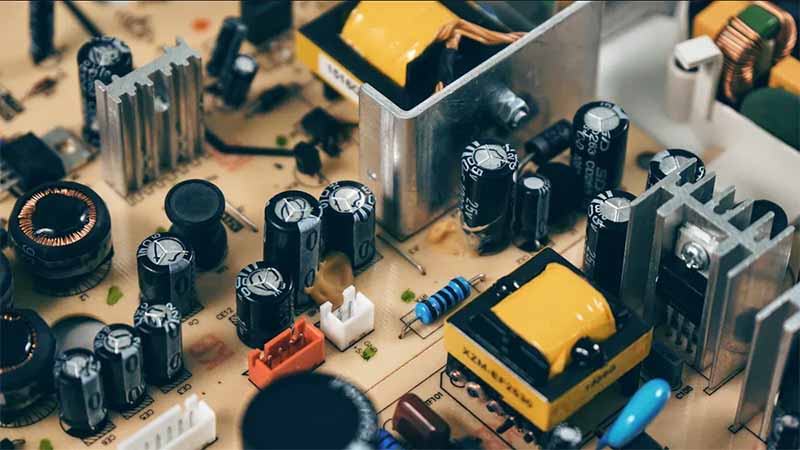
What is the operational amplifier? An operational amplifier (op-amp) is a high-gain voltage amplification device widely used in analog electronics. It can amplify weak electrical signals and perform essential mathematical operations such as addition, subtraction, and integration. From audio equipment to industrial and automotive electronics, operational amplifiers are one of the most fundamental components in modern electronic applications.
The most basic and core function of an op-amp is to amplify weak analog voltage signals. It is widely used for processing signals from sensors, audio devices, and other low-level sources.
2. Noise Reduction in Input Signals
Op-amp circuits can filter input signals to extract signals of desired frequencies, effectively reducing noise.
3. Mathematical Operations
By connecting external feedback components, op-amps can perform analog mathematical operations such as addition, subtraction, integration, and differentiation. This capability is the origin of the term "operational amplifier."
4. Signal Processing and Transformation
Op-amps can implement voltage following, impedance conversion, active filtering, and level shifting, enabling signal buffering, filtering, and adaptation.
5. Voltage Comparison and Signal Generation
When operating in open-loop mode, op-amps can act as voltage comparators to determine the relative magnitude of input voltages. With feedback circuits, they can also generate waveforms such as square waves and sawtooth waves.
How Does an op-amp Work?
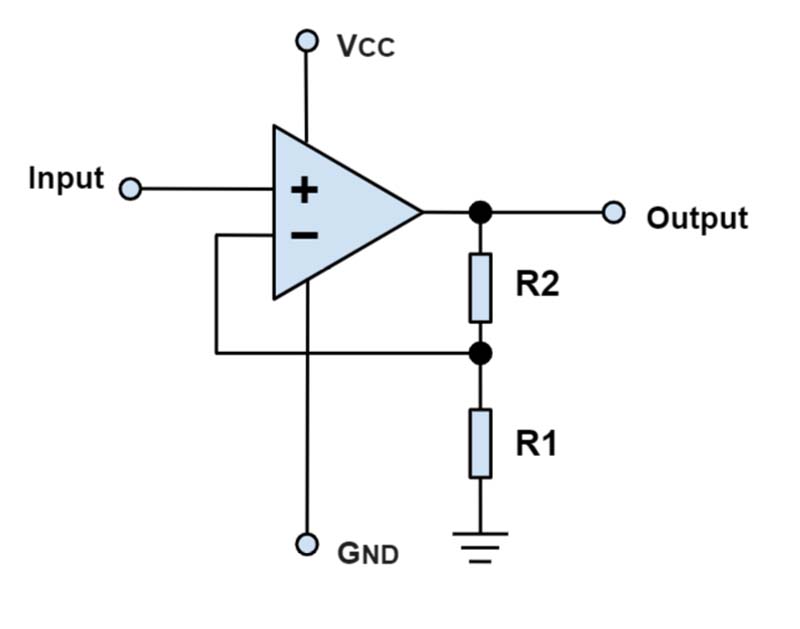
An operational amplifier (op-amp) is a high-gain direct-coupled differential amplifier with two input terminals: the non-inverting input (V+) and the inverting input (V−). Its output voltage is determined by the voltage difference between the two inputs, expressed as:
Vout=AOL(V+−V−)
where AOL is the very high open-loop voltage gain.
In the open-loop condition, the op-amp acts as a voltage comparator. Due to its extremely high gain, even a tiny input difference will drive the output into positive or negative saturation, making it switch between two fixed voltage levels.
In the closed-loop condition with negative feedback, a portion of the output signal is fed back to the inverting input. Negative feedback reduces the overall gain but greatly improves stability, linearity, bandwidth and input/output impedance characteristics. This allows the op-amp to perform precise functions such as signal amplification, mathematical operations (addition, subtraction, integration, differentiation), active filtering and impedance matching.
Furthermore, an ideal op-amp has infinite input impedance, zero output impedance, infinite open-loop gain and infinite bandwidth. These ideal characteristics form the basis for analyzing practical op-amp circuits.
What is Operational Amplifier in Electronics
An operational amplifier (op-amp) is a high-gain direct-coupled voltage amplifier with two input terminals and one output terminal. It can perform signal amplification, mathematical operations, signal processing, voltage comparison and waveform generation through external feedback circuits. It is one of the most important basic components in analog electronic circuits.
1. Signal Amplification
Op-amps are widely used to amplify weak analog signals from sensors, microphones, and transducers. By using negative feedback, they can provide stable and controllable voltage gain, making small signals large enough for subsequent processing, measurement, or output.
2. Mathematical Operation Circuits
As the name "operational amplifier" implies, they can perform various analog mathematical operations. Typical circuits include adder, sub-tractor, integrator, and differentiable. These circuits are widely used in analog computation, control systems, and signal processing.
3. Active Filters
Op-amps are used to design active filter circuits such as low-pass, high-pass, band-pass, and band-reject filters. Compared with passive filters, active filters have higher performance, better selectivity, and no signal attenuation. They are commonly used in noise elimination and frequency selection.
4. Voltage Comparator
In open-loop condition, op-amps act as voltage comparators. They compare the input voltage with a reference voltage and switch the output between high and low saturation levels. This function is widely used in threshold detection, overvoltage protection, alarm circuits, and digital interface systems.
5. Waveform Generation
Op-amps combined with resistors and capacitors can form various signal generators, such as sine wave oscillators, square wave generators, and triangular wave generators. These circuits provide stable periodic signals for test instruments, communication systems, and control equipment.
6. Impedance Buffering and Matching
Voltage followers constructed by op-amps have high input impedance and low output impedance. They can isolate the signal source from the load, avoid loading effects, and improve driving capability. This is very important in signal transmission and interface circuits.
Op-Amp Basic Parameters
Input Offset Voltage (Vos)
Due to internal component mismatches, an op-amp produces an equivalent input error voltage even when the ideal input is zero. This error is amplified by the closed-loop gain, directly affecting DC accuracy. It is particularly critical in high-gain applications or when amplifying very weak signals, such as sensor front-ends.
Input Bias Current (Ib)
A small current required at the op-amp inputs to maintain proper internal operation. When flowing through external resistances, it can generate additional voltage drops, introducing errors. This effect is especially significant for high-impedance signal sources, such as photodiodes or sampling circuits.
Open-Loop Gain (Aol)
The voltage amplification capability without feedback, typically very high (above 10⁵). Although practical applications rely on negative feedback, higher open-loop gain helps ensure the accuracy and linearity of the closed-loop gain.
Gain-Bandwidth Product (GBW)
Indicates the trade-off between gain and bandwidth under closed-loop conditions. When high gain is set, the available bandwidth decreases proportionally. A higher GBW makes the op-amp better suited for high-speed signal amplification or wideband applications.
Slew Rate (SR)
Represents the maximum rate at which the output voltage can change. If the input signal changes faster than this limit, the output cannot follow linearly, causing significant distortion. This is especially important for large-amplitude, high-frequency, or pulse signals.
Common-Mode Rejection Ratio (CMRR)
Measures the op-amp's ability to reject signals common to both inputs. A higher CMRR allows extraction of the desired differential signal even in the presence of noise or interference, making it a key parameter for industrial and measurement systems.
Output Swing
Defines the range of output voltage relative to the supply rails. Limited swing can cause signal clipping and distortion. Rail-to-rail op-amps provide a larger effective dynamic range in low-voltage systems.
Quiescent Current (Iq)
The current consumed by the op-amp when there is no input signal, reflecting its baseline power consumption. Low-Iq devices are suitable for battery-powered or low-power designs but often require trade-offs in speed or drive capability.
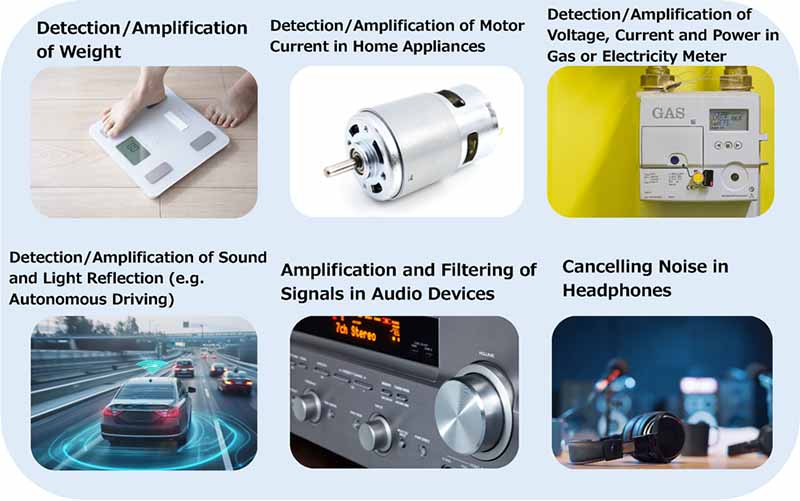
Application of Operational Amplifier in Electronics
1. Mobile Devices and Consumer Electronics
Operational amplifiers are core analog components in everyday mobile and smart home devices. In smartphones, tablets, and other portable electronics, they interface with miniature sensors such as light sensors, pressure sensors, and touch sensors. The op-amp accurately amplifies the extremely weak signals from these sensors, ensuring the device can sensitively respond to changes in the surrounding environment.
2. Industrial Measurement and Control Equipment
In industrial production and measurement systems, operational amplifiers are key components of high-precision instruments. They are widely used in industrial-grade precision measurement devices, data acquisition systems, and automation control systems. Designed to handle environments with significant signal interference and strict accuracy requirements, op-amps reliably amplify weak analog signals from industrial sensors while filtering out environmental noise, ensuring accurate measurement of parameters such as temperature, pressure, displacement, and current.
3. Automotive Electronics
Automotive systems heavily rely on operational amplifiers, especially in various monitoring modules within the engine compartment. Op-amps process signals for critical parameters such as current, acceleration, temperature, and oil pressure. By amplifying and optimizing the weak signals collected by sensors, they provide the vehicle's control computer with accurate data to ensure stable engine operation.
4. Medical Monitoring Devices
Medical electronics demand high signal precision and stability. Operational amplifiers are core components in a variety of life-sign monitoring instruments, commonly used in ECG monitors, ambulatory blood pressure monitors, pulse oximeters, and physiological signal acquisition devices.
5. Audio and Sound Systems
In professional audio equipment, home speakers, and headphone amplifiers, operational amplifiers play a central role in the complete audio signal processing chain. Op-amps are primarily used in preamplifier circuits to boost weak input audio signals. Additionally, they support active filtering and equalization circuits to optimize frequency response, suppress noise and distortion, and restore clear, full-bodied sound.
How to Choose an Operational Amplifier 2026
To choose a suitable operational amplifier, it is essential to consider a range of practical application factors. Selecting the right op-amp in 2026 requires matching device performance to the latest trends in modern electronic design, including portable low-power systems, high-precision sensing applications, automotive and medical equipment with strict reliability standards, and compact integrated circuit designs.
First, determine the application scenario, such as precision measurement, audio processing, high-speed signal conditioning or low-power battery systems. Different applications have different design focuses.
Second, consider the power supply conditions, including single supply or dual supply, supply voltage range, and whether rail-to-rail input and output are needed.
Third, evaluate the stability and anti-interference ability, such as anti-oscillation performance, common-mode interference suppression and noise characteristics.
Fourth, pay attention to the working environment, including temperature range, packaging form and load driving capability.
Finally, balance the performance and cost, select general-purpose devices for ordinary circuits, and choose high-performance op-amps only for key modules to achieve optimal design.
The Best Operational Amplifier in 2026
Based on the mainstream electronic design trends of 2026, including mobile and portable devices, automotive electronics, industrial high-precision measurement, and low-power IoT, and considering the core signal processing requirements of different scenarios, Eastech has carefully selected popular and highly adaptable operational amplifiers for your reference, making it easy to quickly match project requirements and various op-amp application scenarios.
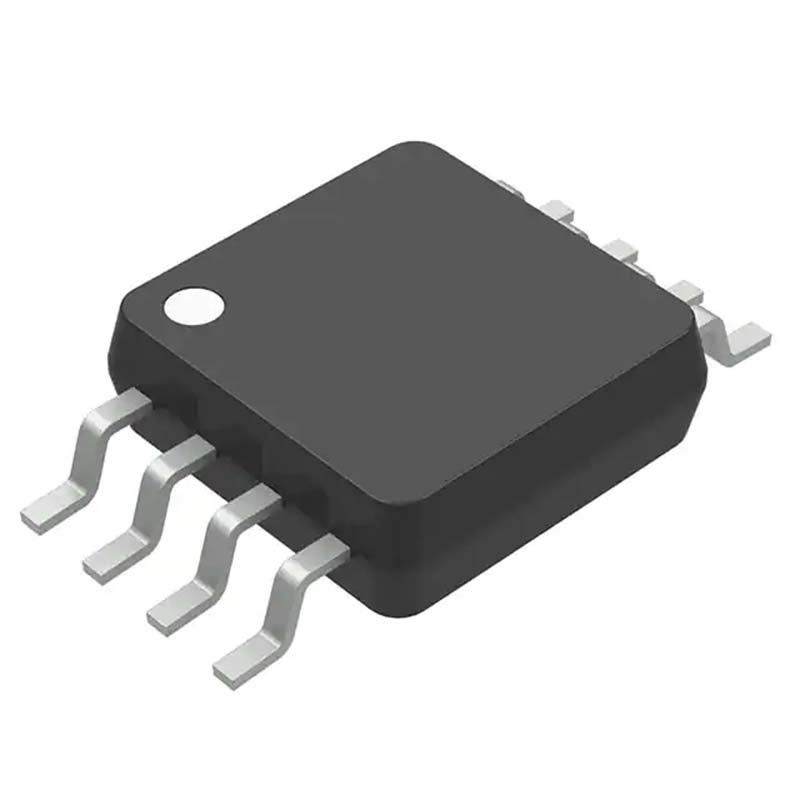
Microchip MCP6N16-100 high-precision zero-drift instrumentation amplifier features extremely low input offset voltage and temperature drift, with excellent common-mode rejection; built-in EMI protection ensures strong anti-interference capability; supports a wide low-voltage single supply from 1.8V to 5.5V, with an operating temperature range of -40℃ to 125℃, suitable for harsh environments.
- Applications: Industrial high-precision measurement and control, medical weak-signal acquisition, Wheatstone bridge signal amplification, high-precision pressure/current detection, portable testing instruments.
STMicroelectronics TSZ181H automotive-grade zero-drift op-amp is AEC-Q100 certified; rail-to-rail input and output with excellent wide-temperature stability and negligible parameter drift; supply voltage 2.2V–5.5V, operating temperature -40℃ to 150℃, suitable for extreme high-temperature environments.
- Applications: Engine compartment sensor monitoring, automotive safety control systems, tire pressure/temperature detection, industrial high-temperature signal conditioning, automotive-grade high-precision measurement devices.
STMicroelectronics TSU112IY nanoamp-level ultra-low-power dual op-amp is automotive-grade certified; quiescent current reaches the nanoamp range, ultra-wide low-voltage supply 1.5V–5.5V greatly extends battery life; rail-to-rail input and output with excellent low-frequency noise control.
- Applications: Sensor modules in smartphones/wearables, battery-powered IoT terminals, smart home sensors, low-power automotive modules, portable low-power medical devices.
Analog Devices AD811ANZ high-speed wideband op-amp offers excellent bandwidth and slew rate performance; strong output drive, very low distortion, outstanding large dynamic range signal processing, stable and durable performance.
- Applications: Professional audio preamplifiers, high-fidelity audio equalization circuits, video signal buffering and transmission, high-speed data acquisition systems, test and measurement instruments, high-frequency signal processing circuits.
Of course, our operational amplifiers are sourced from not only ADI, STMicroelectronics, Microchip, Texas Instruments, onsemi and Renesas, but also many other world-renowned brands. With the most comprehensive selection of operational amplifier models available, Eastech serves as your one-stop shop for electronic components and non-electronic components, almost any electronic product you need can be found here. We are committed to providing reliable supply, professional selection guidance and efficient procurement services to support your project.
Finally, understanding what is operational amplifier in electronics is important for designing efficient and reliable circuits. By knowing how op-amps work, their key characteristics, types, and applications, engineers and enthusiasts can make informed decisions when selecting the right amplifier for their projects. For those looking to source high-quality op-amps for your projects, we can offer a wide range of reliable options.
Related information
- 2026.09.20 What is Ceramic Packaging Chip?
- 2026.09.13 What is SMD Resistor?
- 2026.09.06 What is Bus Interface IC?
- 2026.08.30 How to Select Supercapacitor?