

Available 24/7 at
+86 13632816717

How to Select Supercapacitor?
As modern electronic systems demand faster response, higher power density, and reliable energy delivery, supercapacitors have become an important energy storage solution for a wide range of applications. Also known as ultracapacitors, supercapacitors can store and release electrical energy much faster than conventional batteries, while offering excellent power density, long cycle life, and low maintenance requirements. From automotive and industrial equipment to backup power, renewable energy systems, and consumer electronics, supercapacitors provide a reliable solution for applications that require rapid charge and discharge. But what can supercapacitors be used for? Their unique combination of high power output, high instantaneous current and long cycle life makes them suitable for a wide range of applications.
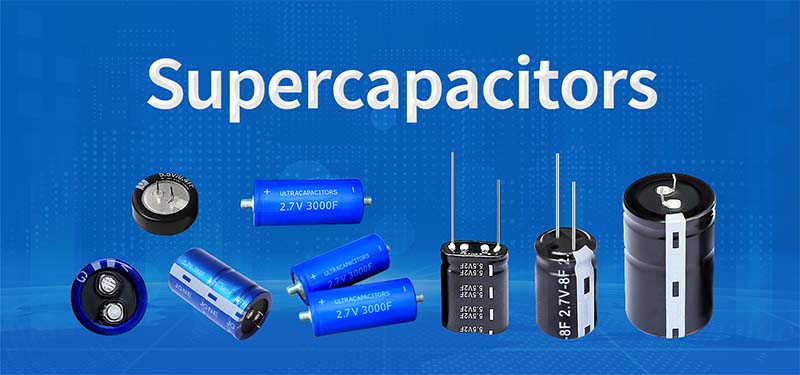
What is Super Capacitor?
Supercapacitors, also known as electrochemical capacitors or electric double-layer capacitors (EDLCs), are energy storage devices that bridge the gap between conventional capacitors and batteries.
Supercapacitors combine high capacitance with rapid energy delivery. They feature high power density, fast charge and discharge, long cycle life, low internal resistance, and excellent reliability. Compared with conventional capacitors, supercapacitors provide significantly higher capacitance and greater energy storage capacity, making them suitable for applications that require rapid energy storage, pulse power, peak power support, and short-term backup power.
Supercapacitors typically feature porous carbon-based electrodes, an electrolyte, and a separator. Their electrodes have a very large specific surface area, providing more sites for charge storage. Depending on the design, materials such as activated carbon, graphene, metal oxides, and conductive polymers may be used. This structure gives supercapacitors high capacitance, low internal resistance, and fast charge and discharge performance.
How Do Supercapacitors Work?
Structure: Supercapacitors store electrical energy through electrostatic charge separation, mainly at the interface between the electrodes and electrolyte. Their internal structure typically consists of two porous electrodes, an electrolyte, and a separator that prevents direct contact between the electrodes while allowing ions to move through.
Charging: When a voltage is applied, electrons accumulate on one electrode and are removed from the other. At the same time, positively and negatively charged ions in the electrolyte move toward the oppositely charged electrode surfaces. This creates an electric double layer (EDL) at the electrode–electrolyte interface, allowing a large amount of charge to be stored.
Principle: The porous structure of the electrodes provides an extremely large effective surface area, while the short distance for ion movement enables fast charge and discharge. In some supercapacitors, materials such as metal oxides or conductive polymers also contribute pseudocapacitance through fast and reversible surface redox reactions, further increasing energy storage capacity.
Discharging: During discharge, the stored charges move back through the external circuit, releasing electrical energy to the connected device. This combination of large electrode surface area, efficient ion movement, and reversible charge storage gives supercapacitors their characteristic high capacitance, high power density, low internal resistance, and long cycle life.
What is the Difference between Capacitor and Supercapacitor?
Conventional capacitors store energy in an electric field between two electrodes separated by a dielectric, while supercapacitors use porous electrodes and an electrolyte to store charge through electric double-layer effects and/or pseudo capacitance. As a result, supercapacitors provide much higher capacitance and energy storage capacity, while conventional capacitors are widely used for high-frequency filtering, signal coupling, and voltage stabilization.
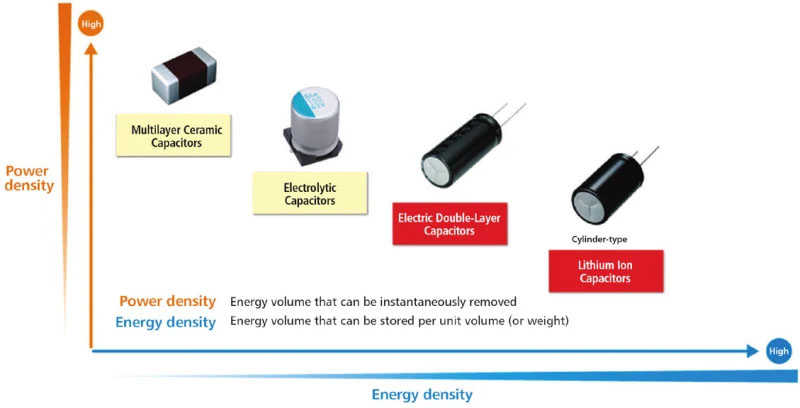
Supercapacitor vs. Capacitor
|
Feature |
Supercapacitor |
Conventional Capacitor |
|
Energy Storage |
Electric double layer and/or pseudocapacitance |
Electric field in a dielectric material |
|
Capacitance |
Very high, typically from farads to thousands of farads |
Usually from pF to mF |
|
Energy Density |
Higher |
Lower |
|
Charge/Discharge |
Fast |
Extremely fast |
|
Cycle Life |
Very long, often hundreds of thousands to millions of cycles |
Generally long, depending on type |
|
Operating Voltage |
Relatively low per cell |
Available across a wide voltage range |
|
Typical Applications |
Energy storage, peak-power support, backup power |
Filtering, coupling, decoupling, timing, signal processing |
What Are the Disadvantages of Supercapacitors?
They generally have lower energy density than batteries, relatively low voltage per cell, and can experience higher self-discharge during storage. They may also require multiple cells and voltage-balancing circuits for higher-voltage applications. In addition, some supercapacitors can have a higher initial cost and larger physical size when designed for substantial energy storage.
Can a Supercapacitor Replace a Battery?
A supercapacitor can replace a battery in some applications, but it is not a direct replacement in every situation. Supercapacitors are well suited to applications requiring rapid charging and discharging, high power output, frequent charge cycles, or short-term energy storage. However, their lower energy density and higher self-discharge make them less suitable for applications requiring long-term, continuous power. In many systems, supercapacitors and batteries can also be used together, with the battery providing sustained energy and the supercapacitor handling peak power demands.
Can You Put Supercapacitors in Series?
Yes. Supercapacitors can be connected in series to increase the overall voltage rating of a supercapacitor bank. When connected in series, the total voltage rating is approximately the sum of the individual cell voltages, while the overall capacitance decreases.
For example, connecting two identical supercapacitors in series gives approximately 2× the voltage rating but ½ the capacitance of a single capacitor.
Because individual cells may have slightly different leakage currents and characteristics, the voltage may not divide evenly. Passive balancing resistors or active balancing circuits are therefore commonly used to prevent any individual cell from exceeding its maximum rated voltage.
What are the Main Types of Supercapacitors?
Supercapacitors can generally be classified according to their energy storage mechanism and electrode materials.
Electric Double-Layer Capacitors (EDLCs): Use porous carbon-based electrodes to store energy through the formation of an electric double layer at the electrode–electrolyte interface.
Pseudocapacitors: Use materials such as metal oxides or conductive polymers to store energy through fast and reversible Faradaic redox reactions. They generally provide higher capacitance and energy density than conventional EDLCs.
Hybrid Supercapacitors: Combine different energy-storage mechanisms, typically using a battery-type electrode with a capacitive electrode. This design aims to achieve a balance between high energy density, high power density, and long cycle life.
Asymmetric Supercapacitors: Use different materials for the positive and negative electrodes to expand the operating voltage range and improve energy storage performance. They are commonly designed to achieve higher energy density while maintaining good power characteristics.
Lithium-Ion Capacitors (LICs): Combine a supercapacitor-type electrode with a lithium-ion battery-type electrode. They offer higher energy density than conventional supercapacitors while retaining relatively high power density and long cycle life.
|
Supercapacitor Types |
Energy Density |
Power Density |
Cycle Life |
Advantage |
|
Electric Double-Layer Capacitors (EDLCs) |
Low-Medium |
Very High |
Very Long |
Fast charge/discharge and excellent durability |
|
Pseudocapacitor |
Medium-High |
High |
Medium-Long |
Higher capacitance and energy storage |
|
Hybrid Supercapacitor |
High |
High |
Long |
Good balance between energy and power |
|
Asymmetric Supercapacitor |
Medium-High |
High |
Long |
Higher operating voltage and energy storage |
|
Lithium-Ion Capacitor (LIC) |
High |
Medium-High |
Long |
Higher energy density with good power capability |
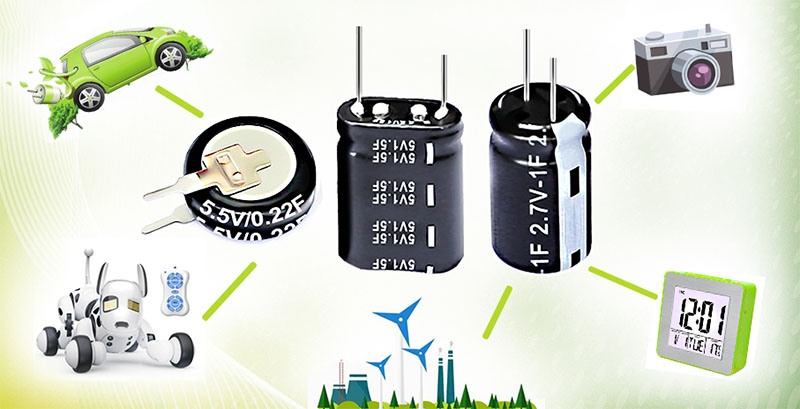
What Can Supercapacitors Be Used For?
Supercapacitors are widely used in applications that require fast charging and discharging, high power output, reliable energy delivery, and frequent cycling.
Automotive Electronics: Used in start-stop systems, regenerative braking, and peak power assistance. They can quickly deliver high power during engine starting or acceleration and capture energy during braking.
Industrial Equipment: Used for peak power support, power stabilization, and short-term emergency power. Supercapacitors can help equipment handle sudden power demands and reduce voltage fluctuations.
Backup Power: Used as short-term backup power for memory devices, controllers, monitoring systems, and other electronic equipment. They can provide immediate power during brief interruptions.
Renewable Energy: Used in solar and wind power systems for short-term energy storage and power smoothing.
UPS Systems: Used to provide immediate power during short power interruptions or voltage drops.
Telecommunications: Used for backup power and power fluctuation management in communication equipment and network infrastructure.
How to Select a Supercapacitor?
Selecting the right supercapacitor starts with understanding the specific power and energy demands of the application.
Peak Power
Determine the maximum power the supercapacitor must deliver to the load during short-duration events such as motor startup, acceleration, pulse loads, or power interruption.
Peak Power Duration
Determine how long the supercapacitor needs to provide the required peak power. A higher peak power requirement or longer discharge duration generally requires greater energy storage capacity.
Required Energy
Calculate the total energy required during the discharge period. The required capacitance depends on the energy demand and the allowable voltage range. The stored energy can be estimated using E = ½C(V₁² − V₂²), where V₁ is the initial voltage and V₂ is the minimum operating voltage.
Voltage
Supercapacitors operate over a continuously changing voltage range as they discharge. Therefore, both the maximum charging voltage and minimum usable voltage should be considered. For higher-voltage systems, multiple cells may need to be connected in series, with appropriate voltage balancing.
Leakage Current
Leakage current determines how quickly a supercapacitor loses its stored energy when it is not supplying a load. Low leakage is especially important for applications involving long standby periods or infrequent charge/discharge cycles.
In practice, Peak Power + Peak Power Duration → Required Energy → Capacitance and Voltage Range. This makes these parameters the starting point for selecting a suitable supercapacitor, while ESR, temperature, cycle life, and physical size can then be evaluated for the specific application.
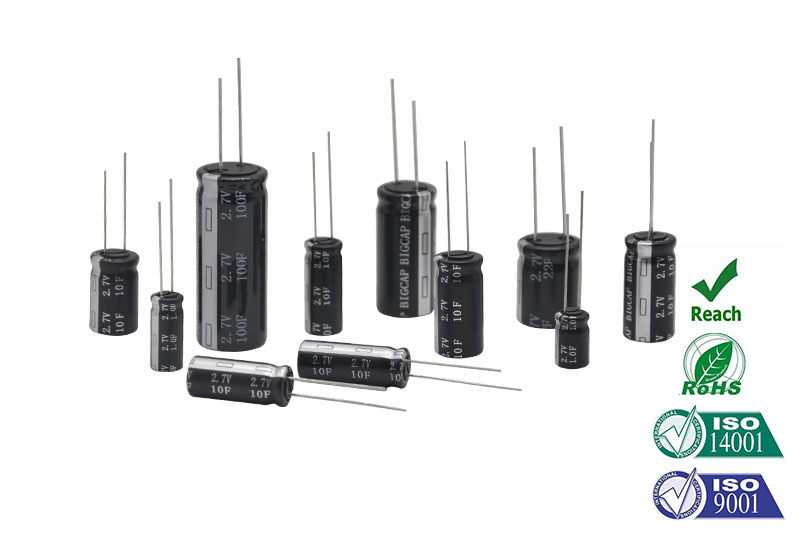
Where to Buy Cheap Supercapacitors from a Reliable Distributor?
Finding the right capacitor is an important step in building reliable power and energy storage systems. Our capacitor distribution business supports customers with supercapacitors and other capacitor components for applications such as peak-power delivery, short-term backup, energy recovery, and power stabilization.
Our inventory covers a broad selection of capacitor models, specifications, and package types, with in-stock components available for faster delivery when required. We also assist with hard-to-find, obsolete, discontinued, and long-lead-time capacitor models, helping customers locate components that may no longer be readily available through conventional distribution channels. When an original part is unavailable, we can also help identify compatible or alternative models.
Our sourcing network covers products from established capacitor manufacturers and brands, including Murata, Maxwell, Jamicon, and TDK, among others. Whether you need a specific supercapacitor for production, replacement components for existing equipment, or assistance sourcing difficult-to-find parts, you can submit your BOM online for sourcing and quotation support.
Finally, supercapacitors are particularly useful when a system needs rapid bursts of power, frequent charge-discharge cycles, or short-term energy support. Different types of supercapacitors are optimized for different electrical and operating conditions, so the most suitable choice depends on how the stored energy will be delivered and how frequently the device will be cycled. Evaluating these trade-offs at the system level helps ensure the super capacitor delivers the required power and service life without adding unnecessary cost or design complexity.
Related information
- 2026.08.23 What is Aluminium Electrolytic Capacitor?
- 2026.08.16 What are BJT and MOSFET Transistors?
- 2026.07.28 What are Programmable Logic Controllers?
- 2026.07.26 What is a Ceramic Capacitor?