

Available 24/7 at
+86 13632816717

What is SMD Resistor?
Surface-mount devices (SMDs) have become essential components in modern electronics, enabling manufacturers to build smaller, lighter, and more densely populated circuit boards. Among the most widely used SMD components are resistors and capacitors, which are available in various package sizes to meet different electrical and space requirements. This article introduces the key advantages of SMD resistors and capacitors and guides manufacturers on where to buy SMD resistors.
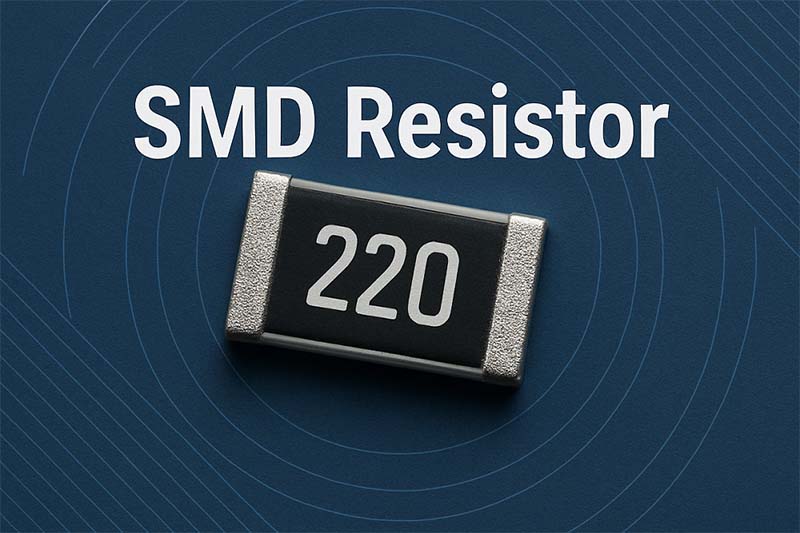
What is SMD Resistor?
An SMD resistor (Surface-Mount Device resistor) is a small electronic component designed to provide resistance in a circuit and is mounted directly onto the surface of a PCB. Unlike traditional through-hole resistors, SMD resistors have no long leads and are soldered onto pads on the circuit board. They are widely used in smartphones, computers, automotive electronics, power supplies, and other compact electronic devices.
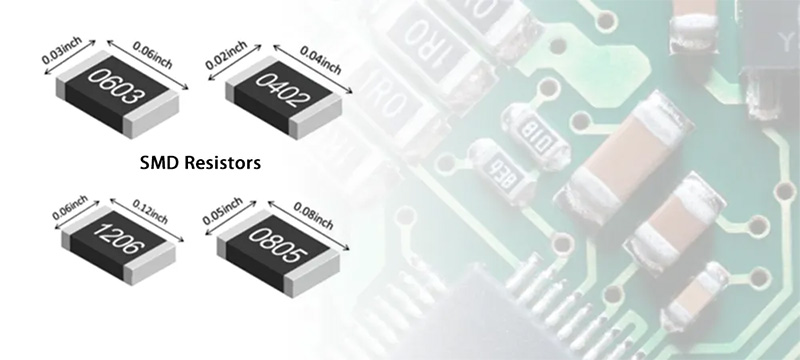
SMD resistors are available in different sizes, resistance values, power ratings, and tolerances. Common package sizes include 0201, 0402, 0603, 0805, and 1206. Their compact size and automated assembly compatibility make them suitable for high-density PCB designs.
The main difference between an SMD resistor and other types of resistors is how they are mounted, physical size, and typical applications.
|
Feature |
SMD Resistor |
Through-Hole Resistor |
|
Mounting |
Soldered onto PCB surface |
Leads inserted through PCB holes |
|
Size |
Very small and compact |
Generally larger |
|
Assembly |
Ideal for automated SMT assembly |
Often requires through-hole assembly |
|
PCB Space |
Requires less board space |
Requires more space |
|
Mechanical Strength |
Generally lower for high mechanical stress |
Generally stronger |
|
Typical Applications |
Smartphones, computers, IoT, compact electronics |
Power electronics, industrial equipment, prototypes |
|
Packages |
0201, 0402, 0603, 0805, 1206 |
Axial, radial |
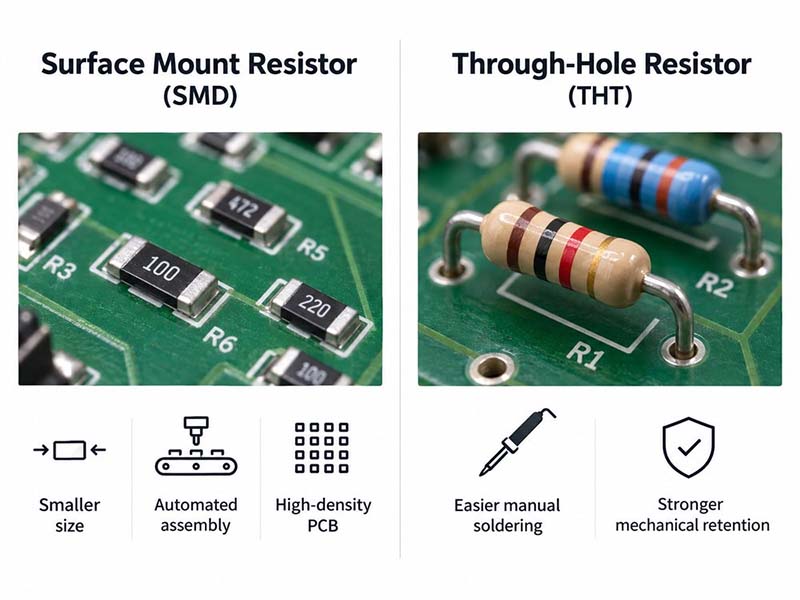
SMD Resistors vs. SMT Resistors
Resistors are essential passive components in electronic circuits, widely used to control current and voltage. Based on their mounting method, resistors are generally divided into SMD resistors and through-hole resistors.
Through-hole resistors have wire leads that pass through holes in a PCB and are soldered to the board. They are widely used in industrial equipment, power electronics, and applications where strong mechanical connections or relatively high power handling are required.
SMD resistors are mounted directly onto the surface of a PCB without requiring through-holes. Their compact size allows more components to be placed on a smaller board, while their compatibility with automated SMT assembly makes them well suited for high-volume electronic manufacturing.
Both types perform the same basic function, but their mounting methods, physical size, assembly processes, and typical applications are different. As electronic products continue to become smaller and more integrated, SMD resistors have become increasingly common in modern PCB designs, particularly in smartphones, computers, automotive electronics, and other compact devices.
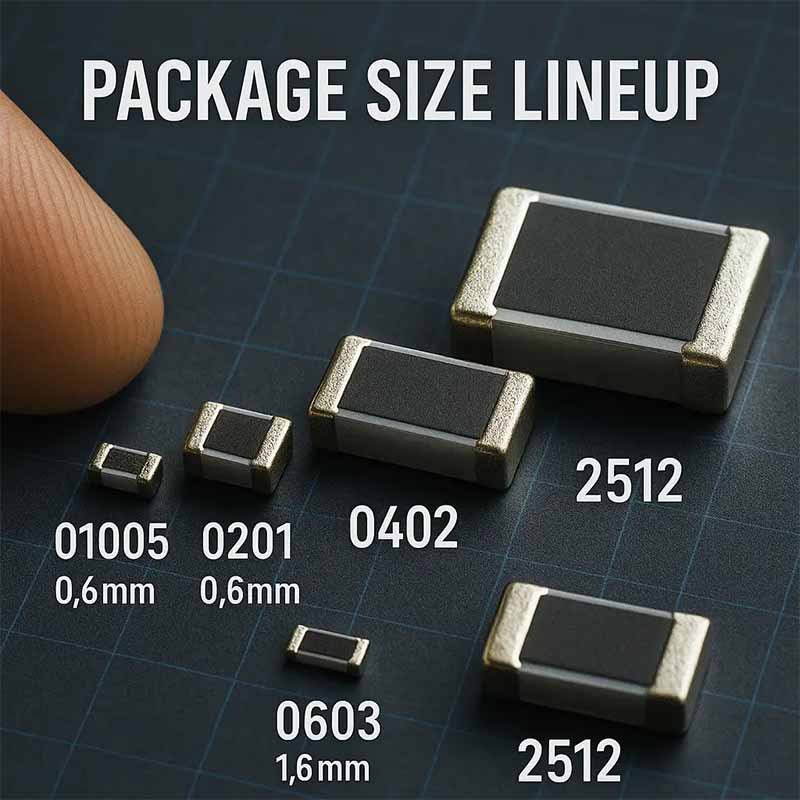
SMD Resistor and Capacitor Packages
SMD resistors and capacitors are available in a variety of standardized package sizes. The package code generally indicates the component's length and width.
|
Package |
Approx. Size (mm) |
Common Applications |
|
201 |
0.6 × 0.3 |
Ultra-compact electronics |
|
402 |
1.0 × 0.5 |
Smartphones, wearables, compact PCBs |
|
603 |
1.6 × 0.8 |
General-purpose electronics |
|
805 |
2.0 × 1.25 |
General electronics, power circuits |
|
1206 |
3.2 × 1.6 |
Higher-power or larger components |
|
1210 |
3.2 × 2.5 |
Capacitors and higher-capacitance applications |
|
1812 |
4.5 × 3.2 |
Larger capacitors, filtering, power applications |
|
2220 |
5.7 × 5.0 |
High-capacitance or high-power applications |
For surface mount resistor, common packages include 0201, 0402, 0603, 0805, 1206, 1210, 2010, and 2512. Larger packages such as 2010 and 2512 are often used when higher power dissipation is required.
For SMD capacitors, common packages include 0201, 0402, 0603, 0805, 1206, 1210, 1812, and 2220. Capacitor package selection depends not only on capacitance but also on voltage rating, dielectric type, temperature characteristics, and required PCB space.
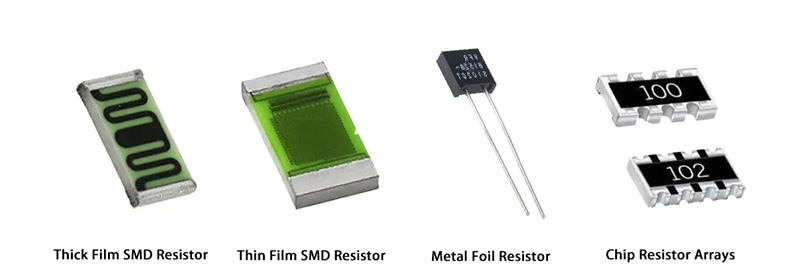
SMD Resistors Main Types and Application
SMD resistors come in different types to meet the requirements of various electronic circuits. They can be classified based on their construction, performance, and application.
Thick-film resistors are one of the most common types of SMD resistors. They offer a good balance of cost, stability, and performance, making them suitable for general-purpose electronic applications.
Thin-film resistors provide higher precision, lower temperature coefficients, and better long-term stability than standard thick-film resistors. They are often used in precision circuits, highly precise RF uses, and applications where resistance accuracy is important.
Metal oxide and metal film resistors are also available in SMD packages and can provide good stability and temperature performance. These types of SMD resistors are ideal for power electronics, automotive uses, and audio equipment.
Chip resistor arrays are SMD components that integrate multiple resistors into a single compact package. Compared with using several individual SMD resistors, resistor arrays can reduce PCB space, component count, and assembly complexity. They are commonly used in voltage divider circuits, pull-up and pull-down networks, signal conditioning, LED circuits, and digital interfaces.
What Are the Advantages of SMD Resistor in Electronics?
1. Compact Size
SMD resistors are much smaller than traditional through-hole resistors, helping save valuable PCB space and supporting compact electronic designs.
2. Easy Automated Assembly
They are designed for surface-mount technology (SMT), making them suitable for high-speed automated placement and reflow soldering in mass production.
3. High Component Density
Their small size allows more components to be installed on a single PCB, making SMD resistors ideal for smartphones, computers, IoT devices, and other high-density electronics.
4. Consistent Manufacturing
SMD resistors can be manufactured and assembled using highly automated processes, providing consistent dimensions and electrical performance.
5. Lower Assembly Cost
Automated SMT assembly can reduce manual labor and improve production efficiency, particularly for large-volume PCB manufacturing.
6. Wide Range of Specifications
SMD resistors are available in various resistance values, tolerances, power ratings, and package sizes, such as 0201, 0402, 0603, 0805, and 1206, to meet different circuit requirements.
7. Suitable for Modern Electronics
Their compact design, efficient assembly, and wide range of specifications make SMD resistors a standard choice for modern electronic and high-density PCB applications.
What are SMD Resistors Used for?
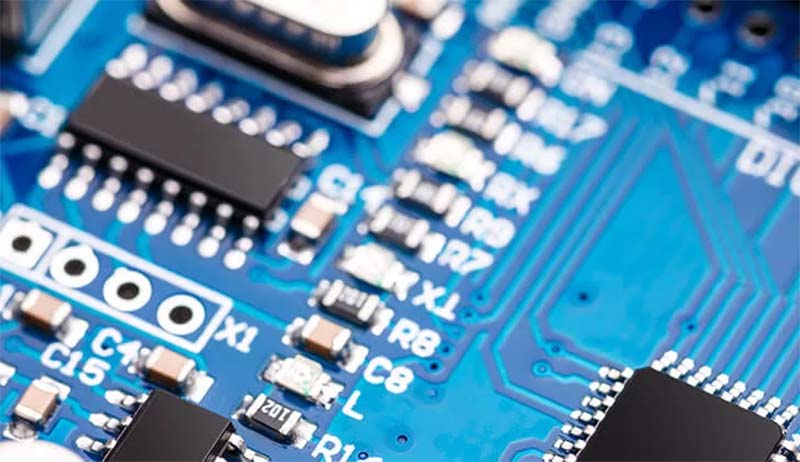
SMD (Surface Mount Device) resistors are the most common passive components on modern PCBs, mainly used to control current and divide voltage in circuits.
1. Current limiting
Restrict the current flowing through LEDs, IC pins and sensors to prevent burnout.
2. Voltage division
Create a lower reference voltage for analog sampling, sensor input and comparator circuits.
3. Pull-up / Pull-down resistors
Fix logic signal levels on I2C, SPI and other digital communication lines, avoid floating signals.
4. Load resistors & termination resistors
Match impedance for high-speed signal lines to reduce signal reflection. Also act as dummy load for testing.
5. Gain setting for amplifiers
Set amplification multiple of op-amp circuits.
6. Power dissipation
Dissipate excess power in power supply and switching circuits.
Typical products using SMD resistors
Mobile phones, laptops, motherboards, power adapters, sensors, automotive electronics, IoT modules, wearable devices.Their small size makes them particularly suitable for compact, high-density PCB designs.
How to Calculate the Resistance Value of SMD Resistor from its Marking?
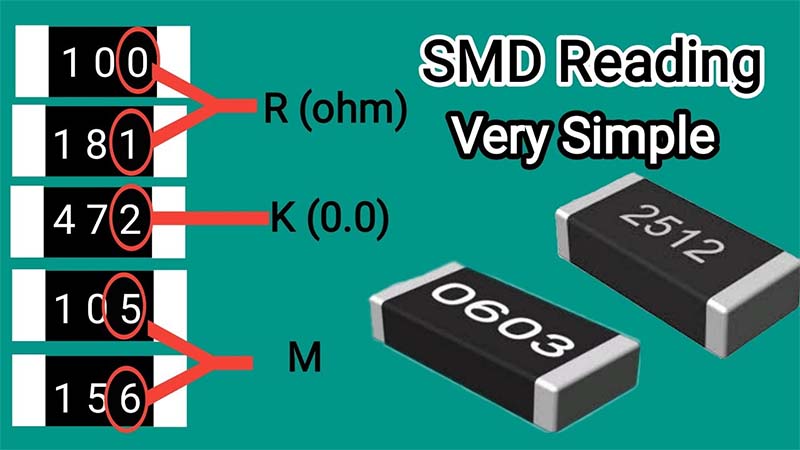
SMD resistors are usually marked with numerical or alphanumeric codes to indicate their resistance values. Common three-digit and four-digit codes can be used to calculate the resistance value directly.
For a three-digit code, the first two digits represent the significant figures, while the third digit indicates the number of zeros to add. For example, an SMD resistor marked 103 has a resistance of 10 × 10³ Ω, or 10 kΩ. Similarly, 472 represents 47 × 10² Ω, or 4.7 kΩ.
For a four-digit code, the first three digits represent the significant figures, and the fourth digit indicates the number of zeros to add. For example, 1002 represents 100 × 10² Ω, or 10 kΩ. This marking method is commonly used for resistors that require more precise resistance identification.
Some precision SMD resistors use alphanumeric codes to indicate resistance values, particularly in smaller packages. The letter R is commonly used to represent a decimal point. For example, 4R7 means 4.7 Ω, while R47 means 0.47 Ω.
How to Selecting the Right Surface Mount Resistor
1. Confirm Basic Electrical & Part Specifications
Select standard and purchasable SMD resistors with clear parameters, including resistance value, tolerance, TCR (temperature coefficient of resistance), and package size. Meanwhile, verify pad pattern, soldering performance, product lifecycle status, and the mapping relationship between BOM and component package.
2. Check Continuous Power, Voltage and Current Ratings
Calculate the worst-case working conditions. Confirm the allowable continuous voltage, current and power consumption of the resistor. Take resistor tolerance and maximum ambient/terminal operating temperature into account to ensure stable power performance under extreme temperatures.
3. Evaluate Pulse Working Performance
If the circuit involves pulse signals, check single and repetitive pulse parameters. Confirm pulse duration, repetition frequency, peak power, peak voltage and average power, and ensure the resistor's resistance change is within the allowable range during pulse operation.
4. Match Application-Specific Technical Requirements
Select resistors with qualified features according to actual usage scenarios. Check requirements for precision, low noise, current sensing, high voltage resistance, surge resistance, sulfur resistance, moisture resistance and pollution resistance. Also confirm adaptability for vibration and flexible PCB working environments.
5. Ensure Compatibility with Assembly Processes
Verify compatibility with SMT production processes, including component mounting, stencil printing, reflow soldering, inspection and rework. Ensure good package traceability, and match PCB copper symmetry and overall assembly technology requirements.
6. Complete Actual Working Verification
Test the assembled PCB under maximum credible load and extreme ambient conditions. Record detailed data before and after testing, including temperature, voltage, current, resistance value, sample quantity and test repeatability to guarantee reliable product performance.
Where to Buy SMD Resistors?
After selecting the right SMD resistor, finding a reliable supplier is an important part of the purchasing process. Buyers should consider product authenticity, availability, pricing, MOQ, delivery time, and supply stability when choosing an electronic component distributor.
As a professional electronic component distributor, Eastech provides a wide range of SMD components for prototyping, maintenance, and volume production. Our product range covers SMD resistors, SMD capacitors, inductors, diodes, transistors, LEDs, ICs, sensors, and other electronic components from various manufacturers and brands.
EASTECH can assist with component sourcing, stock and availability checks, competitive quotations, and hard-to-find or discontinued part sourcing.
|
Manufacturer |
Part Number |
Package |
Resistance |
Tolerance |
Power |
|
MCR03EZPFX1002 |
603 |
10 kΩ |
±1% |
0.1 W |
|
|
ROHM |
MCR10EZPFX1001 |
805 |
1 kΩ |
±1% |
0.125 W |
|
Samsung Electro-Mechanics |
RC1005F103CS |
402 |
10 kΩ |
±1% |
0.063 W |
|
Samsung Electro-Mechanics |
RC1608F103CS |
603 |
10 kΩ |
±1% |
0.1 W |
|
CRCW060310K0FKEA |
603 |
10 kΩ |
±1% |
0.125 W |
|
|
Vishay |
CRCW080510K0FKEA |
805 |
10 kΩ |
±1% |
0.125 W |
|
Panasonic |
ERJ3EKF1002V |
603 |
10 kΩ |
±1% |
0.1 W |
|
Panasonic |
ERJ6ENF1002V |
805 |
10 kΩ |
±1% |
0.125 W |
When sourcing SMD resistors, choosing products from established manufacturers can help ensure consistent quality and reliable performance. Popular SMD resistor brands include ROHM, Samsung Electro-Mechanics, Vishay, and Panasonic, offering a wide range of resistance values, tolerances, power ratings, and package sizes such as 0402, 0603, 0805, and 1206.
The SMD resistor models listed above are only a selection of the products we can supply. We also offer more brands, package sizes, resistance values, and specifications, with a wide range of SMD resistor inventory available for different applications. If you cannot find the exact part number you need, send us your BOM or part requirements, we can help source the required parts and provide samples for testing and evaluation before mass production.
Final word, selecting the right resistor requires more than simply choosing the correct resistance value. Factors such as package size, power rating, tolerance, temperature characteristics, and circuit requirements all affect component performance and reliability. As a result, the surface mount resistor has become widely used in modern PCB manufacturing due to its compact size, reliable performance, and compatibility with automated assembly. By carefully matching these specifications to the application, manufacturers can choose the right resistor for their designs and ensure stable, reliable circuit performance.
Related information
- 2026.09.06 What is Bus Interface IC?

- 2026.08.30 How to Select Supercapacitor?
- 2026.08.23 What is Aluminium Electrolytic Capacitor?
- 2026.08.16 What are BJT and MOSFET Transistors?