

Available 24/7 at
+86 13632816717

How Important are Electronic Components for AI?
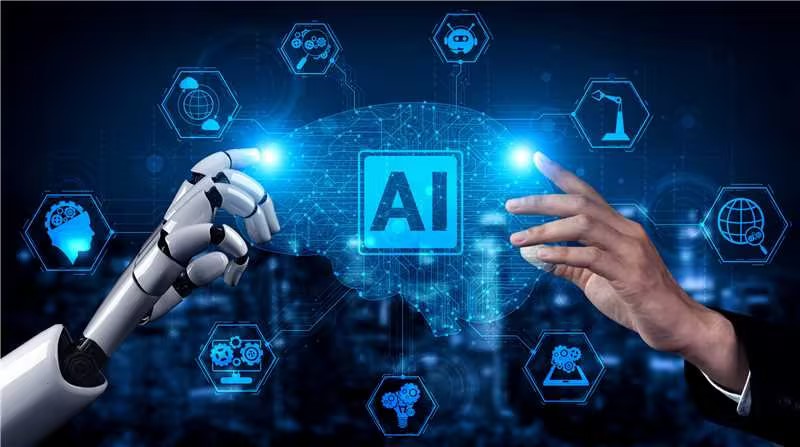
Artificial intelligence (AI) has evolved from a concept to an essential part of daily life and industry, powering everything from smart assistants and large language models to autonomous driving and precision medical diagnosis. Yet behind all seamless AI operations and intelligent decisions lies an often-overlooked foundation: electronic components. These tiny devices-including microprocessors, memory chips, sensors, and capacitors-are the "nerve cells" of AI, translating abstract algorithms into action and enabling perception, processing, and learning. This article is introduce the electronic components for artificial intelligence systems.
How Does Electronic Components for AI Work?
Artificial intelligence works on the basic logic that core electronic components, including transistors (the foundation of binary logical operations), microprocessors (responsible for signal processing and calculation), memory chips (for storing data and instructions), sensors and interface chips (converting physical signals to digital ones recognizable by AI), and passive components (stabilizing system operation), work together to transmit, process and store electrical signals, converting these signals into logical operations and data processing to simulate human intelligent behaviors.
Basic Electronic Components for Artificial Intelligence Systems
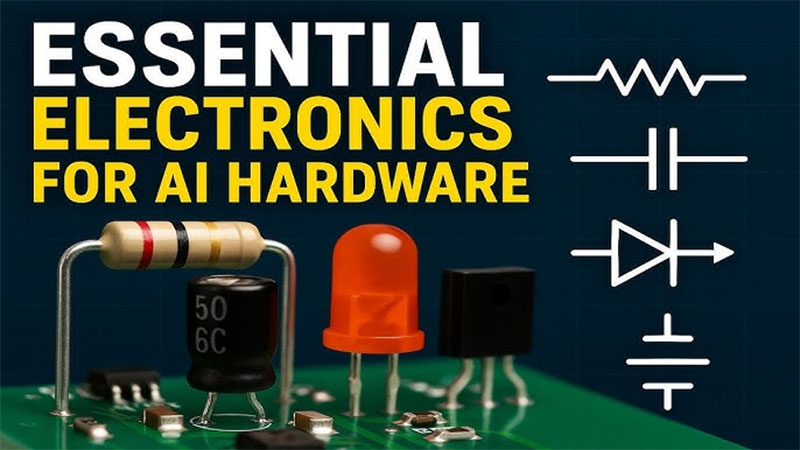
1. Capacitor
Stores electrical energy and stabilizes voltage, filtering noise to ensure reliable power supply for AI circuits and processors.
2. Resistor
Limits electric current, controls voltage levels, and protects sensitive AI chips and sensors from overcurrent damage.
A compact assembly of many electronic components on a semiconductor chip, forming the core of AI computing, memory, and signal processing.
4. Logic Components
Perform basic digital operations (AND, OR, NOT, etc.), forming the foundation of decision-making and data processing in AI systems.
5. Transistor
Acts as a switch or amplifier; billions of transistors in CPUs, GPUs, and AI accelerators enable fast computation and neural network operations.
6. Diode
Allows current to flow in one direction, used for rectification, circuit protection, and signal modulation in AI hardware interfaces.
7. Sensor
Converts physical inputs (light, temperature, pressure, motion, sound) into electrical signals, providing real‑world data for AI perception and analysis.
8. Microcontroller (MCU)
A compact integrated circuit that controls embedded AI systems, managing sensors, actuators, and low-level decision-making in edge devices.
9. Communication Module
Enables data transmission (Wi-Fi, Bluetooth, Ethernet, 4G/5G) between AI devices, cloud servers, and other hardware for distributed computing and IoT connectivity.
Application of Electronic Components in the Artificial Intelligence System
1. Industrial Intelligent Inspection
Industrial intelligent inspection is one of the most mature application scenarios combining AI and electronic components. Its core lies in using AI algorithms to achieve automated, high-precision detection of defects and errors in industrial production, replacing manual inspection to improve efficiency and accuracy. Electronic components provide end-to-end support: sensors capture raw data such as images and physical parameters; operational amplifiers, filters, and ADCs convert analog signals into digital signals while filtering interference; MCUs, relays, and other control components execute AI algorithm commands, forming a closed-loop inspection system.
2. Accelerated Prototyping
The core of AI prototyping is to quickly verify algorithm feasibility and shorten R&D cycles. Electronic components lower development barriers by providing lightweight, highly compatible, and easily debuggable hardware platforms. Embedded AI chips and FPGAs offer core computing power; GPIO interfaces and serial communication chips enable rapid debugging and adaptation; low-power components support mobile and portable prototype operation, helping engineers quickly turn ideas into testable prototypes.
Prototypes such as AI smart cars, voice control systems, and AI vision recognition platforms all rely on various electronic components combined with lightweight AI algorithms to enable rapid functional validation and iteration.
3. Intelligent Supply Chain Management
Intelligent supply chain management uses AI algorithms to achieve efficient demand forecasting, inventory optimization, and logistics scheduling. Electronic components are the backbone of stable system operation. Various sensors collect real-time data on inventory, logistics, and environmental conditions; signal processing components transmit data to AI computing chips for analysis and decision-making; control components then drive warehousing and logistics equipment to execute scheduling commands, while communication components ensure real-time data synchronization across all stages.
4. Intelligent Customer Service
Intelligent customer service relies on AI algorithms to automate customer inquiry responses, problem resolution, and request routing. Electronic components provide stable hardware support to ensure smooth interaction and efficient service. Microphone sensors and audio processing chips capture and process user voice input, converting analog audio signals into digital signals for AI chips to perform speech recognition, intent understanding, and response generation. Audio driver chips and speakers output voice replies. Meanwhile, MCUs and communication chips enable real-time connectivity between the intelligent customer service system, backend databases, and human support systems, improving service accuracy.
5. AI Intelligent Terminal Devices
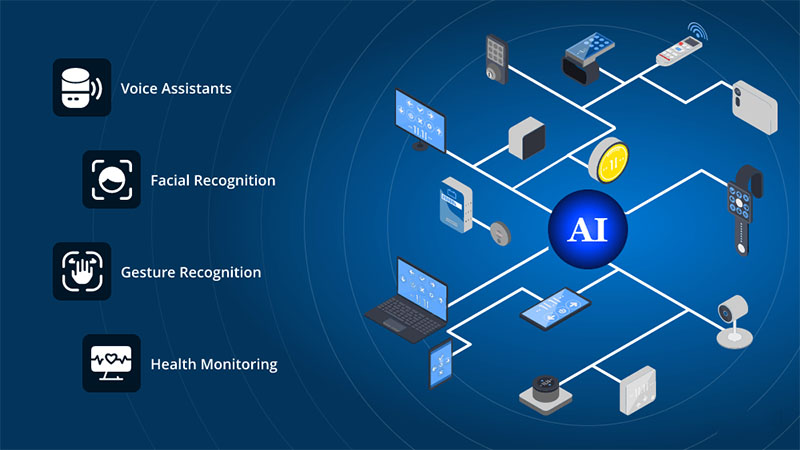
AI intelligent terminal devices include smartphones, wearables, and smart home products. Their core is personalized interaction and intelligent control enabled by AI algorithms, with electronic components providing compact, low-power, and high-performance hardware support. Miniature sensors capture user actions and environmental changes; embedded AI chips and low-power MCUs run lightweight AI algorithms (such as facial recognition, voice wake-up, and scene adaptation); display driver chips and Bluetooth/Wi-Fi communication chips enable interactive feedback and device interconnection, allowing terminals to perceive intelligently and respond autonomously.
6. AI Medical Assisted Diagnosis
AI medical assisted diagnosis applies AI algorithms to analyze medical data, providing diagnostic references for healthcare professionals and improving efficiency and accuracy. Electronic components are essential for precise data acquisition and efficient processing. Medical-grade sensors (such as imaging sensors and physiological signal sensors) collect key data including medical images, ECG, and blood pressure. High-precision processing chips and ADCs perform noise reduction, amplification, and digitization, while AI computing chips run image recognition and pathological analysis algorithms to rapidly generate diagnostic insights.
7. AI Autonomous Driving
AI autonomous driving is a high-end application resulting from deep integration of AI and electronic components. Its core is enabling autonomous perception, decision-making, and control through AI algorithms. Electronic components form the system's "sensory organs" and "central brain". RADAR, cameras, and millimeter-wave radar sensors continuously collect data on road conditions, vehicles, and pedestrians. FPGAs and AI computing chips process massive data streams in real time to perform path planning, risk prediction, and driving decisions.
Challenges of Electronic Components used in Artificial Intelligence Systems
- High computing demand: AI tasks like deep learning require massive parallel computing and high bandwidth, which puts severe pressure on processors, memory, and power delivery.
- Power consumption and heat dissipation: Advanced AI chips and high-density circuits consume large amounts of power, leading to overheating and reduced efficiency, especially in edge devices.
- Reliability and stability: AI systems often run 24/7, so components must maintain long-term stability under continuous high loads, resisting noise, voltage fluctuations, and aging.
- Miniaturization and integration: For edge AI and mobile devices, components need to be smaller, lighter, and more integrated while maintaining computing power, which increases design and manufacturing difficulty.
- Compatibility and scalability: Diverse AI frameworks and algorithms require components to support flexible interfaces, scalability, and software-hardware co-optimization.
- Cost constraints: High-performance AI components (e.g., advanced GPUs, FPGAs, ASICs) are expensive, hindering widespread deployment in low-cost applications.
Futures of Artificial Intelligence Electronic Components
Artificial intelligence and electronic components are entering a new era of deep integration, and their technological innovation and application have great potential.
1. Component-Level Innovation
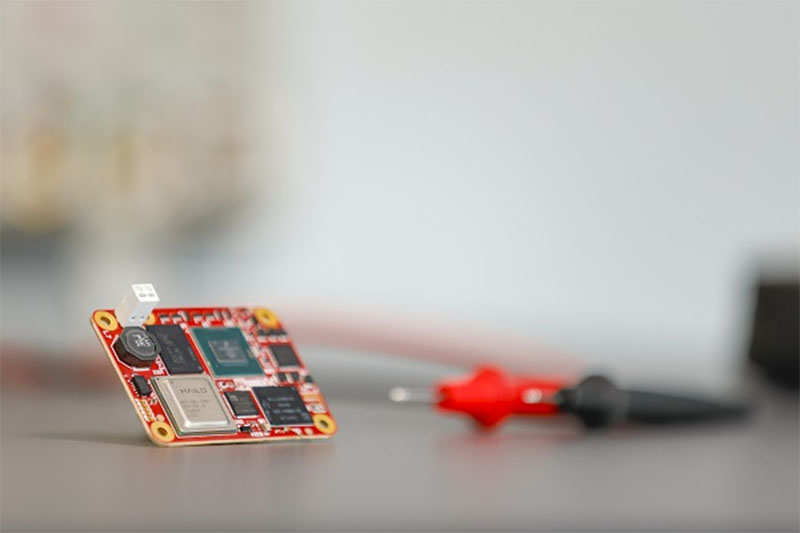
Next-generation electronic components will be AI-native designed: high-performance AI accelerators, 3D-stacked chips, and low-power edge computing components will become mainstream.
2. Edge AI and Miniaturization
More AI functions will shift from cloud to end devices, driven by compact, high-efficiency components. Smart sensors, embedded chips, and integrated modules will enable real-time inference, low latency, and offline intelligence in smartphones, IoT devices, autonomous vehicles, robots, and medical equipment, expanding AI from data centers to every scenario.
3. Synergy of Software and Hardware
AI algorithms and electronic components will evolve collaboratively. Dedicated chips (ASICs, FPGAs, NPUs) customized for large models, computer vision, and natural language processing will improve performance per watt dramatically.
4. Applications Expansion
AI-powered electronic components will reshape industries: autonomous driving with high-speed sensing and computing chips; smart manufacturing with predictive maintenance and real-time control chips; medical care with intelligent imaging and diagnostic components; aerospace and military with highly reliable, radiation-resistant AI chips.
Related information
- 2026.08.09 What Are Automotive Chips?
- 2026.07.19 What is GDDR Memory?
- 2026.05.05 What are Inertial Measurement Units?