

Available 24/7 at
+86 13632816717

What Are Automotive Chips?
From power management and engine control to advanced driver assistance, infotainment, and in-vehicle networking, automotive chips must deliver reliable performance under demanding operating conditions. Unlike conventional consumer-grade components, automotive semiconductors are designed to meet stricter requirements for temperature, durability, quality, and long-term reliability. This article explores what type of chips are used in cars and the major manufacturers serving the automotive market.
What Are Automotive Chips?
Automotive chips are semiconductor components specifically designed for use in vehicles. They control, monitor, communicate, and power many automotive systems, from the engine and transmission to ADAS, infotainment, and electric-vehicle battery management. The electrification and intelligent evolution of automobiles have greatly benefited from advances in semiconductor technology, as semiconductors are widely used across various automotive subsystems.
Quality and Reliability
Compared with chips used in consumer electronics, automotive integrated circuits must operate reliably and continuously under harsher environments and over much longer lifecycles. A failure of chips used in critical systems such as braking, power control, airbags, or ADAS could directly affect vehicle safety. Therefore, the automotive industry requires stricter standards for quality, reliability, and environmental adaptability. They are designed to withstand wide temperature ranges, vibration, electrical fluctuations, and long operating periods.
Key Requirements:
AEC-Q100 qualification for automotive integrated circuits
Wide operating temperature ranges, typically from −40°C to +125°C or higher
High resistance to vibration, shock, and electrical noise
Long-term reliability for extended vehicle service life
Functional safety compliance, such as ISO 26262, for safety-critical applications
Consistent performance and low failure rates under harsh automotive conditions
For automotive manufacturers and suppliers, these requirements help ensure that chips perform reliably throughout the vehicle's lifecycle.
What Are Automotive Chips Used For?
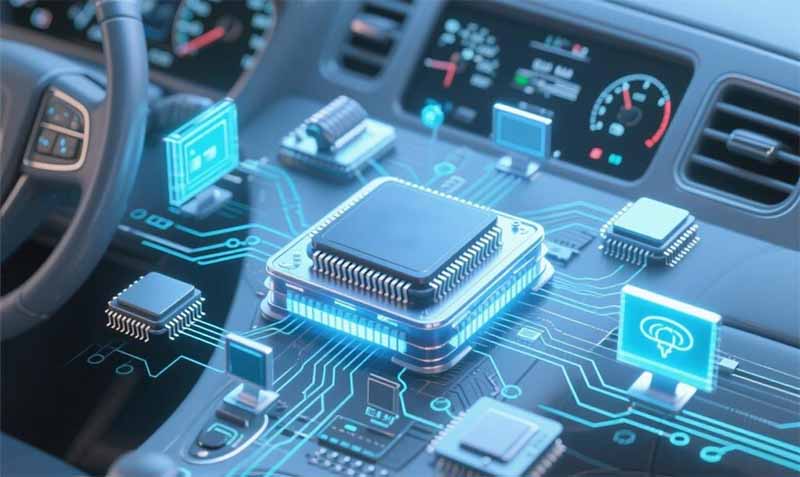
Power control
Monitor and adjust engine fuel injection, ignition timing, new-energy motor output and battery management. BMS chips manage lithium-ion battery charging, discharging, temperature and safety protection for EVs.
Chassis & safety systems
Support ABS, ESP, electronic stability control, brake assistance and air-bag triggering. They collect sensor data to stabilize vehicle driving and activate safety protection during collisions.
Vehicle body control
Manage lighting, window lifting, door locks, air-conditioning, seat adjustment and wiper systems to realize automated body-level functions.
Infotainment & connectivity
Power central control screens, instrument panels, car audio, Bluetooth, vehicle-network communication and navigation, processing audio-visual playback and human-vehicle interaction.
Advanced driver-assistance & autonomous driving
Process data from cameras, radars and LiDAR. Complete environment perception, object detection, path planning for functions such as adaptive cruise, lane-keeping, automatic emergency braking and self‑driving computation.
Power conversion for new-energy vehicles
Power semiconductor integrated circuits (IGBT, SiC MOSFET) convert high-voltage direct-current power, driving motors and completing on-board charging and voltage transformation.

What Type of Chips Are Used in Cars?
With the development of automotive electrification, intelligence, and connectivity, chips have been widely adopted in power systems, body control systems, intelligent cockpits, ADAS, and new energy vehicle battery systems. Different types of automotive chips perform various functions, including computing, control, communication, signal processing, and power management.
PMIC (Power Management IC)
PMICs are responsible for power conversion, regulation, distribution, and monitoring within vehicles. They provide stable operating voltages for MCUs, sensors, communication modules, display systems, and other components.
MCU (Microcontroller Unit)
MCUs are among the core chips in automotive electronic control units (ECUs). They execute control programs and process data collected from sensors. They are widely used in engine control, body control, doors, seats, lighting, air conditioning, chassis, and battery management systems.
ASIC (Application-Specific Integrated Circuit)
ASICs are custom-designed for specific automotive applications, enabling optimized performance, power consumption, and cost efficiency for dedicated tasks.
SoC (System-on-Chip)
SoCs integrate CPUs, GPUs, AI accelerators, memory controllers, and various interfaces into a single chip, providing powerful computing and data processing capabilities. They are mainly used in intelligent cockpits, autonomous driving, ADAS, and in-vehicle infotainment systems.
MPU (Microprocessor Unit)
MPUs are mainly responsible for running complex software and high-performance data processing. Compared with traditional MCUs, they typically offer stronger computing capabilities. They are commonly used in in-vehicle infotainment systems, digital instrument clusters, intelligent cockpits, and domain controllers.
DSP (Digital Signal Processor)
DSPs are designed for high-speed digital signal processing and can efficiently process audio, image, radar, and communication signals. They are commonly used in automotive audio systems, ADAS, radar systems, and voice recognition applications.
Communication Chips
Automotive communication chips enable data transmission between ECUs and between vehicles and external devices. They support communication technologies such as CAN, LIN, FlexRay, Ethernet, Wi-Fi, Bluetooth, 5G, and V2X.
Battery Management IC (BMS IC)
BMS chips monitor the voltage, current, and temperature of electric vehicle batteries. They also support battery balancing, protection, and state monitoring, making them essential components in EV battery systems.
Motor Driver IC
Motor driver chips control and drive motor operation, including functions such as start, stop, speed control, and direction control.
ADAS Chips
ADAS chips process large amounts of data generated by sensors such as cameras, millimeter-wave radars, and LiDAR. They provide computing support for functions including automatic emergency braking, lane keeping, blind spot detection, and adaptive cruise control.
What Are the Semiconductor Components Used in Cars?
In addition to integrated circuit chips, automobiles also use a wide range of semiconductor components, including analog devices, discrete devices, memory, sensors, and optoelectronic devices. Together, these components perform functions such as signal detection, power conversion, data storage, communication, control, and safety protection.
Analog Devices:
Analog semiconductors are used to process continuously varying voltages, currents, and other analog signals. They include operational amplifiers, comparators, ADCs, DACs, analog switches, and voltage references. These devices are widely used in automotive sensor interfaces, signal conditioning, power management, and control systems.
Discrete Components:
Discrete semiconductors include individually packaged devices such as diodes, transistors, MOSFETs, and IGBTs. They are mainly used for rectification, switching, power control, and circuit protection.
Memory:
Memory devices store software programs, configuration parameters, and operating data in automotive systems. Common types include Flash, EEPROM, SRAM, and DRAM.
Optoelectronic Devices:
Optoelectronic semiconductors enable conversion between electrical and optical signals. They include LEDs, lasers, photodetectors, and VCSELs.
Sensors:
Automotive sensors detect vehicle conditions and the surrounding environment. They include pressure, temperature, position, speed, acceleration, magnetic field, optical, and distance sensors.
Power Semiconductors:
Power semiconductors are primarily responsible for high-voltage and high-current power conversion and control. They include MOSFETs, IGBTs, SiC MOSFETs, and power diodes.
RF Devices:
RF semiconductors are used to generate, receive, and process high-frequency wireless signals. They include RF amplifiers, RF switches, filters, and transceivers, and are mainly used in connected vehicles, 5G, Wi-Fi, Bluetooth, GNSS, and millimeter-wave radar systems.
MEMS Devices:
MEMS semiconductors use micro-electro mechanical technology to detect physical parameters such as motion, pressure, and sound. Examples include accelerometers, gyroscopes, and pressure sensors.
As electric vehicles, intelligent driving, intelligent cockpits, and connected vehicle technologies continue to develop, demand for automotive semiconductors will continue to grow. In the future, automotive chips and semiconductor components will evolve toward higher computing performance, lower power consumption, greater integration, and higher reliability. Wide-bandgap semiconductors such as SiC and GaN, along with AI, advanced sensors, and in-vehicle communication technologies, will also see broader adoption.

The Leading Automotive Grade Chips Manufacturers
Infineon - Power Semiconductors, MCUs, Power Management
Infineon is one of the leading manufacturers worth highlighting as a major automotive-grade chip supplier. Its strengths extend beyond MOSFETs and IGBTs to automotive MCUs, power management, sensors, connectivity, and security. According to 2025 data released by TechInsights, Infineon ranked first among global automotive semiconductor suppliers for the sixth consecutive year, with an automotive MCU market share of approximately 36%.
NXP - Automotive Control, Communication, Radar
NXP has long focused on automotive electronics and has strong capabilities in MCUs, in-vehicle networking, automotive Ethernet, radar, wireless connectivity, and security chips. It is particularly important in in-vehicle communication and automotive networking.
Renesas - MCUs, SoCs, ADAS
Renesas is a major supplier of automotive control chips, with products covering MCUs, MPUs, SoCs, analog devices, and power management components. In addition to traditional ECU control, Renesas has increasingly focused on ADAS and autonomous driving computing platforms, with ADAS solutions supporting various sensors such as cameras, radar, and LiDAR, as well as high-performance SoCs.
Texas Instruments - Analog Chips, Power Management , Radar
Texas Instruments strengths in the automotive sector are mainly concentrated in analog and power semiconductors, including PMICs, DC-DC converters, data converters, amplifiers, interface chips, and millimeter-wave radar chips.
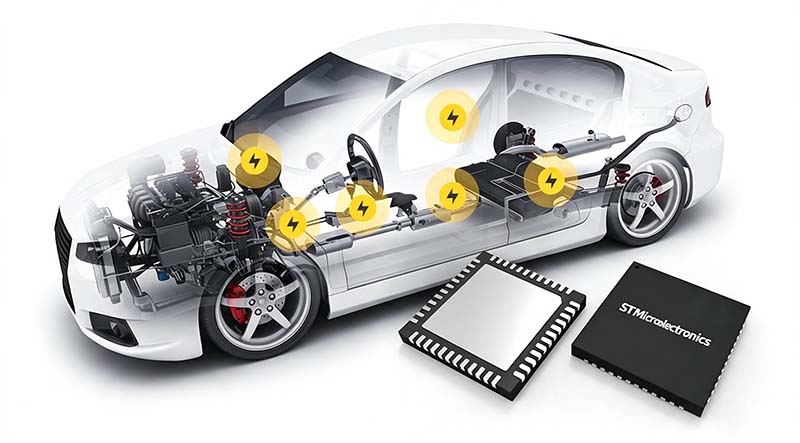
STMicroelectronics - MCUs, Power Semiconductors, MEMS
STMicroelectronics offers a broad range of automotive products, including automotive STM32 MCUs, power semiconductors, SiC devices, MEMS sensors, analog chips, and automotive body electronics.
Onsemi - Power Semiconductors, Sensors
onsemi has strong capabilities in automotive power electronics and image sensors, making its products particularly well suited to electric vehicles and ADAS applications. Its portfolio includes SiC power devices, MOSFETs, power modules, and automotive image sensors.
NVIDIA - AI Computing for Autonomous Driving
NVIDIA focuses primarily on high-performance automotive computing, autonomous driving chips, and AI. Its GPUs, CPUs, and AI acceleration platforms provide the computing power required for autonomous driving and ADAS applications.
The Best Automotive Grade Chips & Distributor Online
The NXP S32K344 is a 32-bit automotive MCU based on the Arm Cortex-M7 core, designed for vehicle control, body electronics, zone controllers, and battery management systems. It supports functional safety up to ASIL D and is AEC-Q100 Grade 1 qualified.
The SPC58NH92C5 is a high-performance automotive MCU from STMicroelectronics with a triple-core architecture running at up to 200 MHz. It integrates large Flash and SRAM resources and supports applications requiring advanced processing performance and automotive reliability.
The TPS653860 is an automotive power management IC designed for safety-relevant applications from Texas Instruments. It supports a 2.3 V to 36 V input range, multiple regulated outputs, diagnostics, and functional-safety features for automotive processors and control systems.
The NCV7729 is an intelligent H-bridge driver designed by onsemi for DC and stepper motor control in automotive applications. It integrates current control, short-circuit protection, thermal shutdown, and diagnostic functions, making it suitable for safety-critical automotive motor systems.
SAMSUNG
KLM8G1GEUF-B04P
K4F6E3S4HM-THCL
K3KL9L90QM-MHCT
K3KL3L30QM-JHCT
They are automotive memory solutions designed to support the demanding requirements of modern vehicle electronics. Covering embedded storage and high-speed DRAM technologies, these memory devices can support applications such as intelligent cockpits, ADAS, infotainment, and automotive computing systems, providing reliable data storage and high-speed memory performance for vehicles.
Why Are Automotive Chips in Short Supply?
The shortage of automotive chips is not caused by a single factor. It results from a combination of rapidly growing demand, long manufacturing cycles, complex supply chains, and stringent automotive-grade certification requirements. As vehicles become increasingly electrified, intelligent, and connected, the number of semiconductors used in each vehicle continues to rise, putting greater pressure on the automotive chip supply chain.
Growing Demand for Electronic Products:
As markets for smartphones, computers, servers, consumer electronics, and new energy vehicles continue to expand, global demand for MCUs, memory, power semiconductors, and analog chips is also increasing. When multiple industries compete for the same wafer manufacturing and packaging and testing capacity, the supply of automotive chips can come under pressure.
Growing Demand for AI:
The rapid development of generative AI and data centers is driving demand for GPUs, AI accelerators, HBM, advanced logic chips, and related power management devices. These products compete for wafer fab capacity, advanced packaging, equipment, and supply chain resources, adding pressure to the overall semiconductor supply chain.
Complex Automotive Chip Manufacturing:
Automotive chips must meet requirements for high reliability, wide operating temperature ranges, and long-term stable operation. Their manufacturing and testing processes are generally more stringent than those for ordinary consumer chips. In addition, automotive chips have long product lifecycles, requiring manufacturers to maintain specific processes and product supply for extended periods, making production capacity adjustments less flexible than in the consumer electronics industry.
Difficult Automotive-Grade Certification:
Automotive chips must undergo rigorous reliability testing and quality qualification. For example, many automotive ICs need to meet requirements such as AEC-Q100. The process from chip design and wafer fabrication to validation, qualification, and mass production can take a long time. When market demand suddenly increases, suppliers find it difficult to rapidly expand qualified production capacity in the short term.
As new energy vehicles, ADAS, intelligent cockpits, and software-defined vehicles continue to develop, this imbalance between supply and demand will continue to affect the automotive semiconductor market.
Final word, as vehicles continue to evolve toward greater electrification and intelligence, semiconductor selection is becoming an increasingly strategic part of automotive electronic design. The best automotive grade chips are not necessarily those with the highest specifications, but those that offer the right balance of performance, reliability, compatibility, and availability for a specific system. Choose a trusted automotive-grade chip distributor for professional product selection support, a reliable supply chain, and flexible purchasing solutions. Reduce procurement costs and supply risks while efficiently meeting the chip requirements of your automotive electronics projects.
Related information
- 2026.07.19 What is GDDR Memory?


- 2026.05.05 What are Inertial Measurement Units?

- 2026.04.08 What Types of Sensors Used in Drones?