

Available 24/7 at
+86 13632816717

What are The Radio Components of a Circuit?
Radio technology is a fundamental part of modern communication systems, enabling wireless transmission across a wide range of applications. From basic circuit elements to more advanced modules, each radio electronics equipment plays a specific role in ensuring stable and efficient signal processing. In this article, we will break down the key components of a radio system, how they function together, and discuss how to select the right radio components for modern advanced electronic systems.
What are the Radio Components of a Circuit?
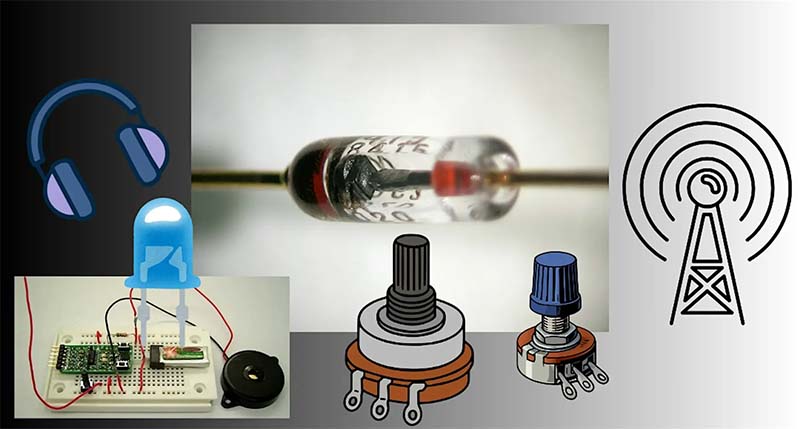
Radio components are the electronic components used in radio frequency (RF) circuits to generate, transmit, receive, filter, amplify, and process radio signals. These components work together to enable wireless communication in devices such as radios, smartphones, Wi-Fi routers, Bluetooth devices, GPS receivers, and IoT equipment.
Transmitter Circuit
Generates and sends radio frequency (RF) signals through an antenna. It converts electrical signals into electromagnetic waves for wireless communication.
Receiver Circuit
Receives RF signals from an antenna and converts them into usable electrical signals. It extracts the transmitted information for further processing.
Filter Circuit
Removes unwanted frequencies and noise while allowing the desired signal to pass. It improves signal quality and reduces interference.
Amplifier Circuit
Increases the strength of weak RF or electrical signals without changing the information they carry. It helps improve transmission range and reception sensitivity.
Demodulator Circuit
Recovers the original voice, data, or video from a modulated RF signal. It converts the received carrier signal back into useful information.
Oscillator Circuit
Generates a stable RF carrier frequency used for transmitting and receiving signals. It provides the timing and frequency reference for the radio system.
Modulator Circuit
Combines the carrier wave with voice, data, or video signals before transmission. It prepares the information for wireless communication.
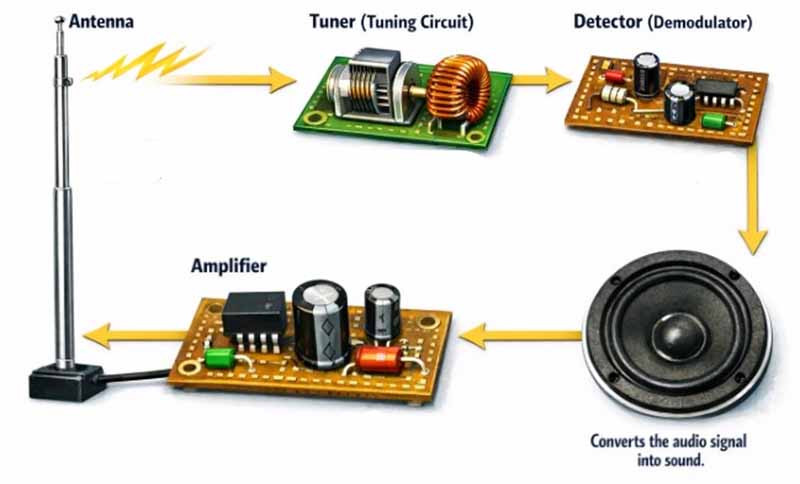
Different functional modules work together through electrical signals, and the implementation of these modules is achieved by a series of the electronic components of a radio system.
1. Signal Generation and Oscillation SectionCrystal Oscillator
Voltage Controlled Oscillator (VCO)
Phase-Locked Loop (PLL) Synthesizer
Function generator-related circuits
2. RF Front-End
Antenna
RF Filter / Band-pass Filter
RF Amplifier
Low Noise Amplifier (LNA)
3. Modulation and Demodulation Circuits
Modulator
Demodulator
Mixer
Intermediate Frequency (IF) Amplifier
4. Signal Processing and Control Core
Microcontroller Unit (MCU)
Digital Signal Processor (DSP)
RF Transceiver IC
Analog-to-Digital Converter (ADC)
Digital-to-Analog Converter (DAC)
5. Power Amplification and Output Stage
Power Amplifier (PA)
Driver Amplifier
Impedance Matching Network
6. Power Management Section
Voltage Regulator (LDO / DC-DC Converter)
Power Management IC (PMIC)
Decoupling Capacitors
Inductors and Ferrite Beads
7. Auxiliary and Protection Components
Resistors
Capacitors
Diodes
ESD Protection Devices
Transistors (BJTs / MOSFETs)
How Do Radio Components Work?
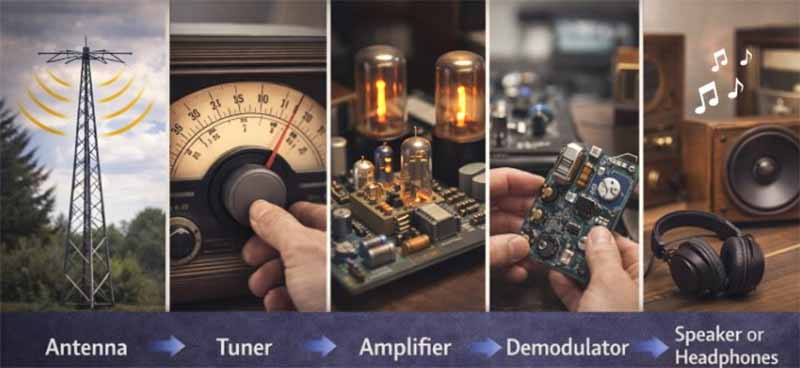
Radio components work together to transmit and receive wireless signals. During transmission, an oscillator generates a stable radio frequency (RF) carrier, while a modulator combines it with voice, data, or other information. The signal is then strengthened by an amplifier, cleaned by a filter, and transmitted into the air through an antenna.
On the receiving side, the antenna captures the incoming RF signal. A filter removes unwanted frequencies and interference, and an amplifier boosts the weak signal. Finally, a demodulator extracts the original information, such as audio or digital data, which is then sent to the device for processing.
Applications of Radio Electronics
Radio electronics are widely used in modern wireless communication and electronic systems. They enable devices to transmit, receive, and process radio frequency (RF) signals efficiently across a wide range of industries.
Wireless Communication:
Smartphones, 4G/5G networks, Wi-Fi, and Bluetooth devices. Radio circuit components enable stable signal transmission and reception in wireless communication devices.
Broadcasting:
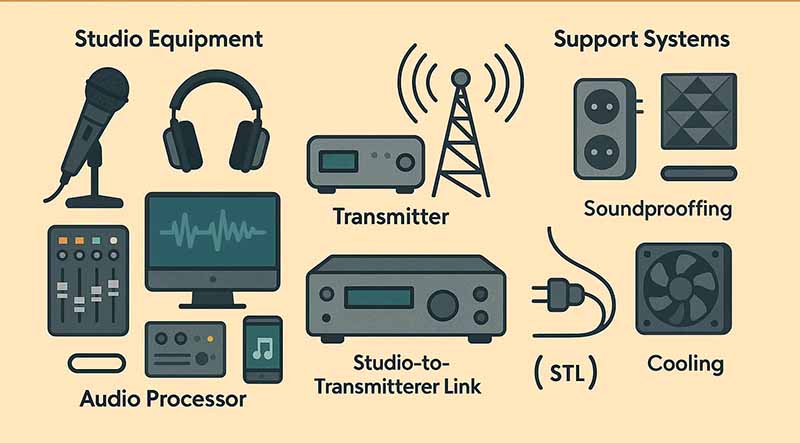
AM/FM radio and television transmission systems. Specialized radio electronic components process and modulate frequency signals for radio and TV broadcasting.
Internet of Things (IoT):
Smart homes, wearable devices, industrial sensors, and connected appliances. Miniature radio components support low-power wireless data transmission for IoT sensors and smart devices.
Automotive Electronics:
Vehicle navigation, keyless entry, radar, and vehicle-to-everything (V2X) communication. Radio system components serve vehicle wireless communication, navigation and remote monitoring functions. They improve driving safety by stabilizing vehicle signal reception and anti-interference performance.
Aerospace & Defense:
Radar systems, avionics, military communications, and electronic warfare. High-precision radio electronic equipment provides stable wireless communication and radar signal processing for aerospace and military systems.
Medical Equipment:
Wireless patient monitoring, medical telemetry, and remote healthcare devices. Integrated radio components support wireless data transmission for medical monitoring and portable medical devices.
Industrial Automation:
Wireless monitoring, remote control systems, and factory automation. Radio circuit components realize wireless signal control and data feedback for industrial automation equipment.
Radio electronic components play a important role in enabling reliable wireless connectivity and high-frequency signal processing.
How to Select Radio Components
The best radio components balance frequency performance, power handling, signal quality, reliability, and cost. By matching component specifications to your application requirements, you can build stable and efficient RF systems.
1. Define the Operating Frequency
Choose components that support your target RF frequency band, such as HF, VHF, UHF, or microwave frequencies.
2. Consider Power Requirements
Ensure amplifiers, transistors, and other RF components can handle the required transmit power and signal levels without distortion.
3. Check Signal Performance
Evaluate key specifications such as gain, noise figure, bandwidth, insertion loss, and linearity to achieve reliable signal transmission and reception.
4. Ensure Impedance Matching
Most RF circuits use 50 Ω or 75 Ω impedance. Proper impedance matching minimizes signal reflection and maximizes power transfer.
5. Evaluate Environmental Conditions
Select components that can operate reliably within the required temperature range, humidity, vibration, and other environmental conditions.
6. Verify Package and PCB Compatibility
Choose package types and footprints that fit your PCB layout while considering thermal performance and assembly requirements.
7. Select Reliable Manufacturers
Purchase RF components from reputable manufacturers or authorized distributors to ensure consistent quality, long-term reliability, and technical support.
Where to Buy Quality Radio Components
Once you've identified the right radio components for your application, choosing a trusted supplier becomes just as important as the selection process itself. A reliable partner can offers genuine products, stable supply, broad inventory, and dependable technical support.
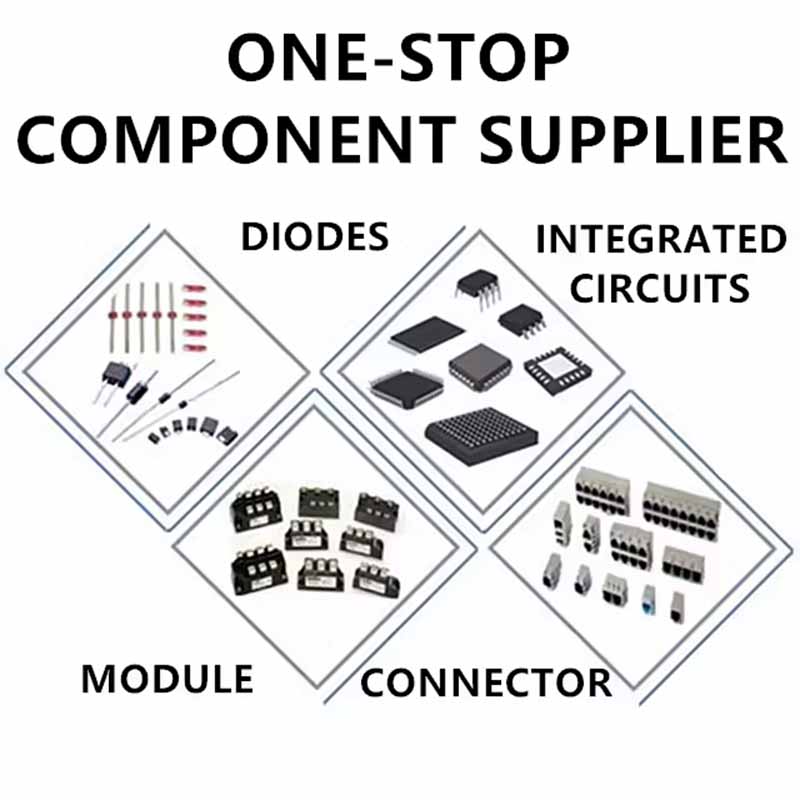
Eastech provides a comprehensive range of electronic components to support radio frequency and embedded system designs, including:
- RF and radio components
- Integrated circuits (IC)
- RF transistors and RF IC
- Amplifiers and oscillators
- Capacitors, resistors, and inductors
- Diodes and transistors
- Connectors and other passive components
- Memory and storage devices
We source components from leading global manufacturers and offer reliable supply, competitive pricing, and professional support for OEM, ODM, distributors, and electronics manufacturers. Whether you need components for prototyping or equipment manufacturing, Eastech provides a one-stop sourcing solution to help keep your projects moving.
Overall, radio circuit design is all about how different electronic blocks interact to achieve stable wireless communication. A clear view of the main components of a radio system also helps improve design efficiency and overall circuit reliability in practical use. Once you understand radio electronics equipment in a system context, it becomes clearer what are the radio components of a circuit and how each part contributes to signal generation, processing, and output. Every application may require a different balance of performance, power consumption, and integration level, which makes component selection an important step in the design process.
Related information
- 2026.09.20 What is Ceramic Packaging Chip?
- 2026.09.13 What is SMD Resistor?
- 2026.09.06 What is Bus Interface IC?

- 2026.08.30 How to Select Supercapacitor?