
Available 24/7 at
+86 13632816717

What is a Quartz Crystal Oscillator?
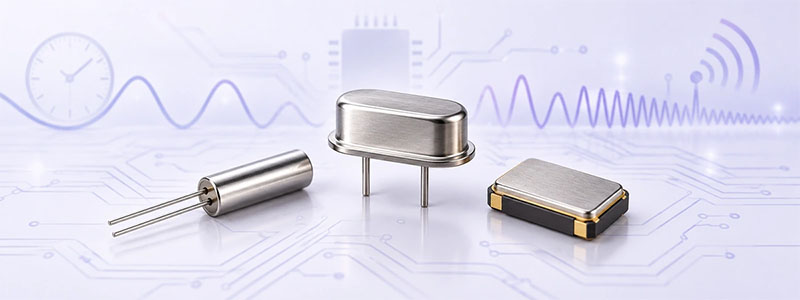
Quartz crystal oscillators are essential timing components in modern electronic systems, providing stable and precise frequency signals for a wide range of applications. From microcontrollers and communication equipment to embedded systems and automotive electronics, these components help maintain accurate timing and synchronized system operation. This article explores what are crystal oscillators used for, how quartz crystal oscillators work and their applications in electronic designs.
What is a Quartz Crystal Oscillator?
A quartz crystal oscillator is an electronic component that uses the mechanical resonance of a quartz crystal to generate a stable electrical signal at a specific frequency. It serves as a reliable timing and frequency reference in electronic circuits, helping synchronize digital operations, maintain communication timing, and support accurate signal processing.
Quartz crystal oscillators operate based on the piezoelectric effect of quartz. When an alternating electrical voltage is applied to the crystal, it produces mechanical vibrations at a characteristic resonant frequency. These vibrations interact with the oscillator circuit to sustain a periodic electrical signal. Because quartz has excellent frequency stability and a high quality factor (Q factor), it can maintain a consistent output frequency under suitable operating conditions.
In electronic systems, quartz crystal oscillators are widely used in microcontrollers, microprocessors, communication equipment, networking devices, industrial control systems, automotive electronics, and consumer electronics. They provide the stable clock signals required for data transmission, processor synchronization, frequency synthesis, and other timing-sensitive operations.
How Does a Quartz Crystal Oscillator Work?
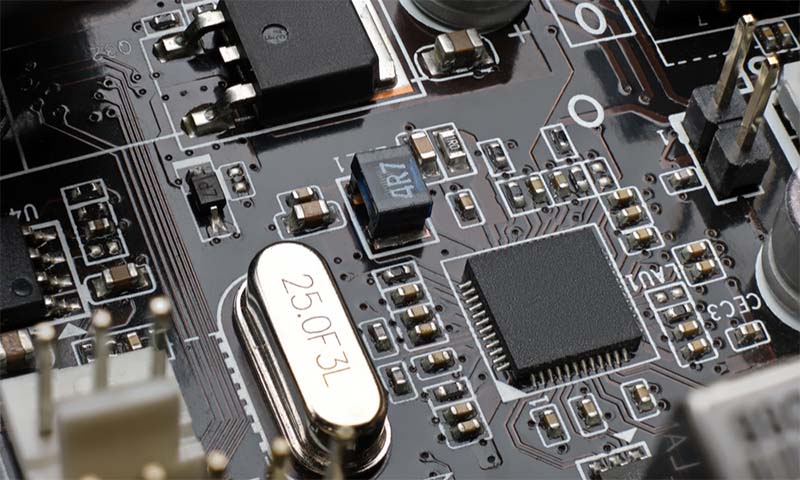
A quartz crystal oscillator works by combining the piezoelectric properties of a quartz crystal with an electronic feedback circuit to generate a stable periodic signal at a specific frequency. Its operation depends on the crystal's mechanical resonance, which provides a precise frequency reference for electronic systems.
When an alternating voltage is applied across the electrodes of a quartz crystal, the piezoelectric effect causes the crystal to expand and contract mechanically. At its resonant frequency, the crystal vibrates efficiently and exhibits a sharp electrical response. The oscillator circuit uses this resonant behavior to sustain continuous oscillations, producing a stable electrical output signal.
The frequency stability of a quartz crystal oscillator is influenced by factors such as temperature, load capacitance, aging, drive level, and circuit design. Depending on system requirements, different oscillator designs incorporate additional compensation or control mechanisms to improve frequency accuracy under varying operating conditions.
What Are Crystal Oscillators Used for in Microelectronics?
In microelectronics, quartz crystal oscillators provide stable frequency references for integrated circuits (ICs), semiconductor devices, and high-speed digital systems. They play a critical role in clock generation, timing control, data synchronization, and communication interface operation.
1. Clock Generation for Microcontrollers and SoCs
Microcontrollers (MCUs) and system-on-chip (SoC) devices rely on clock signals to coordinate instruction execution, peripheral operations, and internal data transfers. Quartz crystal oscillators can serve as external reference sources for clock-generation circuits, including phase-locked loops (PLLs), which generate the internal clock frequencies required by different functional blocks.
In embedded processors and application-specific integrated circuits (ASICs), the stability of the reference clock influences system timing accuracy and can affect the performance of communication interfaces and other timing-sensitive functions.
2. FPGA and Programmable Logic Systems
Field-programmable gate arrays (FPGAs) and programmable logic devices use clock signals to synchronize sequential logic, data-processing pipelines, memory controllers, and high-speed interfaces. Quartz crystal oscillators commonly provide external reference clocks for FPGA development boards, embedded computing platforms, and programmable digital systems.
The reference clock may feed internal clock-management resources, such as PLLs or mixed-mode clock managers, to generate multiple clock domains at different frequencies. In designs involving high-speed serial transceivers, clock stability and phase noise must be considered alongside the transceiver's reference-clock specifications. The oscillator itself does not perform the FPGA's logic operations; instead, it provides a timing reference that supports coordinated circuit operation.
3. High-Speed Communication ICs and Networking Chips
Communication ICs, Ethernet controllers, network processors, and wireless transceivers require accurate reference frequencies for signal transmission and reception. Quartz crystal oscillators provide reference signals used by frequency synthesizers, PLLs, and clock-recovery-related circuits, depending on the device architecture.
In Ethernet, Wi-Fi, cellular communication, and optical networking equipment, oscillator performance can influence carrier-frequency accuracy, clock jitter, and the overall timing budget. Applications with demanding phase-noise or jitter requirements may use specialized clock oscillators or reference-clock solutions designed for high-speed interfaces.
4. Analog-to-Digital and Digital-to-Analog Converters
Analog-to-digital converters (ADCs) and digital-to-analog converters (DACs) depend on clock signals to control sampling and conversion timing. In ADC applications, clock jitter can contribute to sampling uncertainty and degrade signal-to-noise performance, particularly when measuring high-frequency input signals.
Quartz crystal oscillators can serve as reference sources for clock-generation circuits that supply these converters with suitable sampling clocks. The required oscillator characteristics depend on the converter's sampling rate, clock architecture, signal bandwidth, and performance targets.
5. Memory Interfaces and Digital Processing Systems
Processors, memory controllers, and digital processing ICs use clock signals to coordinate data transfers and internal operations. Crystal oscillators may provide reference clocks for the clock-generation circuits that support these functions, particularly in embedded computing platforms and specialized digital systems.
In designs using DDR memory, high-speed serial interfaces, or other timing-sensitive interconnects, the complete clock architecture must satisfy the relevant timing and signal-integrity requirements.
6. Wireless RF ICs and Frequency Synthesizers
Radio-frequency (RF) integrated circuits use reference-frequency signals to generate or control local oscillator frequencies for wireless transmission and reception. Quartz crystal oscillators can supply reference inputs to PLL-based frequency synthesizers, which derive the operating frequencies required by RF transceivers and other radio components.
Reference-frequency accuracy and phase noise are important considerations in applications such as wireless connectivity, satellite navigation, and RF communication modules.
7. Timing ICs and Clock Distribution Networks
Dedicated timing ICs, clock generators, and clock-buffer devices use reference inputs to generate and distribute clock signals throughout complex electronic systems. Quartz crystal oscillators can provide the reference frequency for these devices, which then produce the required clock outputs for processors, FPGAs, communication chips, and other integrated circuits.
In multi-clock-domain systems, clock distribution design must account for output frequency, jitter, skew, synchronization, and electrical loading.
Overall, quartz crystal oscillator used for generating a periodic signal: they support the timing architecture that enables integrated circuits to process data, communicate, and operate in a coordinated manner.
MEMS Oscillator vs. Quartz Crystal Oscillator
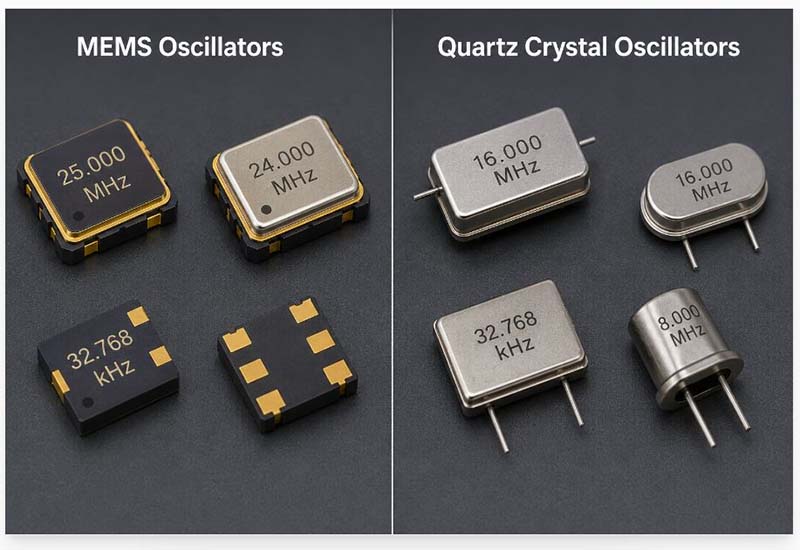
Quartz Oscillator: Relies on the piezoelectric effect of synthetic quartz wafer. Mechanical resonance of the crystal defines frequency.
MEMS Oscillator (Silicon Oscillator): Uses micromachined silicon resonant structure on silicon die. Frequency is controlled and calibrated by internal CMOS circuitry.
|
Type |
Quartz Crystal Oscillator |
MEMS Oscillator (Silicon Oscillator) |
|
Frequency Stability |
Excellent. TCXO down to ppb level; standard XO ±20~100 ppm. |
Good, usually ±10~±50 ppm; high-grade MEMS can reach ±0.5 ppm, but cannot reach OCXO ppb performance. |
|
Phase Noise / Jitter |
Superior, low phase noise, very low jitter. Better for high-speed serial links (PCIe, SerDes). |
Acceptable for most applications; jitter is generally higher than premium quartz. |
|
Temperature Drift |
AT-cut quartz has a well-known parabolic temperature curve; TCXO compensates it. |
Silicon resonator has steeper temperature drift, fully corrected by on-chip digital compensation. |
|
Shock & Vibration Resistance |
Poor. Quartz wafer is brittle; heavy shock/vibration may cause frequency shift or damage. |
Very good. Silicon MEMS structure is robust, high shock/vibration tolerance, ideal for rugged industrial, aerospace. |
|
Size & Packaging |
Small SMD available, but quartz is a separate die inside package. |
Ultra-small, single-chip solution (resonator + CMOS in one silicon die); supports tiny packages. |
|
Frequency Range |
32.768 kHz ~ ~200 MHz fundamental; overtone up to hundreds of MHz. |
Wide range: kHz up to GHz directly, easy for high-frequency clock. |
|
Power Consumption |
Low for standard quartz; 32.768kHz RTC crystal is ultra-low power. |
Slightly higher power than quartz, especially high-frequency MEMS. RTC MEMS power is higher than 32.768kHz quartz. |
|
Common Brands |
Kyocera, Epson, NDK, KDS, TXC, Rakon |
SiTime (market leader), Discera, Microchip MEMS, Abracon MEMS |
Quartz is still the king for ultra-stable, low-jitter, low-power precision timing. MEMS oscillators are a strong alternative, winning on robustness, programmability, supply flexibility and mechanical ruggedness, but cannot beat top-tier quartz on the highest stability and phase noise performance.
What Are the Types of Quartz Oscillators?
Quartz crystal oscillators are available in several types, each designed to meet different requirements for frequency stability, temperature performance, frequency control, and output timing. In microelectronics, the appropriate oscillator depends on the target IC, reference-clock architecture, operating environment, and system-level performance requirements.
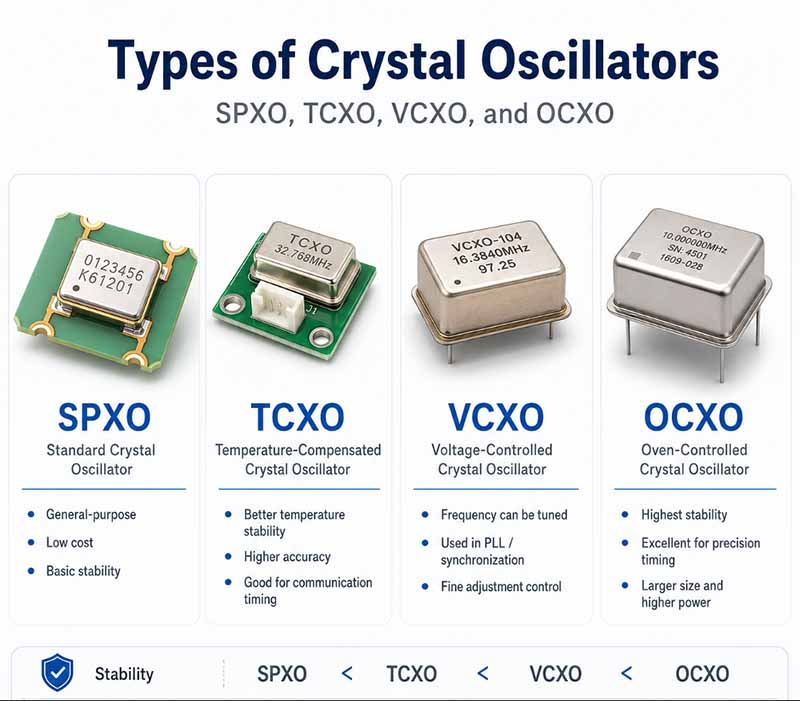
The main types of quartz crystal oscillators include standard crystal oscillators (XO), temperature-compensated crystal oscillators (TCXO), voltage-controlled crystal oscillators (VCXO), oven-controlled crystal oscillators (OCXO), and digitally controlled crystal oscillators (DCXO).
1. Standard Crystal Oscillator (XO)
For general-purpose timing applications, standard crystal oscillators (XOs) provide a reliable and cost-effective frequency reference. Each device combines a quartz resonator with an electronic oscillation circuit to generate a periodic output signal at a specified frequency, without requiring specialized temperature compensation or frequency-control functions.
XOs are widely used in microcontrollers, embedded processors, FPGA boards, Ethernet controllers, storage devices, and general-purpose digital circuits. Depending on the device, they are available in different frequencies, package sizes, supply voltages, and output formats, including CMOS and other logic-level outputs.
2. Temperature-Compensated Crystal Oscillator (TCXO)
When an application requires improved frequency stability across changing ambient temperatures, temperature-compensated crystal oscillators (TCXOs) offer an effective solution. They incorporate a compensation mechanism that reduces frequency variations caused by temperature changes, providing better stability than a typical uncompensated oscillator.
TCXOs are commonly used in wireless communication modules, GNSS receivers, cellular devices, RF transceivers, and precision timing circuits. In these applications, maintaining a stable reference frequency helps support accurate frequency synthesis and reliable wireless communication.
3. Voltage-Controlled Crystal Oscillator (VCXO)
Frequency adjustment is essential in systems that must synchronize a local clock with an external timing reference. Voltage-controlled crystal oscillators (VCXOs) address this requirement by allowing the output frequency to be adjusted within a limited range through an applied control voltage.
VCXOs are frequently used in phase-locked loops (PLLs), clock synchronization circuits, digital video systems, telecommunications equipment, and selected high-speed data interfaces. Their pull range, tuning sensitivity, phase noise, and control characteristics are important selection parameters for clock-recovery and synchronization applications.
4. Oven-Controlled Crystal Oscillator (OCXO)
For applications demanding exceptionally high frequency stability, oven-controlled crystal oscillators (OCXOs) maintain the quartz crystal near a selected operating temperature using a temperature-controlled enclosure. This approach minimizes the effects of ambient temperature fluctuations and enables highly stable frequency output.
OCXOs are commonly found in telecommunications infrastructure, precision test and measurement instruments, frequency standards, radar systems, and other demanding timing applications. Compared with standard XOs, they generally consume more power, require more space, and have longer warm-up times, making them better suited to systems where frequency stability takes priority over size and power consumption.
5. Digitally Controlled Crystal Oscillator (DCXO)
Digital frequency adjustment provides another approach to managing oscillator performance. Digitally controlled crystal oscillators (DCXOs) use digital control signals or adjustment circuitry to tune or correct their output frequency. Depending on the implementation, the control mechanism may adjust the crystal's effective load conditions or use other electronic techniques to achieve frequency correction.
DCXOs can be found in selected wireless devices, digital communication systems, and timing applications that require electronically managed frequency adjustment. Their control resolution, tuning range, interface, and correction behavior depend on the specific device architecture.
6. Spread-Spectrum Crystal Oscillator
Electromagnetic interference (EMI) is an important consideration in dense digital circuits and high-speed electronic systems. Spread-spectrum crystal oscillators address this challenge by intentionally modulating the output frequency within a defined range, distributing clock energy across a wider frequency band and potentially reducing peak EMI emissions.
These oscillators are used in computing platforms, display electronics, digital interfaces, and other systems where electromagnetic compatibility is a key design consideration. Because the output frequency is intentionally modulated, designers must verify that the modulation profile and frequency deviation are compatible with the receiving ICs and interface timing requirements.
Leading Quartz Crystal Oscillator Manufacturers
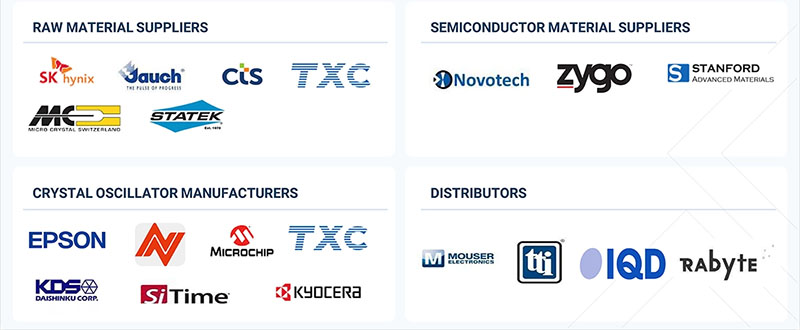
The quartz crystal oscillator market includes established manufacturers offering frequency-control components for consumer electronics, industrial systems, automotive electronics, telecommunications, and high-speed digital applications. These companies develop a range of crystal oscillators and resonators with different frequency ranges, stability characteristics, package options, and operating specifications.
KYOCERA Corporation, through its crystal device business, is a recognized supplier of quartz crystal resonators and crystal oscillators. Its product portfolio serves applications across communication equipment, automotive electronics, industrial systems, and other electronic devices.
KYOCERA's timing components support frequency generation and clock-reference requirements in compact electronic designs.
2. Seiko Epson Corporation
Seiko Epson Corporation is an established manufacturer of quartz crystal devices and timing components, including crystal oscillators and temperature-compensated oscillators. Its products are used in consumer electronics, communication equipment, industrial control systems, and automotive applications.
The company's portfolio addresses applications requiring compact packages, stable frequency output, and dependable timing performance. Its oscillator solutions are relevant to embedded computing platforms, wireless modules, and precision electronic circuits.
3. Nihon Dempa Kogyo Co., Ltd. (NDK)
NDK specializes in quartz crystal devices, crystal oscillators, frequency synthesizers, and related frequency-control technologies.
NDK's broad product range includes standard crystal oscillators and specialized frequency-reference solutions. These components are used in communication systems and digital electronic platforms where frequency stability and reliable timing are important design considerations.
TXC Corporation is a major manufacturer of frequency-control components, including quartz crystals, crystal oscillators, and temperature-compensated oscillators.
With offerings for different package sizes and operating requirements, TXC serves applications ranging from general-purpose clock generation to communication-related timing. Its components can be considered for designs involving microcontrollers, communication modules, and digital processing systems.
5. Murata Manufacturing Co., Ltd.
Murata Manufacturing is a prominent electronic components supplier with products spanning passive components, ceramic technologies, and timing-related devices. Its frequency-control portfolio includes crystal devices used in compact electronic systems.
Murata components are relevant to applications such as mobile electronics, wireless connectivity, automotive systems, and industrial equipment.
Microchip Technology provides timing and frequency-control solutions through its oscillator and precision-timing product lines, including technologies associated with Microsemi and Vectron International.
Its portfolio addresses applications such as telecommunications, networking, industrial systems, and precision instrumentation. Depending on the product family, available solutions may include crystal-based oscillators and specialized reference-clock components designed for demanding frequency-stability, jitter, or synchronization requirements.
Source Quartz Crystal Oscillators at Eastech
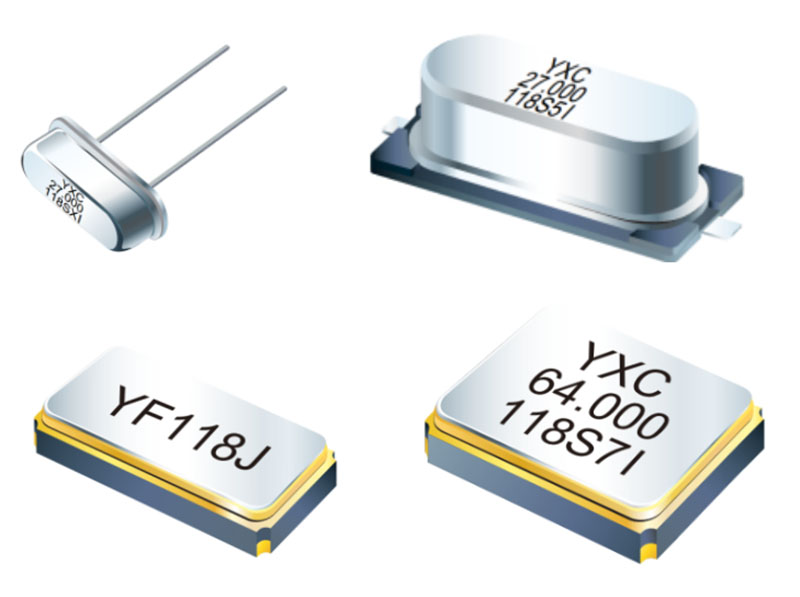
For manufacturers, engineering teams, and electronic component buyers, access to dependable component supply is equally important for product development and production continuity.
Eastech specializes in electronic component distribution, supporting customers sourcing semiconductor devices, integrated circuits (ICs), timing components, and other electronic parts for industrial, communication, automotive, and embedded system applications. Our supply advantages include access to a broad range of electronic components, support for sourcing specific part numbers, and solutions tailored to different procurement requirements.
Finally, understanding the different types of quartz oscillator, including XO, TCXO, VCXO, and OCXO, helps engineers evaluate frequency stability, temperature performance, and control requirements for specific designs. As a reliable electronic component distributor, Eastech supports customers with electronic component sourcing solutions for a wide range of semiconductor and timing applications. Contact Eastech to discuss your sourcing requirements and find suitable components for your projects.