

Available 24/7 at
+86 13632816717

What Are RF Amplifiers?
From mobile networks and satellite communications to radar and test equipment, different types of RF amplifiers serve specific performance requirements. An RF power amplifier is particularly important in transmission systems, where it boosts signal power to drive antennas and extend communication range. This article discusses what RF amplifiers are, how they work, and the applications of RF amplifier ICs.
What Are RF Amplifiers?
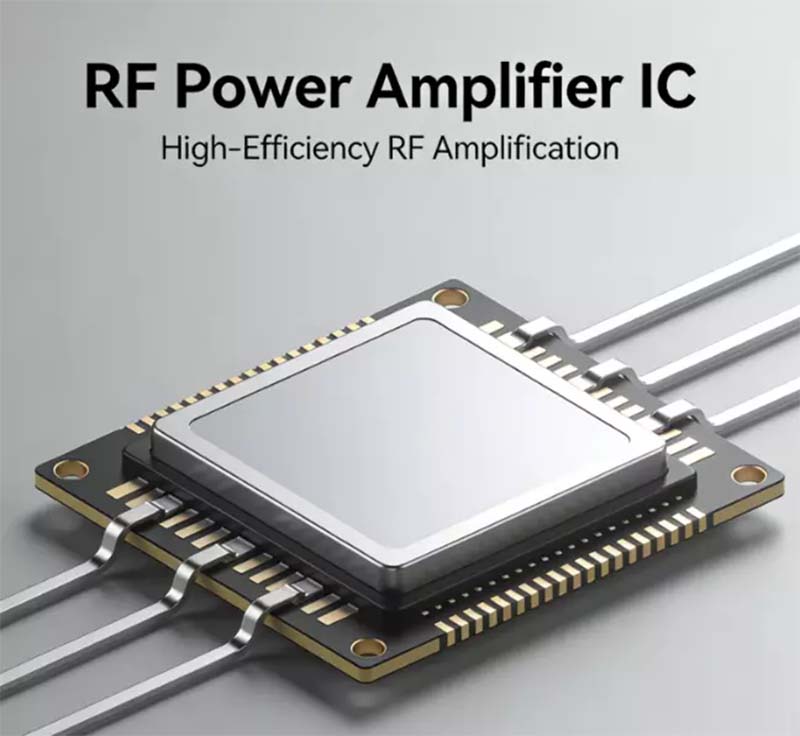
RF amplifiers (Radio Frequency amplifiers) are electronic components designed to increase the power or amplitude of radio frequency signals without significantly altering their original characteristics. They are widely used in wireless communication systems, RF circuits, radar equipment, satellite communications, and other applications that require reliable high-frequency signal transmission and reception.
Operating across a broad range of frequencies, RF amplifier ICs strengthen weak input signals or boost signal power to achieve the required output level. Depending on their position and function within an RF signal chain, they can improve signal reception sensitivity, compensate for transmission losses, and provide sufficient power to drive antennas or other RF circuit stages.
How Do RF Amplifiers Work?
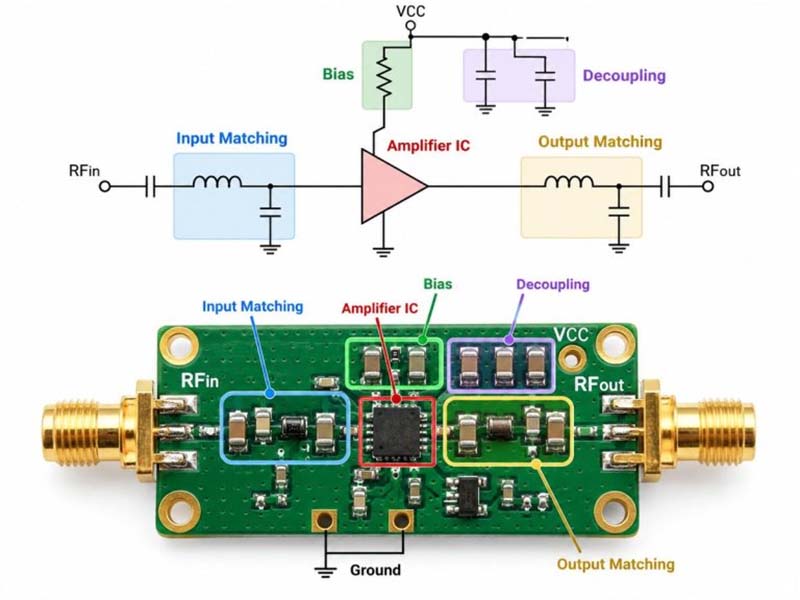
RF amplifiers work by increasing the amplitude or power of radio frequency signals while maintaining their essential signal characteristics, such as frequency and waveform. They use active electronic devices, typically transistors, to control the flow of electrical energy from a power supply and deliver an amplified version of the input RF signal.
The basic three main stages:
1. RF Signal Input: A weak radio frequency signal enters the amplifier through its input terminal. In receiver applications, this may be a signal captured by an antenna.
2. Signal Amplification: The amplifier's active components, such as bipolar junction transistors (BJTs), field-effect transistors (FETs), or GaAs-based devices, use energy from an external power supply to increase the signal amplitude or power.
3. Amplified Signal Output: The amplified RF signal is delivered to the next circuit stage or an antenna, depending on the system design.
In practical RF circuit designs, input and output matching networks are also important. They help establish the required impedance, commonly 50 ohms, to improve power transfer and reduce signal reflections. Additional biasing and filtering circuits may be used to establish proper transistor operating conditions and control unwanted frequencies.
The actual amplification performance depends on several electrical parameters, including gain, operating frequency, noise figure, output power, linearity, and power consumption.
What Are the Different Types of RF Amplifiers?
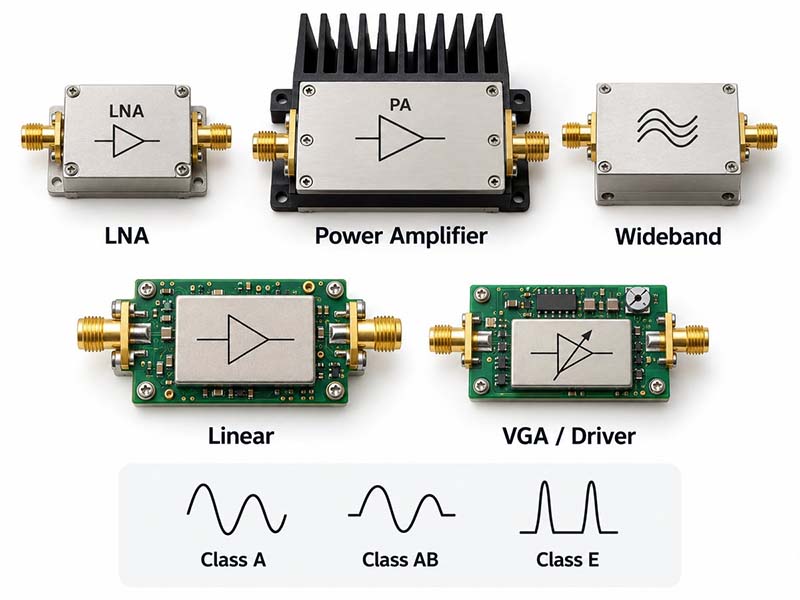
RF amplifiers are generally classified into several types based on functions:
Low Noise Amplifiers (LNAs): Amplify weak incoming RF signals while introducing minimal additional noise, helping preserve signal quality in receiver circuits.
Power Amplifiers (PAs): Increase RF signal power to levels suitable for transmission through antennas or other output stages.
Variable Gain Amplifiers (VGAs): Provide adjustable amplification to accommodate different input signal levels and dynamic operating conditions.
Driver Amplifiers: Boost RF signals to the levels required to drive subsequent power amplifier stages.
Wideband Amplifiers: Support a broad frequency range, making them suitable for RF systems operating across multiple frequency bands.
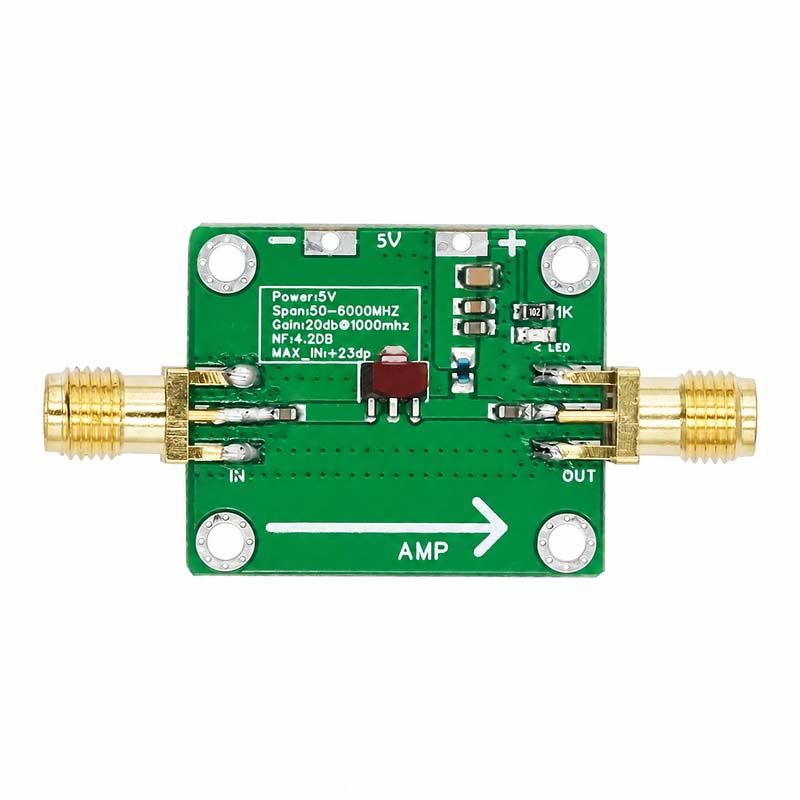
RF amplifier ICs are available in different frequency ranges, gain levels, output power capabilities, noise figures, and package configurations.
For engineers and electronic equipment manufacturers, RF amplifiers are essential electronic components for maintaining signal strength and performance throughout modern RF and wireless communication systems.
Key Specifications of RF Power Amplifier IC
When evaluating RF amplifier ICs for electronic designs, engineers need to consider several electrical and performance specifications. These parameters determine how effectively an amplifier handles RF signals, maintains signal integrity, and meets the operating requirements of a particular application.
The following are some of the most important specifications of RF amplifier IC:
1. Frequency Range
The frequency range defines the range of RF signals that an amplifier can effectively process. It is typically specified in MHz or GHz. Different RF amplifier ICs support different frequency bands, depending on their circuit architecture and intended applications.
For example, some devices are designed for lower-frequency wireless communication, while others operate in microwave and millimeter-wave frequency ranges. The amplifier's operating frequency should cover the target signal band to ensure consistent performance.
2. Gain
Gain measures how much an RF amplifier increases the input signal's power or voltage. For RF amplifier ICs, power gain is commonly expressed in decibels (dB).
Higher gain allows weak signals to reach the required power level for subsequent circuit stages. However, excessive gain can introduce stability challenges, increase distortion, or cause signal saturation.
3. Noise Figure (NF)
Noise figure indicates how much additional noise an amplifier introduces into a signal relative to an ideal noiseless amplifier. It is expressed in decibels (dB).
A lower noise figure is particularly important for low-noise amplifiers (LNAs), which handle weak incoming signals in receiver circuits.
4. Output Power
Output power represents the RF signal power delivered by an amplifier to its load. It is commonly specified in dBm or watts.
5. Linearity
Linearity describes an amplifier's ability to reproduce the input signal without introducing unwanted distortion. It is particularly important in communication systems that process complex modulated signals.
Common linearity parameters include:
- 1 dB Compression Point (P1dB): The input or output power level at which the amplifier's gain decreases by 1 dB from its small-signal value.
- Third-Order Intercept Point (IP3): A measurement used to evaluate the amplifier's susceptibility to third-order intermodulation distortion.
Higher linearity generally helps reduce signal distortion and interference between adjacent frequency channels.
6. Power Consumption and Efficiency
Power consumption indicates the electrical power required by an RF amplifier during operation, while efficiency describes how effectively the device converts DC input power into RF output power.
For RF power amplifiers, Power Added Efficiency (PAE) is an important performance metric. It measures the additional RF output power relative to the DC power consumed by the amplifier, taking input RF power into account.
7. Input and Output Impedance
Input and output impedance determine how an RF amplifier interfaces with surrounding circuit stages. Many RF amplifier ICs are designed for 50-ohm systems, although other impedance configurations are also available.
8. Operating Voltage and Temperature
Operating voltage defines the supply voltage required for an RF amplifier IC to function correctly.
What Are RF Amplifiers Used For?
RF amplifiers are widely used in electronic systems that transmit, receive, and process radio frequency signals. Their primary purpose is to increase signal power or amplitude, allowing RF signals to travel over longer distances, overcome transmission losses, and maintain reliable communication.
From wireless communication networks to radar and satellite equipment, RF amplifier ICs play an important role in modern electronic systems.
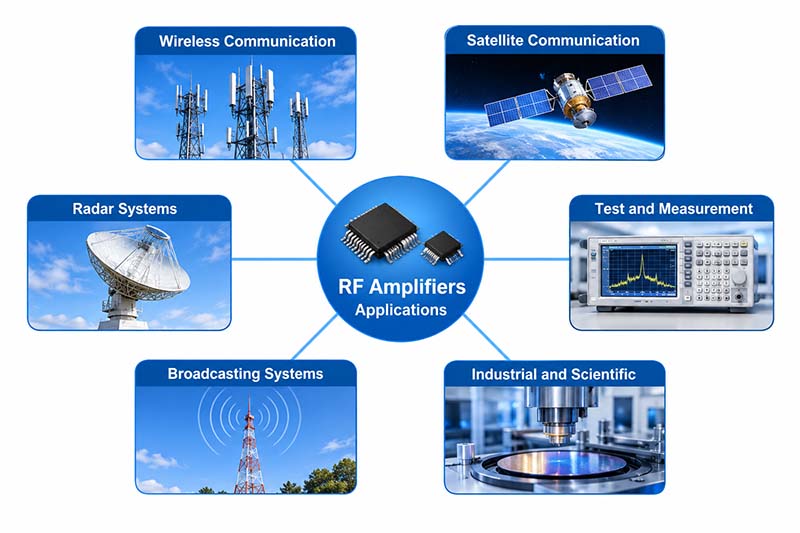
1. Wireless Communication Systems
RF amplifiers are essential components in wireless communication infrastructure, including cellular base stations, 4G LTE, 5G networks, and wireless transceivers.
Power amplifiers boost outgoing RF signals before they reach the antennas, while low noise amplifiers strengthen weak incoming signals received from mobile devices.
2. Satellite Communication
Satellite communication systems rely on RF amplifiers to transmit and receive signals between satellites and ground stations. These amplifiers operate across different frequency bands, including L-band, C-band, Ku-band, and Ka-band.
High power rf amplifiers support signal transmission over long distances, while low-noise amplifiers improve the reception of weak satellite signals. They are commonly used in satellite transponders, ground terminals, and satellite communication equipment.
3. Radar Systems
RF amplifiers are used in radar systems to increase the power of transmitted signals and improve the detection of reflected signals.
Power amplifiers provide the output power required for radar transmission, while low-noise amplifiers process weak echo signals returning from targets. These components are used in weather monitoring, aviation, automotive radar, navigation, and defense systems.
4. Test and Measurement Equipment
RF amplifiers are integrated into various test and measurement instruments, including signal generators, spectrum analyzers, and RF testing systems. They help generate signals at the required power levels or amplify weak signals during measurement and analysis.
5. Broadcasting Systems
Radio and television broadcasting equipment uses RF power amplifiers to increase transmission signal power before broadcasting signals through antennas. These amplifiers support AM, FM, and digital broadcasting systems, helping deliver RF signals across designated coverage areas.
6. Industrial and Scientific Equipment
RF amplifiers are also used in industrial and scientific applications that require controlled high-frequency energy. Examples include plasma generation, semiconductor manufacturing, and material processing. In these systems, RF power amplifiers provide the necessary signal power to drive specialized loads and support high-frequency processing operations.
RF amplifiers serve different functions across communication, broadcasting, radar, testing, and industrial systems. Depending on the application, engineers select suitable RF amplifier ICs based on frequency range, gain, output power, noise figure, linearity, and efficiency.
RF Amplifiers from Analog Devices
Analog Devices (ADI) is a major semiconductor manufacturer offering a broad portfolio of RF amplifier ICs for wireless communication, microwave systems, radar, instrumentation, and other high-frequency applications.
Analog Devices RF amplifiers are designed to support different stages of RF signal chains, including low-noise signal reception, intermediate signal amplification, and high-power transmission. Its product portfolio includes LNAs, power amplifiers, gain blocks, variable gain amplifiers, and broadband amplifiers.
|
Part Number |
Device Type |
BRAND |
|
HMC451LC3TR |
Medium Power Amplifier |
Analog Devices |
|
HMC516LC5TR |
Low Noise Amplifier (LNA) |
Analog Devices |
|
ADL5562ACPZ-R7 |
RF/IF Differential Amplifier |
Analog Devices |
|
ADL5565ACPZ-R7 |
RF/IF Differential Amplifier |
Analog Devices |
|
ADPA7002AEHZ-R7 |
Power Amplifier (PA) |
Analog Devices |
|
HMC519LC4TR |
Low Noise Amplifier (LNA) |
Analog Devices |
|
HMC1114 |
GaN Power Amplifier |
Analog Devices |
|
HMC407MS8GE |
Power Amplifier (PA) |
Analog Devices |
|
HMC308ETR |
RF Gain Block / Driver Amplifier |
Analog Devices |
|
AD603AQ |
Variable Gain Amplifier (VGA) |
Analog Devices |
|
AD8368ACPZ-WP |
Variable Gain Amplifier (VGA) |
Analog Devices |
|
HMC311LP3 |
Gain Block Amplifier |
Analog Devices |
|
ADL5545ARKZ-R7 |
RF/IF Gain Block |
Analog Devices |
|
ADL8122ACPZN |
Low Noise Amplifier (LNA) |
Analog Devices |
|
HMC593LP3E |
Low Noise Amplifier (LNA) |
Analog Devices |
|
HMC618ALP3E |
Low Noise Amplifier (LNA) |
Analog Devices |
|
AD8352ACPZ-R7 |
RF/IF Differential Amplifier |
Analog Devices |
|
ADL8104ACPZN |
Low Noise Amplifier (LNA) |
Analog Devices |
|
ADL8121ACPZN |
Low Noise Amplifier (LNA) |
Analog Devices |
|
HMC1082ALP4E |
Medium Power Amplifier |
Analog Devices |
|
HMC462 |
Distributed Low Noise Amplifier |
Analog Devices |
|
HMC463 |
Distributed Variable Gain Amplifier |
Analog Devices |
|
HMC8412LP2FETR |
Low Noise Amplifier (LNA) |
Analog Devices |
|
AD8369ARUZ-REEL7 |
Variable Gain Amplifier (VGA) |
Analog Devices |
|
ADL8130 |
Low Noise Amplifier (LNA) |
Analog Devices |
|
ADL7075 |
Low Noise Amplifier (LNA) |
Analog Devices |
|
ADPA9005 |
Power Amplifier (PA) |
Analog Devices |
|
ADPA1120 |
Power Amplifier (PA) |
Analog Devices |
|
HMC3587 |
Gain Block Amplifier |
Analog Devices |
|
ADL6332 |
Variable Gain Amplifier (VGA) |
Analog Devices |
|
ADPA1112 |
GaN Power Amplifier |
Analog Devices |
|
ADPA1113 |
GaN Power Amplifier |
Analog Devices |
|
ADPA1116 |
GaN Power Amplifier |
Analog Devices |
|
ADPA9007 |
Power Amplifier (PA) |
Analog Devices |
|
ADH943AS |
Power Amplifier (PA) |
Analog Devices |
|
ADL8124 |
Low Noise Amplifier (LNA) |
Analog Devices |
|
ADL8113 |
Low Noise Amplifier (LNA) |
Analog Devices |
|
ADL8108 |
Low Noise Amplifier (LNA) |
Analog Devices |
|
ADL8101 |
Ultrawideband Low Noise Amplifier |
Analog Devices |
|
ADL8103 |
Low Noise Amplifier (LNA) |
Analog Devices |
|
ADL8154 |
Low Phase Noise Amplifier |
Analog Devices |
|
ADL8142ACPZN |
Low Noise Amplifier (LNA) |
Analog Devices |
|
ADL5569 |
RF Differential Amplifier |
Analog Devices |
|
ADL5567 |
RF Differential Amplifier |
Analog Devices |
|
ADL5566 |
RF Differential Amplifier |
Analog Devices |
|
ADL5561 |
RF/IF Differential Amplifier |
Analog Devices |
|
ADL6317 |
Transmit Variable Gain Amplifier (TxVGA) |
Analog Devices |
|
ADL6316 |
Transmit Variable Gain Amplifier (TxVGA) |
Analog Devices |
|
ADL6331 |
Transmit Variable Gain Amplifier (TxVGA) |
Analog Devices |
|
HMC3653 |
Gain Block Amplifier |
Analog Devices |
|
TRF37D73IDSGR |
RF Gain Block Amplifier |
Texas Instruments |
|
TRF37D73IDSGT |
RF Gain Block Amplifier |
Texas Instruments |
|
TRF37A73IDSGR |
RF Gain Block Amplifier |
Texas Instruments |
|
TRF37A73IDSGT |
RF Gain Block Amplifier |
Texas Instruments |
|
TRF37A75IDSGR |
RF Gain Block Amplifier |
Texas Instruments |
|
TRF37A75IDSGT |
RF Gain Block Amplifier |
Texas Instruments |
|
TRF37B73IDSGR |
RF Gain Block Amplifier |
Texas Instruments |
|
TRF37B73IDSGT |
RF Gain Block Amplifier |
Texas Instruments |
|
TRF37B75IDSGT |
RF Gain Block Amplifier |
Texas Instruments |
|
TRF37C73IDSGR |
RF Gain Block Amplifier |
Texas Instruments |
|
TRF37C73IDSGT |
RF Gain Block Amplifier |
Texas Instruments |
|
TRF37C75IDSGR |
RF Gain Block Amplifier |
Texas Instruments |
|
TRF37C75IDSGT |
RF Gain Block Amplifier |
Texas Instruments |
|
TRF1208RPVT |
RF Fully Differential Amplifier |
Texas Instruments |
|
TRF0108-SP |
RF Fully Differential Amplifier |
Texas Instruments |
|
TRF0213-SEP |
RF Fully Differential Amplifier |
Texas Instruments |
|
TRF1218 |
RF Fully Differential Amplifier |
Texas Instruments |
|
TRF3302 |
Low Noise Amplifier (LNA) |
Texas Instruments |
|
TRF3302-Q1 |
Automotive Low Noise Amplifier (LNA) |
Texas Instruments |
|
LMH2832IRHAT |
Variable Gain Amplifier (VGA) |
Texas Instruments |
|
THS9000DRWT |
RF Gain Block Amplifier |
Texas Instruments |
|
THS9000DRDT |
RF Gain Block Amplifier |
Texas Instruments |
|
THS9001DBVT |
RF Gain Block Amplifier |
Texas Instruments |
|
THS9001DBVR |
RF Gain Block Amplifier |
Texas Instruments |
|
THS9001DBVRG4 |
RF Gain Block Amplifier |
Texas Instruments |
Eastech – Your Trusted Global Supplier of Analog Devices (ADI) Components
Eastech has established a strong reputation in the global electronic components market through its extensive supply capabilities for Analog Devices (ADI) products. We provide a wide selection of ADI components, including RF amplifiers, operational amplifiers, data converters(ADC&DAC), power management ICs, and other high-performance semiconductor devices.
With a focus on reliable sourcing, competitive pricing, and responsive customer support, Eastech helps customers worldwide access the ADI components they need for their projects and production requirements.
Leveraging our global sourcing network and established supply chain partnerships, Eastech delivers one-stop BOM procurement solutions that simplify component sourcing across multiple brands and product categories.
In conclusion, RF amplifiers are essential components in modern electronic systems, enabling reliable signal transmission and reception across a wide range of applications. From wireless communication and satellite systems to radar and test equipment, selecting the right amplifier depends on factors such as frequency range, gain, output power, noise figure, and linearity. High power RF amplifiers are especially important in applications requiring strong output signals and extended transmission range. Choose the right RF amplifier supplier with Eastech to support your next-generation electronic applications.
>Related information

- 2026.11.10 What is a Power Semiconductors?
- 2026.10.25 What is a Quartz Crystal Oscillator?

- 2026.10.07 The Best Micron Memory and Storage Chips