

Available 24/7 at
+86 13632816717

What is the Real Time Clock Integrated Circuit?
In modern embedded and electronic systems, accurate timekeeping is essential for data logging, scheduling, and system synchronization. A real time clock module is a key component that enables devices to maintain precise time even when the main power is turned off. By integrating dedicated timing circuitry and backup power support, it ensures continuous and reliable operation across a wide range of applications.
What is Real-Time Clocks?
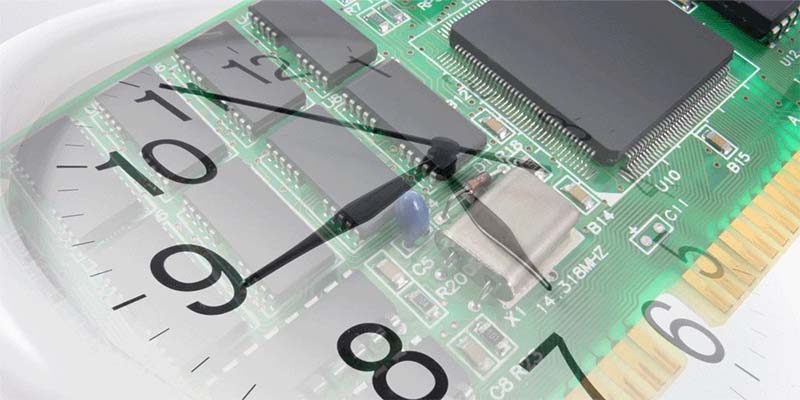
A Real-Time Clock (RTC) is a specialized integrated circuit (IC) that generates, keeps, and outputs accurate time, date, and calendar information from a clock source. It is designed to maintain continuous timekeeping, even when the main system is powered off, by using a backup power source such as a battery or super-capacitor.
While an RTC is the core timekeeping IC, it is often implemented as part of a Real Time Clock module for easier integration into electronic systems. An RTC module combines the RTC IC with essential supporting components, such as a crystal oscillator, backup battery, and passive components, on a single board. This integrated design provides accurate time and date information during normal operation and power outages, making it a convenient solution for embedded systems, IoT devices, industrial equipment, and consumer electronics.
Difference Between Real Time Clock Module and Real Time Clock IC
An RTC IC is the core device responsible for timekeeping, while an RTC module integrates the RTC IC with all the essential supporting components in a single package. These typically include a crystal oscillator, backup power circuitry, and other passive components, eliminating the need for users to design an external oscillator circuit or perform crystal calibration.
Because the required components are already integrated, RTC modules simplify hardware design, reduce the number of external parts, and help minimize PCB space.
Key Components of a Real-Time Clock Module
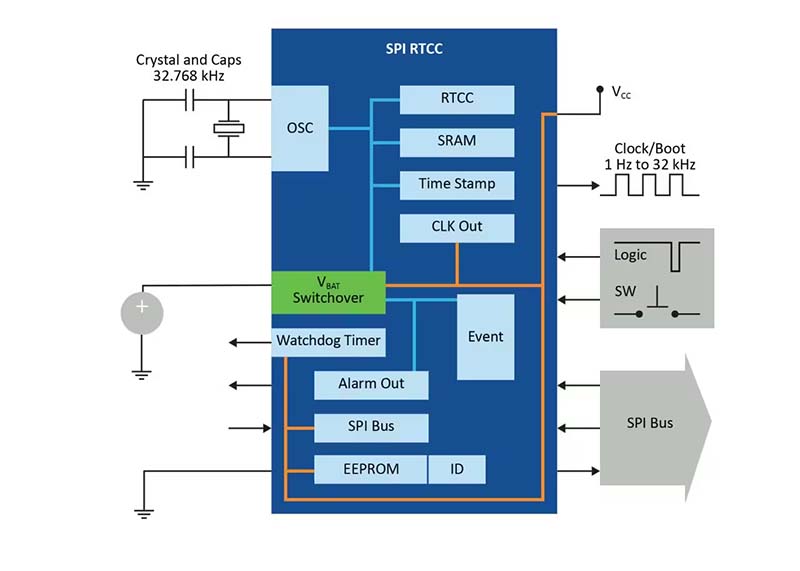
Crystal Oscillator
Typically uses a 32.768 kHz quartz crystal as the timing reference. It generates a stable low-frequency pulse, which is divided by 2¹⁵ to produce an accurate 1 Hz second pulse. This directly determines the accuracy of the module.
Controller
As the core integrated circuit inside the module, it is responsible for dividing the crystal oscillator signal, automatically performing time counting, and managing time register read/write operations as well as external communication command responses.
Memory
Includes time registers for storing clock data and a small amount of general-purpose RAM for user-defined parameters.
Backup Battery
Provides independent power when the main supply is disconnected. It keeps the oscillator running, maintains time counting, and preserves register data. It operates at ultra-low microamp-level power consumption, allowing a single battery to maintain timekeeping for several years.
Interface
This is the communication channel used by a microcontroller or host system to read, write, and configure time data. The most common type is the I2C interface, which uses fewer I/O pins. SPI interfaces are also used in high-precision industrial applications. In addition, it often includes auxiliary pins that can output a 1 Hz or 32.768 kHz square wave, as well as alarm interrupt signals.
How an Real Time Clock Integrated Circuit Works?
Real-Time Clock (RTC) works as an independent low-frequency timing subsystem that continuously counts time based on a stable clock source, regardless of the main CPU activity.
1. Stable Low-Frequency Oscillator
The RTC is driven by a dedicated clock source, typically a 32.768 kHz quartz crystal oscillator. This frequency is chosen because it can be easily divided down to 1 Hz using binary counters.
2. Clock Division Chain
Inside the RTC, a frequency divider chain reduces the high-frequency oscillation step by step:
32.768 kHz → 1 Hz pulse (1-second tick)
This 1 Hz signal becomes the fundamental time increment for counting seconds.
3. Hardware Time Counters
Dedicated hardware counters increment sequentially:
Seconds counter
Minutes counter
Hours counter
Date / day / month / year registers
These counters operate autonomously without CPU intervention.
4. Battery-Backed Domain
A separate backup power domain (VBAT domain) keeps the oscillator and registers alive when main power is removed, ensuring time retention.
5. Register-Based Time Storage
Time is stored in dedicated RTC registers (often BCD or binary format). These registers are continuously updated by the hardware counter logic.
6. Alarm and Compare Logic
The RTC includes compactor circuits that continuously compare current time registers with preset alarm values. When a match occurs, it triggers:
Interrupt flags
Wake-up signals (to MCU or system controller)
7. Interrupt Generation Path
When an event condition occurs (alarm, overflow, periodic tick), the RTC asserts an interrupt line to the MCU, allowing it to exit low-power mode or execute time-based tasks.
The RTC continuously converts a stable low-frequency crystal signal into 1-second timing pulses, uses hardware counters to maintain calendar time, and stores it in battery-backed registers that operate independently of the main system clock.
What is the Function of a Real-Time Clock Module?
Real-Time Clock (RTC) Integrated Circuit is designed to keep accurate time and date information independently of the main processor. Its primary functions include:
Maintaining Accurate Timekeeping
Continuously tracks time with high precision, even when the main system is powered off.
Providing Battery-Backed Time Retention
Even when the MCU is in sleep mode, the RTC continues timekeeping and can wake the MCU via its wake-up timer or alarm at set intervals or specific times, reducing active runtime and lowering overall system power consumption.
Generating Timing and Alarm Events
Supports programmable alarms, periodic interrupts, and timer functions to trigger scheduled operations at specific times or intervals.
Reducing Processor Workload
Handles timekeeping independently, eliminating the need for the main CPU to continuously count clock cycles or maintain software timers.
Supporting Calendar Management
Automatically manages calendar functions, including leap years, month lengths, and date rollover, ensuring long-term accuracy.
Providing a Stable Time Reference
Uses a precision crystal oscillator (typically 32.768 kHz) to deliver consistent and reliable timekeeping with low power consumption.
The primary role of an RTC integrated circuit is to maintain accurate time and calendar information, retain it during power loss, and provide timing, alarm, and interrupt functions while minimizing system power consumption and processor overhead.
Real-Time Clock (RTC) Module Features
Dedicated Timekeeping Hardware
Integrates hardware counters for seconds, minutes, hours, day, date, month, and year, reducing dependency on MCU software timing loops.
Low-Frequency Crystal Oscillator Support
Typically operates with a 32.768 kHz tuning-fork crystal to achieve stable long-term frequency accuracy and low drift.
Battery-Backed Domain Architecture
Includes a separate power domain (VBAT domain) that maintains register states and oscillator operation during main power loss.
Binary or BCD Time Registers
Provides time/date storage registers often in Binary-Coded Decimal (BCD) or binary format for simplified decoding and interfacing.
Asynchronous Clock Domain Operation
RTC runs independently from the system clock, enabling decoupled timekeeping from CPU frequency variations.
Wake-Up Timer / Alarm Registers
Contains programmable compare registers that generate internal event flags or interrupt signals when match conditions occur.
Interrupt Generation Logic
Built-in interrupt controller supporting alarm, periodic, and overflow events with configurable masking and flag registers.
Calibration / Compensation Circuitry (in some RTCs)
Supports digital trimming or temperature compensation to reduce crystal frequency deviation over temperature and aging.
Low-Power Backup Mode Operation
Designed with ultra-low leakage CMOS circuitry optimized for microamp or sub-microamp current consumption in backup mode.
Bus Interface Integration
Communicates with MCU via standard serial interfaces such as I²C, SPI, or proprietary low-pin-count buses.
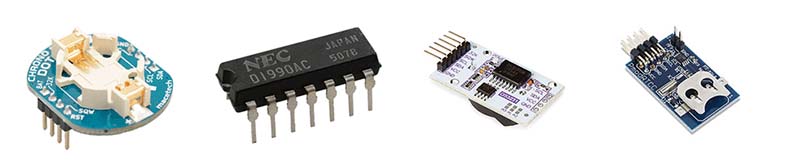
How to Choose the Right Real Time Clock Chips?
As an embedded system design engineer, selecting an appropriate real-time clock (RTC) chip or module is critical to system reliability and time accuracy. The RTC provides a stable and continuous time reference for functions such as time logging, system scheduling, and event synchronization.
During the selection process, key factors such as accuracy, power consumption, level of integration, and system cost must be carefully evaluated to identify the most suitable solution for the design requirements. By comparing datasheet specifications, typical application circuits, and user feedback, engineers can further verify the most appropriate RTC device to ensure stability and compatibility in the target application.
Key Factors in Right Real Time Clock Chip or Module Selection
1. Accuracy
The time deviation of an RTC is a core performance indicator, mainly determined by crystal stability, internal calibration capability, and aging characteristics. For high-precision applications, devices with frequency calibration or temperature compensation should be prioritized.
2. Backup Power Support
The device should support a low-power backup mode (such as VBAT), allowing it to maintain timekeeping and preserve register data when the main power supply is interrupted.
3. Level of Integration
This includes whether the RTC integrates components such as a crystal oscillator, power-switching circuit, RAM, temperature sensor, or timestamp modules. Higher integration helps reduce external components and simplifies system design.
4. Temperature Compensation
High-end RTCs often include a TCXO or digital temperature compensation mechanism to reduce frequency drift caused by temperature variations, improving long-term timekeeping stability.
5. Communication Interface
Common interfaces include I²C and SPI. Selection should consider MCU compatibility, bus speed, and the availability of I/O resources in the system.
6. Package Type
RTC chips are available in various package types such as SOIC, TSSOP, and QFN. Selection should be based on PCB space constraints, thermal considerations, and assembly requirements.
7. Operating Voltage
Different RTC devices support different supply voltage ranges (e.g., 1.8V, 3.3V, or wider ranges). It is important to ensure compatibility with the system power architecture and consider voltage stability in low-power modes.
In conclusion, selecting an RTC chip is essentially a trade-off between time accuracy, power efficiency, system integration, and cost. A well-balanced choice not only improves timekeeping reliability but also reduces external circuit complexity, thereby optimizing overall embedded system performance.
The Best Real Time Clock Integrated Circuits Model
Manufacturer: NXP Semiconductors
PCF85063B is an ultra-low power real-time clock (RTC) IC that integrates accurate calendar and timekeeping functions with minimal energy consumption. It operates with a 32.768 kHz crystal and supports I²C communication, providing continuous time tracking including seconds, minutes, hours, date, weekday, month, and year. The device also includes programmable alarm and timer functions, as well as a clock output feature, making it suitable for compact and power-sensitive embedded designs.
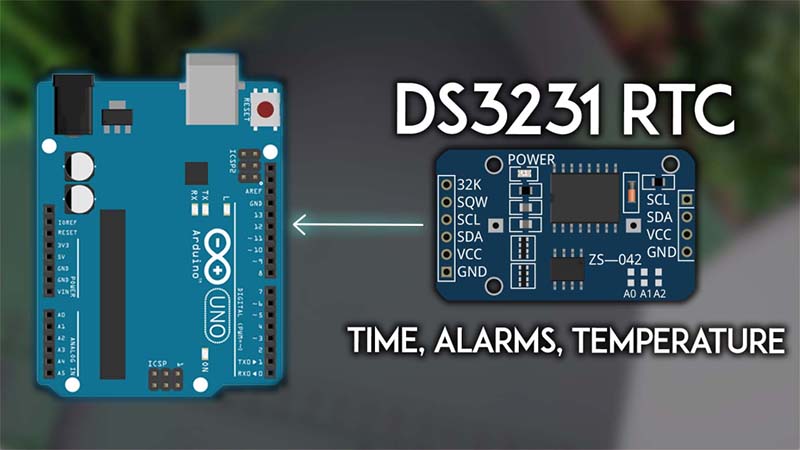
DS3231
Manufacturer: Analog Devices (Maxim Integrated)
DS3231 is a high-precision RTC with an integrated temperature-compensated crystal oscillator (TCXO), ensuring extremely stable and accurate timekeeping performance without the need for external calibration. It supports I²C communication and provides full calendar and clock functions, along with alarm and interrupt capabilities. The built-in temperature compensation mechanism significantly reduces frequency drift over temperature variations, improving long-term accuracy.
DS3231 is widely used in applications requiring high timing precision and stability, such as industrial control systems, data logging, and instrumentation equipment.
PCF8563
Manufacturer: NXP Semiconductors
PCF8563 is a low-power RTC designed for cost-sensitive applications, providing basic timekeeping and calendar functions with simple system integration. It operates via I²C interface and supports full clock and calendar counting, alarm generation, timer interrupts, and programmable clock output. Its low current consumption and minimal external component requirements make it suitable for mass-produced consumer electronics.
M41T62
Manufacturer: STMicroelectronics
M41T62 is a low-power real-time clock (RTC) device designed for accurate timekeeping in embedded and industrial systems. It integrates a 32.768 kHz oscillator circuit, I²C serial interface, and full calendar functionality. Additional functions include programmable alarm, watchdog timer, and square-wave output for system synchronization.
M41T62 is widely used in industrial control equipment, consumer electronics, communication systems, and portable devices where reliable timekeeping and stable operation are required.
As a professional electronic component supplier, we focus on providing one-stop sourcing solutions for integrated circuits, including RTC chips, power management ICs, memory devices, analog components, and interface ICs.
We are committed to providing reliable, cost-effective, and application-oriented semiconductor solutions. Whether you are designing low-power IoT products or high-precision industrial systems, we can support you with suitable RTC chips and a complete IC sourcing service.
Related information
- 2026.09.20 What is Ceramic Packaging Chip?
- 2026.09.13 What is SMD Resistor?
- 2026.09.06 What is Bus Interface IC?

- 2026.08.30 How to Select Supercapacitor?