

Available 24/7 at
+86 13632816717

What are BJT and MOSFET Transistors?
Transistors are fundamental building blocks in modern electronic circuits, playing an important role in switching, amplification, and power control. Among the many transistor types available, BJTs and MOSFETs are two of the most widely used. Although both can control current in a circuit, they operate in different ways and have distinct characteristics, advantages, and applications. In this article, we'll explore what BJTs and MOSFETs are, difference between BJTs and MOSFETs and the key applications.
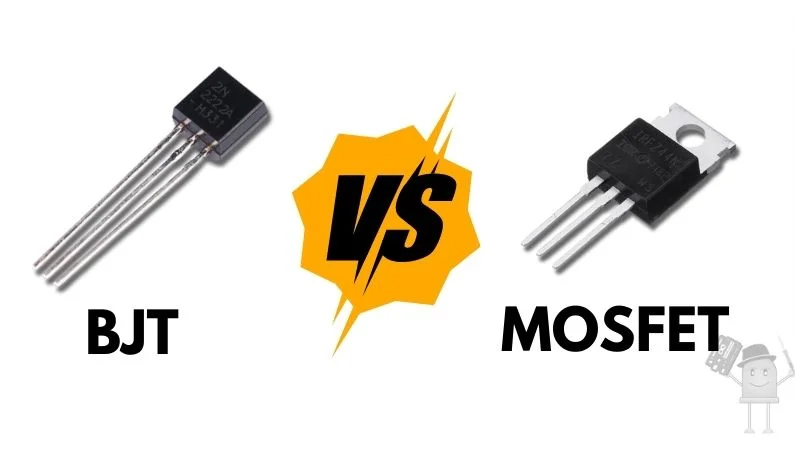
What are BJT and MOSFET Transistors
What is BJT Transistor?
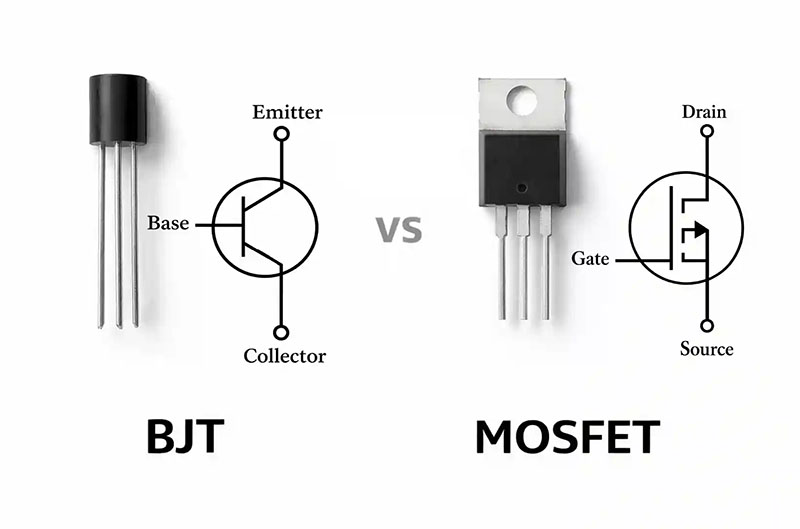
A BJT (Bipolar Junction Transistor) is a three-terminal semiconductor device that controls current using a small current applied to its base. Its three terminals are the emitter, base, and collector. When the appropriate base current is supplied, the transistor allows a larger current to flow between the collector and emitter, making BJTs useful for switching and signal amplification applications.
What is MOSFET Transistor?
A MOSFET (Metal-Oxide-Semiconductor Field-Effect Transistor) is a three-terminal transistor that controls current primarily through the voltage applied to its gate. Its terminals are the source, gate, and drain. The gate voltage creates an electric field that controls the current flowing between the source and drain. Because the gate requires very little steady-state current, MOSFETs are widely used for efficient switching and power management.
MOSFET vs BJT Transistors
BJT - Bipolar Junction Transistor
A BJT is a current-controlled transistor. It uses a small amount of current flowing into one of its terminals to regulate a much larger current passing through the other two.
A BJT has three terminals:
Emitter - where current enters (or exits, depending on type)
Base - the control terminal
Collector - where the main current flows through
When you feed a small current into the base, it "opens the gate" and allows a proportionally larger current to flow from the collector to the emitter. This is why BJTs are often described as current amplifiers - a tiny base current controls a much bigger collector current.
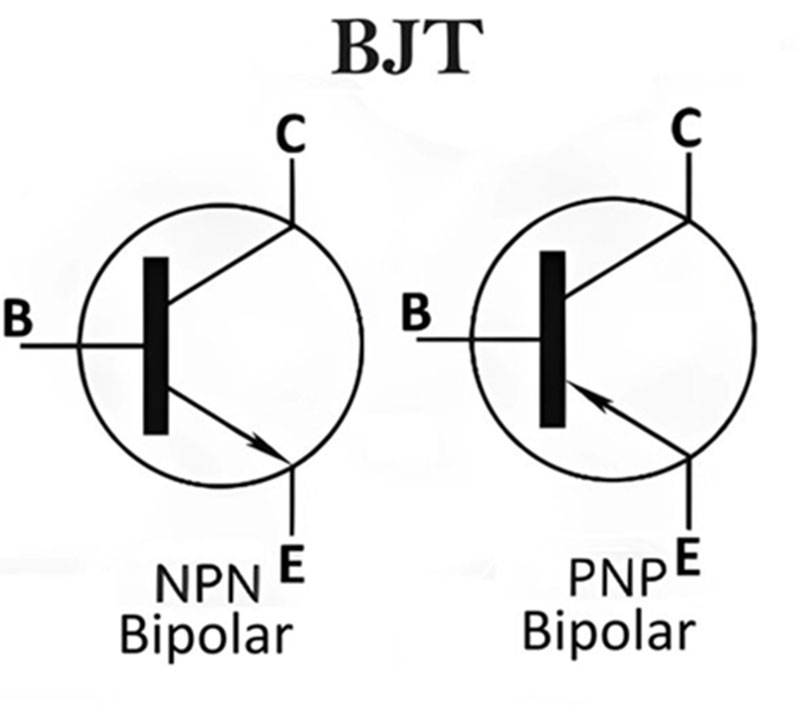
NPN and PNP
NPN - the most common type. Current flows from collector to emitter when a positive voltage is applied to the base relative to the emitter. It turns on when current flows into the base.
PNP - the complementary counterpart. Current flows from emitter to collector, and it turns on when current flows out of the base (or when the base voltage is pulled below the emitter voltage).
In practice, NPN transistors are used more frequently because they tend to be more efficient and faster, while PNP transistors are often paired with NPNs in push-pull configurations or for high-side switching.
Because the base needs continuous current to stay on, BJTs can draw more power from the driving circuit. They're widely used in analog circuits, audio amplifiers, and low-to-medium power switching applications.
MOSFET - Metal-Oxide-Semiconductor Field-Effect Transistor
A MOSFET is a voltage-controlled transistor. Instead of relying on input current, it uses an electric field generated by a voltage to switch current on or off.
A MOSFET also has three terminals:
Source - the source of charge carriers
Gate - the control terminal (insulated from the channel by a thin oxide layer)
Drain - where current flows out
When you apply a voltage to the gate, it creates an electric field that either attracts or repels charge carriers in the channel between the source and drain. This field effectively opens or closes the conductive path, allowing or blocking current flow.
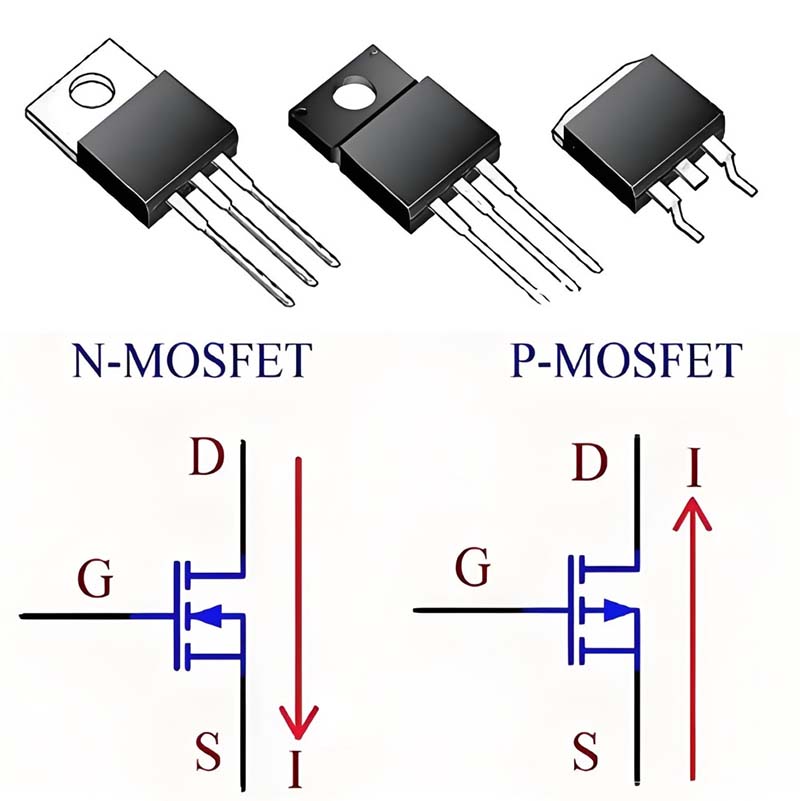
N-Channel and P-Channel
N-Channel MOSFET (NMOS) - conducts using electrons. It turns on when the gate voltage is raised above the source voltage. N-channel MOSFETs are the most widely used because electrons move faster than holes, giving them superior switching performance and lower on-resistance.
P-Channel MOSFET (PMOS) - conducts using "holes" (the absence of electrons). It turns on when the gate voltage is pulled below the source voltage. P-channel devices are commonly used for high-side switching and in complementary CMOS logic alongside NMOS transistors.
The biggest advantage of MOSFETs in general? The gate is electrically insulated, so a MOSFET draws almost no steady-state input current - it only needs a voltage signal. This makes MOSFETs extremely energy-efficient and ideal for high-speed switching, power supplies, motor control, and digital logic circuits (Nearly every microprocessor is built from MOSFETs).
|
Feature |
BJT |
MOSFET |
|
Control mechanism |
Current |
Voltage |
|
Terminals |
Emitter, Base, Collector |
Source, Gate, Drain |
|
Subtypes |
NPN, PNP |
N-Channel, P-Channel |
|
Input current draw |
Yes (continuous base current) |
Near zero (insulated gate) |
|
Switching speed |
Moderate |
Very fast |
|
Power efficiency |
Lower (drive current losses) |
Higher |
|
Typical uses |
Amplifiers, analog circuits, low-power switching |
Digital logic, power switching, motor drives |
Features of BJT Transistors
Good Current Gain
BJTs can use a relatively small base current to control a much larger collector current, providing good current amplification. This makes them suitable for applications such as audio amplification and analog signal processing.
Excellent Linearity
BJTs generally offer good linearity in analog amplifier circuits, allowing input signals to be amplified with relatively high accuracy. As a result, they are widely used in audio amplifiers and other analog applications.
Requires Continuous Input Current
BJTs require base current to maintain their operating state, which means the input consumes some power. Compared with MOSFETs, this makes BJTs less advantageous for low-power and battery-powered applications.
Relatively Slow Switching Speed
BJTs need to store and release charge during switching, which can limit their performance at high frequencies. As a result, they are generally less suitable than many MOSFETs for high-speed switching applications.
Features of MOSFET Transistors
High Input Impedance and Low Drive Power
MOSFETs are primarily controlled by the voltage applied to the gate. Since the gate requires almost no continuous input current, MOSFETs have low drive power requirements, making them particularly suitable for low-power and battery-powered devices.
Fast Switching Performance
MOSFETs can turn on and off quickly, making them highly suitable for high-frequency switching applications. They are commonly used in switching power supplies, DC-DC converters, motor control circuits, and other power electronics.
Low Conduction Losses
Many MOSFETs have a low on-resistance (RDS(on)), which helps reduce power loss and heat generation when the device is conducting. This can improve the overall efficiency of the electronic circuit.
Sensitivity to Electrostatic Discharge
The thin insulating layer at the MOSFET gate can be sensitive to electrostatic discharge (ESD) and excessive gate voltage. Therefore, proper ESD protection and gate protection should be considered during handling, installation, and circuit design.
Temperature Affects Conduction Performance
The on-resistance of a MOSFET typically increases as the temperature rises, resulting in higher conduction losses. In high-power applications, an appropriate thermal management and cooling system is therefore necessary to maintain a suitable operating temperature.
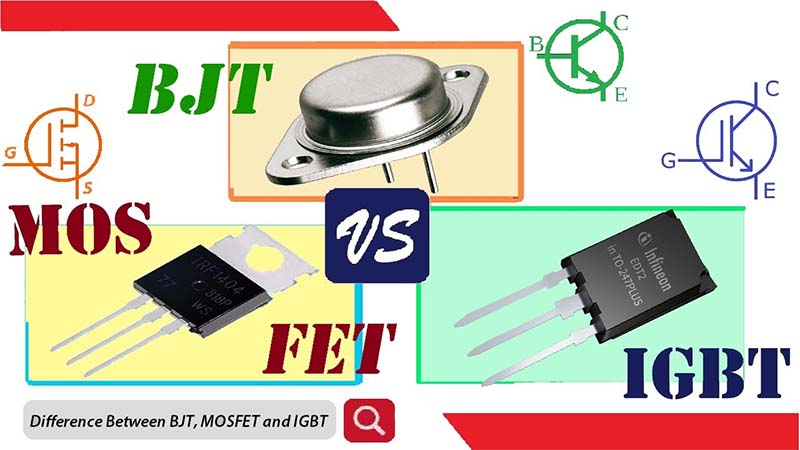
BJT vs. MOSFET vs. IGBT
BJT, MOSFET, and IGBT are three important types of transistors used for switching, amplification, and power control. While they all regulate current in electronic circuits, they differ in their control methods, switching speed, power-handling capability, and typical applications.
|
Feature |
BJT |
MOSFET |
IGBT |
|
Control method |
Current-controlled |
Voltage-controlled |
Voltage-controlled |
|
Input impedance |
Low |
High |
High |
|
Switching speed |
Moderate |
Fast |
Moderate |
|
Drive power |
Higher |
Low |
Low |
|
Voltage capability |
Low to medium |
Low to high |
High |
|
Current capability |
Medium |
Low to high |
High |
|
Typical applications |
Amplifiers, analog circuits |
Digital circuits, power supplies, motor control |
Inverters, motor drives, industrial equipment |
BJT: Best suited for analog amplification and applications requiring good linearity and current gain.
MOSFET: Ideal for fast switching, digital circuits, power supplies, and low- to medium-voltage power applications.
IGBT: Designed for high-voltage and high-current applications, combining the easy voltage-driven control of a MOSFET with the strong power-handling capability of a BJT. Common applications include motor drives, industrial inverters, renewable energy systems, and electric vehicles.
What are MOSFET and BJT Transistors Used For?
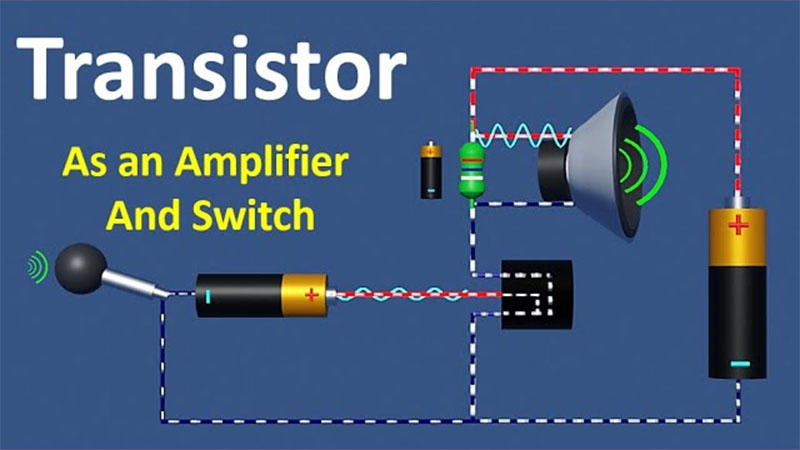
BJTs are current-controlled devices, meaning the base current is relatively constant to control the current flowing through the transistor. They offer good current gain and strong linearity, making them well suited for analog amplification and other applications where stable signal performance is important. However, they require continuous base current to operate, which can increase power consumption. They may also generate more heat and generally have slower switching performance than MOSFETs. BJTs are also used in switching circuits and motor control applications where their current-handling and amplification characteristics are beneficial.
MOSFETs are voltage-controlled devices, meaning that the voltage applied to the gate controls the current flowing between the source and drain. They have very high input impedance and require little steady-state gate current, allowing them to achieve efficient operation with relatively low power consumption. MOSFETs generally offer faster switching and higher efficiency than BJTs, making them widely used in digital logic circuits, power supplies, motor controllers, and other high-frequency and power applications.
What Are MOSFETs Used For?
1. Power Switching
MOSFETs are widely used as electronic switches because they can turn current on and off quickly with relatively low power consumption. They are commonly found in switching power supplies, DC-DC converters, and voltage regulators.
2. Motor Control
MOSFETs are frequently used to control the speed and direction of DC motors, brush-less motors, and other motor-driven systems. Their fast switching capability helps improve motor control efficiency.
3. Battery Management
MOSFETs play an important role in battery-powered devices and battery management systems. They can control charging and discharging currents while helping protect batteries from over-current and short-circuit conditions.
4. Digital Circuits
MOSFETs are the fundamental switching devices used in CMOS technology. They form the basis of logic gates, processors, memory devices, and many other digital integrated circuits.
5. Power Management
MOSFETs are used to regulate and distribute electrical power in computers, telecommunications equipment, automotive electronics, and industrial systems. Their low conduction losses can help improve overall system efficiency.
6. Signal Amplification
MOSFETs can also be used as amplifying devices to increase the strength of electrical signals. Their high input impedance and low input current make them suitable for audio amplifiers, sensor interfaces, RF circuits, and other analog signal-processing applications.
What are the Applications of Bipolar Transistors?
1. Signal Amplification
BJTs are widely used to amplify weak electrical signals. Their high current gain and good linearity make them useful in audio amplifiers, sensor interfaces, and analog signal-processing circuits.
2. Audio Applications
BJTs can provide stable and relatively linear amplification, making them suitable for audio amplifier stages and other circuits where accurate signal reproduction is important.
3. Electronic Switching
BJTs can operate as electronic switches by controlling a larger collector current with a smaller base current. They are used in relay drivers, control circuits, and various low- to medium-power switching applications.
4. Current Regulation
BJTs can be used to control and stabilize current in analog circuits. They are commonly found in current sources, current mirrors, voltage regulators, and other circuit designs that require predictable current control.
5. Analog Integrated Circuits
BJTs remain important in many analog IC designs, particularly where high gain, good matching, or predictable analog characteristics are required. They are often used in amplifiers, differential pairs, and other signal-processing circuits.
The fundamental difference between these two transistor types gives BJTs an advantage in many analog applications, while MOSFETs are widely preferred for digital circuits and power switching. Neither device is inherently superior, the best choice depends on the specific requirements of the circuit.
Where to Buy Transistors & Discrete Semiconductor
For businesses looking for reliable transistor sourcing, Eastech provides a comprehensive selection of BJT, MOSFET, IGBT, and other transistor products for a wide range of electronic applications. We work with products from many well-known semiconductor brands, giving customers access to a broad portfolio of devices with different voltage ratings, current capabilities, package types, switching characteristics, and performance levels. Whether you need transistors for power management, motor control, industrial equipment, automotive electronics, consumer devices, or other circuit designs, our extensive product range can help meet different technical and procurement requirements.
Quality and supply reliability are also central to our transistor sourcing service. We focus on providing high-quality, reliable electronic components and carefully matching products to customer specifications, helping reduce sourcing risks and improve supply continuity. From commonly used transistor models to harder-to-source components, our team can support customers with product selection, sourcing, quotation, and bulk procurement.
Top Transistor Manufacturers
Infineon is one of the leading manufacturers of power semiconductors, with particularly strong product portfolios in MOSFETs and IGBTs. Its MOSFET lineup covering applications from low-voltage switching to high-voltage power conversion. Popular and widely used parts include IRFZ44N, IRF540N, IPP110N20N3, and IKW40N60H3. Infineon also offers a broad range of IGBTs for industrial, automotive, inverter, and power-conversion applications.
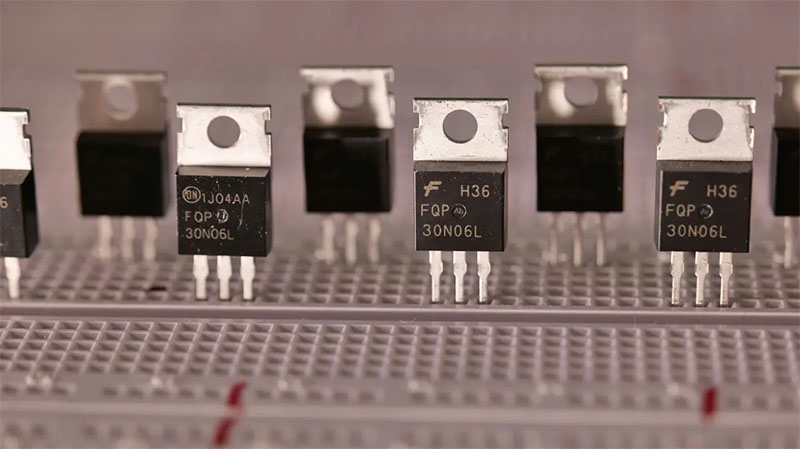
onsemi is a well-known semiconductor manufacturer with an extensive range of discrete transistors, including BJTs, MOSFETs, IGBTs, and power transistors. Popular onsemi transistor models include 2N3904, 2N3906, 2N2222A, FQP30N06L, and NTD5867NL, making the brand a common choice for both general-purpose and power applications.
STMicroelectronics offers a broad selection of BJTs, power MOSFETs, IGBTs, and SiC MOSFETs under its STPOWER portfolio. Popular parts include STP55NF06, STP16NF06, STGD5M65DF2, and IGBTs and MOSFETs up to high-voltage ranges for applications including power supplies, motor control, automotive systems, industrial equipment, and energy conversion.
ROHM Semiconductor
ROHM is a major Japanese semiconductor manufacturer known for its MOSFETs, IGBTs, BJTs, and other discrete semiconductor devices. ROHM's EcoMOS™ family covers silicon MOSFET applications, while its EcoIGBT™ products target high-voltage and high-power switching. Popular ROHM transistor models include R6020KNX, R6030KNX, SCT2H12NZ, and RBN40BM60FS.
Toshiba Electronic Devices & Storage
Toshiba is another established manufacturer with a strong presence in discrete semiconductors, particularly MOSFETs, IGBTs, and bipolar transistors. Its broad product portfolio makes Toshiba a useful option for applications requiring compact packages, switching performance, and reliable power control.
Finally, the practical choice depends on what the circuit needs to accomplish. MOSFETs are often preferred when fast switching and low conduction losses are important, while BJTs can be a strong choice for applications that require predictable current gain and linear amplification. Understanding what are MOSFET and bjt transistors used for can help designers match each device to the right application, whether the priority is efficient switching, current control, signal amplification, or reliable power management.
Related information
- 2026.07.28 What are Programmable Logic Controllers?
- 2026.07.26 What is a Ceramic Capacitor?
- 2026.07.21 What is Inductor and Inductance?
- 2026.07.14 What is Optocoupler in Electronics?