

Available 24/7 at
+86 13632816717

What is a Transistor and How Does it Work?
What does a transistor do? A transistor, also known as a triode, is a core solid-state semiconductor device. It includes various types such as diodes, field-effect transistors (FETs), and silicon-controlled rectifiers (SCRs). It possesses multiple practical functions, including detection, rectification, signal amplification, circuit switching, voltage regulation, and signal modulation, serving as a vital foundational component for the operation of electronic equipment.
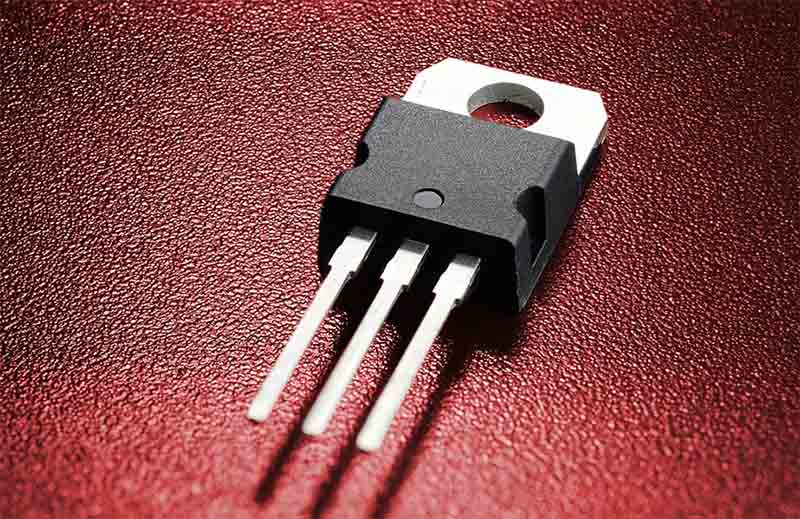
As an adjustable current switch, a transistor can precisely control the magnitude of the output current through changes in the input voltage. Unlike traditional switching devices such as relays and ordinary mechanical switches, a transistor relies on communication signals to control its own opening and closing, requiring no mechanical contact operations.
What Types of Transistors?
Bipolar Junction Transistor (BJT)
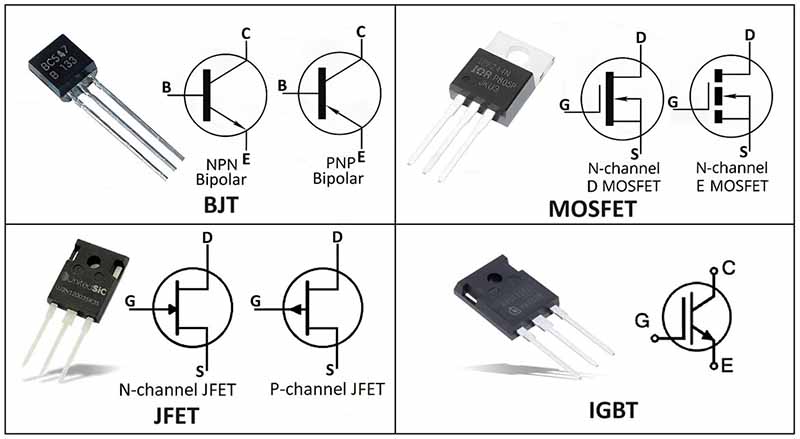
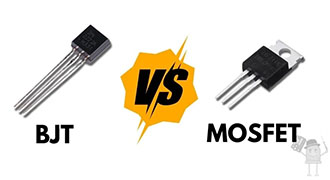
The Bipolar Junction Transistor (BJT) is one of the most commonly used transistor types and is a current-controlled device. Based on structural differences, it can be classified into NPN and PNP types. Its core function is to use a tiny base current to control a much larger current between the collector and emitter, achieving signal amplification and switching control. It is widely applied in scenarios such as analog circuits and power amplification circuits.
The Field-Effect Transistor (FET) is a voltage-controlled device. FETs encompass several branches, the most common of which is the Metal-Oxide-Semiconductor Field-Effect Transistor (MOSFET). Its gate and channel are isolated by an oxide layer, resulting in extremely low power consumption and high integration density. It is widely used in digital circuits, integrated circuits, and switching power supplies.
Insulated Gate Bipolar Transistor (IGBT)
The Insulated Gate Bipolar Transistor (IGBT) is a hybrid power transistor that combines the dual advantages of MOSFET voltage control with the high current capacity and low loss of a BJT. It features a simple input drive and excellent switching performance, while also possessing high voltage resistance, strong current-carrying capacity, and low conduction loss. It is a core component for high-power industrial applications.
Phototransistor
A phototransistor is a special type of transistor whose core characteristic is the ability to convert light signals into electrical signals, belonging to the category of optoelectronic devices. Its structure is similar to that of an ordinary transistor, but the emitter or base is made of photosensitive material. During operation, it does not require an external control current or voltage; instead, it receives external optical radiation (such as visible light or infrared) to change its own conductivity, achieving the conversion and amplification of light signals into electrical signals. Common types include phototriodes, which are mainly applied in scenarios such as light detection, photoelectric control, and optical communications, including photoelectric sensors and optical switches.
Single-Electron Transistor (SET)
The Single-Electron Transistor (SET) is a new type of transistor based on the quantum tunneling effect, belonging to the class of nanoscale devices. Its core characteristics include extremely small size and ultra-low power consumption, enabling the precise control of individual electrons. It is currently mainly applied in quantum computing, nanoelectronics, and ultra-high-precision detection.
What is a Transistor and How Does it Work?
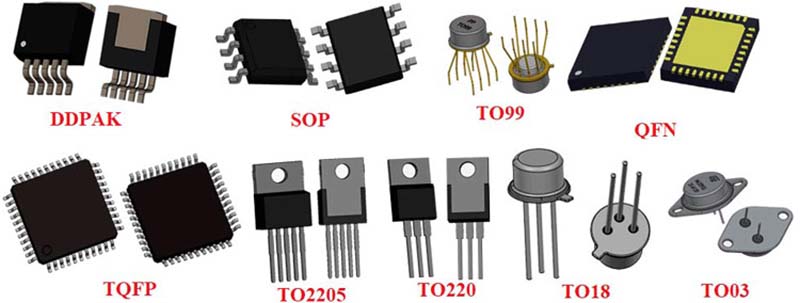
Transistors specifically refer to the commonly used Bipolar Junction Transistors (BJT), which are semiconductor devices often used as amplifiers or electronically controlled switches. Due to their fast response speed and high precision, transistors can be used in various digital and analog circuit designs, including amplifiers, switches, voltage regulators, signal modulators, and oscillator circuits. Transistors can be independently packaged, and multiple transistors can be integrated into a certain part of a circuit.
Transistors utilize the characteristics of semiconductors to control output current/voltage through input signals, essentially serving as a controllable current/voltage switch. The core of a transistor is semiconductor material (such as silicon or germanium), forming regions with different conductive characteristics (such as N-type and P-type semiconductors) through a doping process. The combination of these regions forms a "PN junction"-the PN junction has unidirectional conductivity and is the basis for the transistor to achieve its control functions.
How Do Transistors Work?
Bipolar Junction Transistors (BJT) (NPN Transistors and PNP Transistors)
Bipolar junction transistors are the most widely used type of transistors, mainly divided into two major structures: NPN and PNP. They consist of three key pins: the Emitter (E), Base (B), and Collector (C). The base serves as the signal input terminal; by inputting only a tiny voltage or current signal, it can precisely manage the large main-circuit current between the collector and emitter, achieving the switching between circuit conduction and cutoff.
NPN transistors primarily rely on electrons to complete charge transport: the emitter sends out electrons, while the middle base is responsible for regulating the electron flow. The vast majority of electrons released by the emitter are not consumed at the base but are instead captured and collected by the collector, which then transports them to the back-end circuit to complete current transmission and signal control.
The internal structure and conductive mechanism of a PNP transistor are diametrically opposite to those of an NPN transistor. The base also performs the role of current regulation, but the overall current direction is completely reversed, with the flow from the emitter to the collector as the core. Unlike the NPN, which relies on electrons for conduction, the charge carriers in PNP devices are holes. Holes are output by the emitter and finally collected by the collector, thereby achieving functions such as circuit conduction, switching, and signal regulation.
Field-Effect Transistors (FET)
Field-effect transistors rely on voltage to control the output current and are "voltage-controlled" devices. They do not require the base (the Gate in an FET) to provide current; regulation is achieved solely through voltage signals.
Field-Effect Transistors (FET) are voltage-controlled devices, core-composed of a Source (S), Gate (G), and Drain (D). Their working principle involves applying voltage to the gate to form an electric field, which changes the conductivity of the semiconductor channel, thereby controlling the current between the drain and the source. Their gate consumes almost no current, offering low power consumption and high control precision, making them suitable for scenarios with high requirements for power efficiency and accuracy.
What is the Difference Between Transistor and MOSFET?
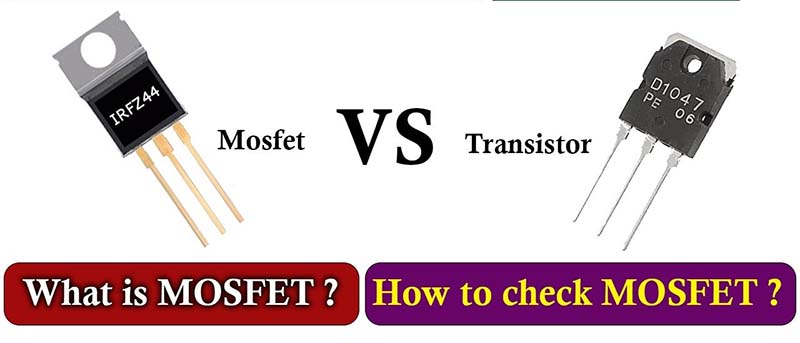
The Field-Effect Transistor (FET) is a common type of transistor. As a voltage-controlled device, its core function is to control the conductivity of the semiconductor channel through the gate voltage, thereby regulating the drain-source current. It includes various types (such as the Junction Field-Effect Transistor JFET, MOSFET, etc.). As the most common type of FET, the MOSFET adds a Metal-Oxide-Semiconductor (MOS) gate structure in its architecture. The gate and the channel are isolated by an oxide layer, which results in the gate consuming almost no current and having lower power consumption than other FETs.
Furthermore, MOSFETs are divided into two types: N-channel and P-channel, where the conductive charge carriers are electrons or holes. With advantages such as simple structure, high integration, and low power consumption, they are widely used in scenarios like integrated circuits and switching power supplies. In contrast, [other] field-effect transistors lack an oxide layer structure, with the gate in direct contact with the channel; this results in a certain amount of gate current and relatively higher power consumption, leading them to be used mostly in analog circuits where high integration is not required.
What Does a Transistor Used For?
Audio Equipment Applications
Achieving audio power amplification, amplification of weak pickup signals from microphones, reception of RF radio signals, and signal conditioning and amplification for various sensors such as temperature, humidity, and pressure. They are widely equipped in home audio systems, car entertainment systems, radios, measuring instruments, and industrial testing meters.
Electronic Switching Control
Used as high-speed electronic switches to replace traditional mechanical switches. They are applied in digital logic circuits, small relay on/off driving, LED dimming control, and low-power load control scenarios such as the start-stop and speed regulation of small DC motors, offering fast response times and long service life.
Power Supply and Voltage Regulator Circuits
Used in linear voltage regulation loops, circuit over-current and current-limiting protection, and secondary loop driving for switching power supplies. They can be used to build simple voltage regulation and constant-current power supply circuits to stabilize output voltage and current, catering to various small power supply devices such as small household appliances, digital devices, and industrial control boards.
Core Components for Analog Circuits
The fundamental core elements of analog electronic circuits, capable of constructing sine wave oscillators, active filter circuits, and differential amplifier circuits. They also serve as the internal basic units of integrated chips such as operational amplifiers and comparators, ensuring the stable processing of analog signals.
Industrial and Automotive Electronics
Signal acquisition and processing for industrial control motherboards, automotive engine ignition control systems, signal amplification and shaping for various on-board vehicle sensors, and drive modules for industrial low-voltage actuators. These applications adapt to complex working conditions and possess strong anti-interference capabilities.
Mobile Communications Field
Functions such as RF (Radio Frequency) signal power amplification, microwave high-frequency signal processing, and wireless signal modulation and demodulation. They are widely used in walkie-talkies, communication base station RF units, Bluetooth and IoT wireless transceiver modules, and short-range wireless transmission equipment.
Smart Electronics
Extensively integrated into smartphones, white goods, smart home control motherboards, lithium battery charging management, and low-voltage power supply loops. They are responsible for weak signal acquisition and processing, logic control, and low-power load driving, ensuring the stable operation of smart devices.
How to Choose the Correct Transistor?
Transistors deliver versatile performance in audio processing, power regulation, industrial systems and wireless circuitry. Given the multiple functions and extensive applications of transistors, it is critical to select a suitable component according to actual circuit demands. The following are some important parameters of transistors.
Current Amplification Coefficient: Measures the transistor's ability to amplify current; it primarily reflects the degree of control the input current has over the output current, commonly represented by $\beta$ (for Bipolar Junction Transistors).
Power Dissipation: The electrical power consumed by the transistor during operation, which is the main cause of device heating. It must be kept within the rated range to avoid damaging the component.
Maximum Oscillation Frequency: The highest frequency at which the transistor can normally achieve signal amplification or oscillation. Beyond this frequency, the device's performance will significantly decline.
Maximum Reverse Voltage: The highest voltage the transistor can withstand when operating in reverse. Exceeding this voltage will lead to breakdown and damage of the device.
Maximum Current: The maximum current allowed through the transistor during normal operation (such as the maximum collector current). Exceeding this limit will damage the device or affect its operational stability.
Selecting an authorized transistor component supplier and reliable suppliers is the key to ensuring transistor quality and supply stability. Eastech has been deeply involved in the global electronic component procurement industry for 20 years, providing comprehensive procurement assistance. We solve full-process issues for customers-including model selection, supply, and after-sales support.
Our company has established long-term, stable, and deep collaborations with numerous well-known semiconductor brands both domestically and internationally. Leveraging brand resources and supply chain advantages, we achieve efficient and dependable procurement matching for our customers. Among these, brands such as ADI, ROHM, onsemi, STMicroelectronics, Infineon, and Vishay offer complete product lines and reliable quality. Their spot supply can satisfy high-end procurement needs, such as high-frequency, high-voltage, and automotive-grade requirements.
In conclusion, understanding what does a transistor used for is essential. Transistors are fundamental components used for amplification, switching, and signal control across a wide range of applications, from consumer electronics to industrial equipment. By comparing the functions of different transistors and their characteristics, designers can choose the most suitable solution for performance, efficiency, and reliability in their specific applications.
Related information
- 2026.09.06 What is Bus Interface IC?
- 2026.08.30 How to Select Supercapacitor?
- 2026.08.23 What is Aluminium Electrolytic Capacitor?
- 2026.08.16 What are BJT and MOSFET Transistors?