

Available 24/7 at
+86 13632816717

The Best Multilayer Ceramic Capacitors: Top Manufacturers and Supply
As electronics continue to become smaller, faster, and more highly integrated, the demand for compact, high-capacitance, high-reliability MLCCs is growing rapidly. With numerous MLCC types, specifications, and manufacturers available worldwide, choosing the right capacitor and sourcing it from a reliable supplier can be challenging. In this article, we will explore the multilayer ceramic capacitor market, and the the major multilayer ceramic capacitor manufacturers, while also introducing EASTECH as a reliable supply partner for MLCC sourcing.
What Are Multilayer Ceramic Capacitors (MLCCs)?
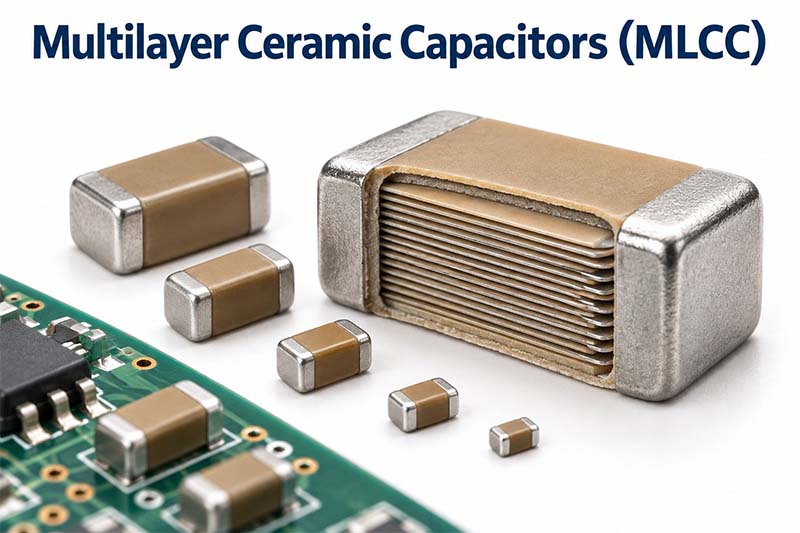
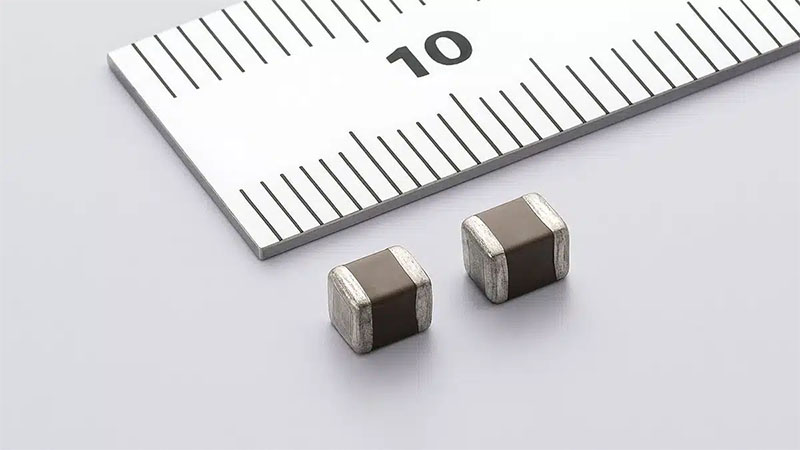
Multilayer Ceramic Capacitors (MLCCs) are passive electronic components that store and release electrical energy. They are widely used in modern electronic circuits for decoupling, filtering, noise suppression, power supply smoothing, and signal coupling. MLCC stands for Multilayer Ceramic Capacitor, referring to its internal structure of alternating ceramic dielectric layers and metal electrodes.
MLCC contains multiple stacked dielectric and electrode layers. These layers effectively form multiple capacitors connected in parallel within a compact component. Increasing the number of active layers and reducing dielectric thickness can significantly increase capacitance while maintaining a small package size.
Multilayer Ceramic Capacitor vs. Electrolytic vs. Tantalum Capacitors
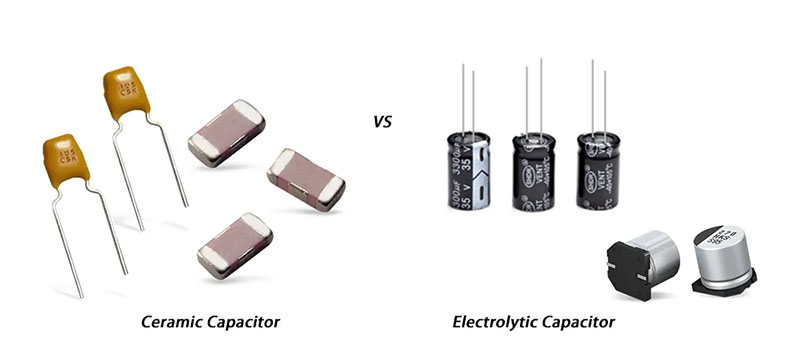
When selecting a capacitor for an electronic circuit, multilayer ceramic capacitors (MLCCs), electrolytic capacitors, and tantalum capacitors each offer different electrical characteristics and are suited to different applications. The choice depends on factors such as capacitance, voltage rating, frequency, ESR, size, temperature, polarity, and reliability requirements.
MLCC vs. Electrolytic Capacitors
MLCCs and electrolytic capacitors serve different purposes in many power and electronic circuits.
MLCCs generally have lower ESR and ESL, making them particularly effective at filtering high-frequency noise and providing fast transient response. Their small surface-mount packages also make them well suited to compact PCB designs.
Electrolytic capacitors, on the other hand, can provide much higher capacitance values, making them useful for bulk energy storage and low-frequency filtering. They are commonly found in power supplies, DC-link circuits, audio equipment, and other applications where large amounts of capacitance are required.
MLCC vs. Tantalum Capacitors
MLCCs and tantalum capacitors can overlap in applications such as power management, filtering, and decoupling, but they have different characteristics.
MLCCs are non-polarized and generally offer excellent high-frequency performance, low ESR, and very small package sizes. However, Class 2 MLCCs such as X5R and X7R can experience significant capacitance reduction under DC bias, particularly at higher voltage-to-rating ratios.
Tantalum capacitors are polarized and are known for providing relatively high capacitance in a compact package with stable characteristics. They can be useful when a circuit requires a compact capacitor with higher capacitance and relatively low ESR.
|
Feature |
MLCC |
Electrolytic Capacitor |
Tantalum Capacitor |
|
Dielectric |
Ceramic |
Electrolyte |
Tantalum oxide |
|
Polarity |
Non-polarized |
Polarized |
Polarized |
|
ESR |
Very low |
Relatively high |
Low |
|
Size |
Very compact |
Larger |
Compact |
|
Leakage Current |
Very low |
Higher |
Higher than MLCC |
|
Applications |
Decoupling, filtering, RF, power management |
Bulk energy storage, power supplies |
Power management, filtering, portable electronics |
Types of Multilayer Ceramic Capacitors
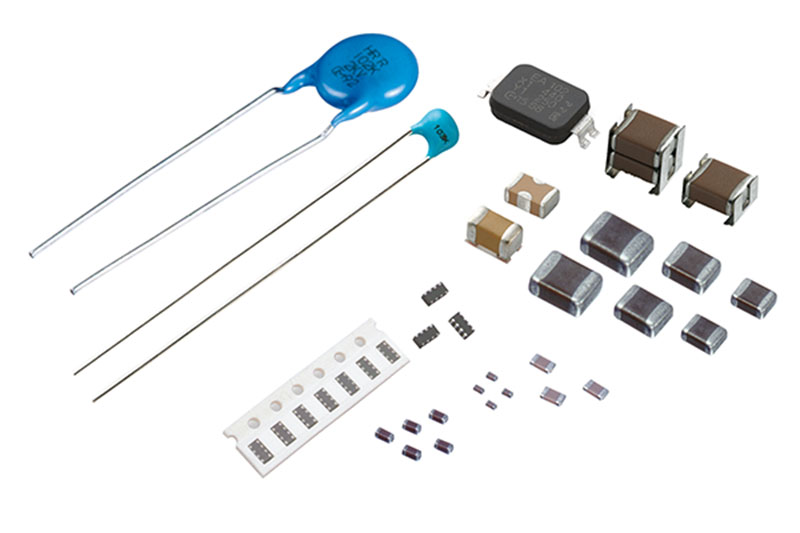
Multilayer ceramic capacitors (MLCCs) can be classified according to their dielectric materials, temperature characteristics, capacitance stability, and application requirements. The two main categories are Class 1 and Class 2 ceramic capacitors.
1. Class 1 MLCCs
Class 1 MLCCs are designed for applications that require high stability, low losses, and precise capacitance characteristics. They generally have a lower dielectric constant than Class 2 capacitors but provide excellent temperature stability and low capacitance change with applied voltage.
The most common Class 1 dielectric is C0G/NP0.
C0G/NP0 MLCCs offer excellent temperature stability, low dissipation factor, and very stable capacitance. They are commonly used in:
RF and microwave circuits
Oscillators and resonant circuits
Timing circuits
Signal filtering
Precision analog circuits
Telecommunications equipment
2. Class 2 MLCCs
Class 2 MLCCs use ceramic dielectrics with a higher dielectric constant, allowing them to achieve much higher capacitance values in a relatively small package. However, their capacitance is more affected by temperature, applied DC voltage, and aging than Class 1 MLCCs.
Common Class 2 dielectric types include X5R, X7R, X6S, X7S, X8R, and X8L.
These MLCCs are widely used for:
Power supply decoupling
Bypass circuits
Voltage filtering
Noise suppression
Power management
Consumer electronics
Automotive electronics
Industrial equipment
|
Dielectric |
Temperature Range |
Main Characteristics |
Applications |
|
C0G/NP0 |
0℃ to +85℃ |
Excellent stability, low loss |
RF, timing, precision circuits |
|
X5R |
-55℃ to +85℃ |
High capacitance, compact size |
Decoupling, power supplies |
|
X7R |
-55℃ to +125℃ |
Good stability and high capacitance |
Automotive, industrial, power management |
|
X6S |
-55℃ to +105℃ |
High capacitance and temperature stability |
Automotive and compact electronics |
|
X7S |
-55℃ to +125℃ |
High capacitance with improved stability |
Automotive and industrial |
|
X8R |
-55℃ to +150℃ |
High-temperature capability |
Automotive and industrial applications |
|
X8L |
-55℃ to +150℃ |
High capacitance and high-temperature operation |
Automotive and power electronics |
How to Choose the Best Multilayer Ceramic Capacitors?
For most MLCC selection applications, C0G/NP0, X5R, and X7R are particularly important.
C0G/NP0 is typically selected when capacitance stability and low loss are more important than achieving very high capacitance.
X5R provides relatively high capacitance in a small package and is widely used for general-purpose decoupling and power-management applications.
X7R offers a wider operating temperature range than X5R and is commonly used in automotive, industrial, and other applications requiring greater temperature stability.
One important consideration with Class 2 MLCCs is DC bias. The effective capacitance of an X5R or X7R capacitor can decrease as the applied DC voltage increases. Therefore, engineers should consider the actual operating voltage rather than selecting an MLCC based solely on its nominal capacitance.
For example, C0G/NP0 may be appropriate for a precision RF circuit, while X7R may be more suitable for automotive decoupling, and X5R may be commonly selected for compact consumer-electronics power-management applications.
Why Are Multilayer Ceramic Capacitors Important for Electronic?
The continued miniaturization of smartphones, computers, automotive electronics, industrial equipment, telecommunications equipment, and other electronic products has increased demand for compact passive components. MLCCs can provide substantial capacitance in a small footprint, making them an important component in high-density PCB designs.
MLCCs are also available in a wide range of case sizes, capacitance values, voltage ratings, dielectric types, and temperature characteristics. Specialized versions are designed for demanding applications such as automotive, industrial, aerospace, military, RF, and high-voltage systems.
What Are Multilayer Ceramic Capacitors Used For?
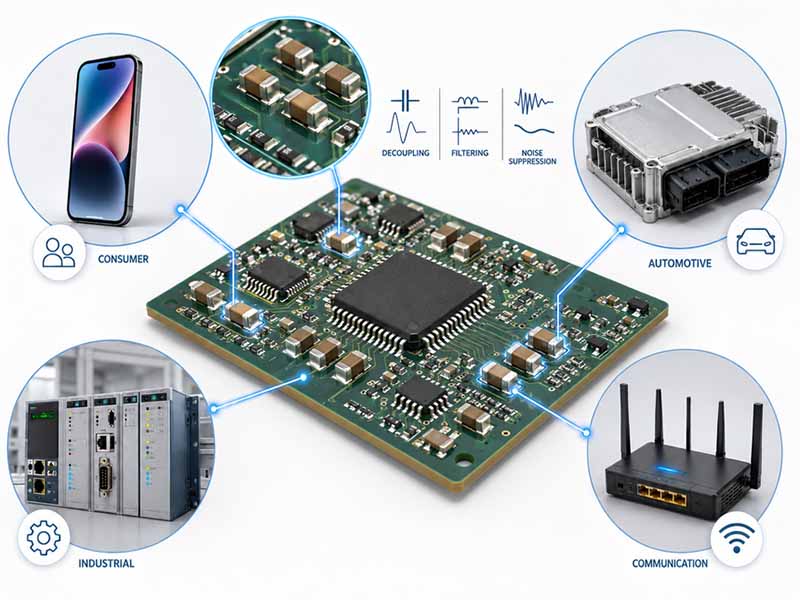
Multilayer ceramic capacitors (MLCCs) are widely used in electronic circuits for filtering, decoupling, bypassing, noise suppression, and energy storage.
Power supply filtering: MLCCs smooth voltage fluctuations and reduce unwanted AC noise and ripple on power rails.
Decoupling and bypassing: They are placed close to IC power pins to provide local transient current and suppress high-frequency noise.
Signal filtering: MLCCs can be combined with resistors and inductors to form filters that remove unwanted frequencies from analog and digital signals.
Noise suppression: MLCCs help reduce electromagnetic interference (EMI) and high-frequency electrical noise.
Coupling and DC blocking: Certain MLCCs are used to pass AC signals while blocking DC components in signal-processing circuits.
Timing and tuning circuits: Stable ceramic capacitors such as C0G/NP0 types are used in oscillators, resonant circuits, and frequency-control applications.
Automotive electronics: Automotive-grade MLCCs are used in engine control units, ADAS systems, infotainment systems, electric vehicles, battery-management systems, and other vehicle electronics.
Consumer electronics: Smartphones, tablets, laptops, TVs, cameras, wearables, and other compact devices can contain hundreds or even thousands of MLCCs.
Industrial and telecommunications equipment: MLCCs are used in power supplies, networking equipment, servers, base stations, and industrial control systems.
The main advantage of MLCCs is that they can provide the required electrical characteristics while occupying very little PCB space. Their small size, low ESR, low ESL, high-frequency capability, and wide range of capacitance and voltage ratings make them particularly suitable for densely packed electronic designs.
For example, a smartphone may use MLCCs throughout its power-management, processor, memory, RF, audio, and communication circuits, while an electric vehicle can use specialized MLCCs in its power electronics, ADAS, infotainment, and battery-management systems.
Multilayer Ceramic Capacitor Market
According to MarketsandMarkets, the global MLCC market is projected to grow from approximately USD 15.00 billion in 2025 to USD 21.93 billion by 2030, representing a CAGR of 7.9%. Another recent market study from Fortune Business Insights estimates the market at USD 15.17 billion in 2025 and forecasts it to reach USD 30.29 billion by 2034. Differences between estimates are largely attributable to differences in market definitions, methodologies, and forecast periods.
Consumer electronics remain a major application area. Smartphones, laptops, tablets, wearable devices, and other compact electronic products require large numbers of MLCCs for power decoupling, filtering, and noise suppression. Continued device miniaturization is also increasing demand for smaller MLCC packages with higher capacitance density.
Automotive electronics are another important growth driver. The increasing use of electronics in vehicles, together with the growth of electric vehicles, ADAS, connectivity, and advanced infotainment systems, is creating demand for automotive-grade MLCCs with high reliability and specialized electrical characteristics. MarketsandMarkets identifies automotive as one of the faster-growing segments of the MLCC market.
5G and telecommunications are also supporting market growth. Telecommunications infrastructure requires MLCCs for high-frequency filtering, decoupling, and power-management functions. The deployment of 5G base stations and small cells is therefore creating additional demand for compact, high-performance MLCCs.
In addition, the growth of AI servers, data centers, and high-performance computing is creating demand for advanced passive components. These systems require increasingly sophisticated power-delivery and high-speed electronic architectures, supporting demand for high-capacitance, low-impedance, and high-reliability MLCCs.
While consumer electronics remain an important application, automotive electrification, AI servers, data centers, 5G infrastructure, and advanced computing are becoming increasingly important sources of demand.
Top Multilayer Ceramic Capacitor Manufacturers
The multilayer ceramic capacitor (MLCC) industry is highly concentrated, with a relatively small number of manufacturers supplying a large share of global demand. Major MLCC manufacturers include companies from Japan, South Korea, Taiwan, the United States, and China. Murata Manufacturing, Samsung Electro-Mechanics, Taiyo Yuden, TDK Corporation, KYOCERA AVX and Yageo are consistently identified among the leading global MLCC suppliers.
MLCC manufacturers compete primarily on capacitance density, miniaturization, dielectric technology, reliability, voltage ratings, automotive qualifications, production capacity, and supply-chain capabilities. Advanced MLCC production requires precise ceramic material processing, extremely thin dielectric layers, high-precision electrode printing, and reliable multilayer stacking.
Murata Manufacturing is one of the most prominent MLCC manufacturers globally. Its MLCC portfolio covers extremely small package sizes, high-capacitance products, automotive-grade components, and products for high-frequency applications.
Murata's competitive advantages include advanced ceramic materials, multilayer manufacturing technology, miniaturization, and vertically integrated production.
2. Samsung Electro-Mechanics
Samsung Electro-Mechanics is another major global MLCC supplier. Its products are used in smartphones, automotive electronics, industrial equipment, and computing systems.
The company has increasingly focused on automotive MLCCs and high-end components for AI servers and data centers. Recent industry data also indicates strong demand for high-end MLCCs from AI server platforms.
3. Taiyo Yuden
Taiyo Yuden is a major Japanese manufacturer specializing in ceramic capacitors and other passive components. Its MLCC portfolio includes products designed for miniaturized consumer electronics, communications equipment, automotive applications, and industrial systems.
TDK Corporation has a broad passive-component portfolio covering MLCCs, inductors, filters, ferrites, and other electronic components. Its MLCC products address consumer, automotive, industrial, and telecommunications applications.
5. KYOCERA AVX
KYOCERA AVX is a global manufacturer of advanced electronic components and offers a broad portfolio of multilayer ceramic capacitors (MLCCs) for commercial, automotive, industrial, aerospace, military, RF, and other demanding applications. Its MLCC portfolio includes both Class 1 and Class 2 dielectric formulations, with products available in a wide range of case sizes, capacitance values, voltage ratings, and termination options.
6. Yageo
Yageo is a major Taiwan-based passive-component manufacturer with a broad MLCC portfolio. Its product range serves consumer electronics, industrial equipment, automotive electronics, and other applications.
Eastech: Your MLCC Supply Partner
As the demand for multilayer ceramic capacitors continues to grow across consumer electronics, automotive, industrial, telecommunications, and other applications, reliable component sourcing has become increasingly important. EASTECH provides a wide range of electronic components, including multilayer ceramic capacitors (MLCCs), to support diverse electronic design and manufacturing requirements.
Our supply-chain capabilities go beyond individual component sourcing. EASTECH Top Supply supports customers with BOM sourcing, multi-brand procurement, component availability checks, alternative part sourcing, and supply coordination, helping reduce procurement complexity and improve supply continuity. By connecting customers with a broad network of manufacturers and distribution channels, we can respond to changing market conditions and help customers address lead-time challenges and sourcing requirements.
Whether you are sourcing C0G/NP0, X5R, X7R, high-voltage, automotive-grade, or other specialized MLCCs, EASTECH Top Supply can help simplify component sourcing and provide solutions according to your specific requirements.
Conclusion: understanding what are multilayer ceramic capacitors used for helps engineers and procurement teams select the right dielectric, capacitance, voltage rating, package size, and reliability level for each application. Choosing the right MLCC manufacturer and maintaining a reliable supply chain are important during supply constraints. With access to a broad range of electronic components and sourcing resources, EASTECH helps customers find suitable MLCC solutions from leading manufacturers and supports their component sourcing requirements across diverse applications.
Related information
- 2026.09.20 What is Ceramic Packaging Chip?
- 2026.09.13 What is SMD Resistor?
- 2026.09.06 What is Bus Interface IC?
- 2026.08.30 How to Select Supercapacitor?