
Available 24/7 at
+86 13632816717

How to Choose the Intel Altera FPGA
Driven by the continued demand for AI, 5G, and the Internet of Things (IoT), the global FPGA market is expected to exceed USD 12 billion by 2027, highlighting FPGA's critical role in modern computing architectures. Intel FPGA (Altera) delivers a comprehensive portfolio of programmable logic devices, providing efficient computing power for data centers, AI, 5G, and edge intelligence applications. This article will guide you through the Intel Altera FPGA selection guide.

FPGA is a programmable logic integrated circuit in which most internal functions can be flexibly modified. Designers can adjust its functionality during the development stage, PCB assembly stage, or even after the product has been deployed. These modifications are achieved by reconfiguring the chip's electrical I/O, logic gates and flip-flops, as well as the internal interconnection structure.
Inside an FPGA are configurable logic arrays (namely Adaptive Logic Modules, ALMs), along with dedicated hardware units such as DSP blocks and RAM blocks. These programmable elements are interconnected through configurable routing resources, forming a complete digital logic system.
Why Choose FPGA for Beginners?
Flexibility
FPGA functionality can be reconfigured on every power-up, offering a high degree of adaptability.
Faster Time-to-Market and Improved Performance
FPGAs help shorten development cycles while enabling better overall system performance.
High Integration
Modern FPGAs integrate a wide range of hardware resources, including on-chip processors, 28Gbps and higher-speed transceiver I/Os, memory blocks, and DSP units.
Total Cost of Ownership (TCO) Advantage
Although ASICs may have lower unit costs, their development involves high NRE expenses, specialized tools, experienced design teams, and longer production cycles-resulting in higher overall costs.
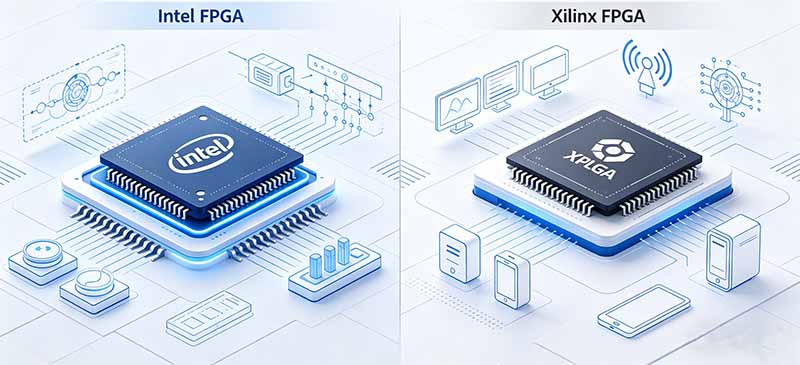
Intel Xilinx FPGA Comparison
In the FPGA market, the comparison between Intel and Xilinx (AMD) has always been a industry focus. Both offer high-performance programmable logic solutions. Intel leverages its x86 ecosystem and 3D packaging technologies to emphasize processor synergy and data center applications. Xilinx, as the inventor of the FPGA, relies on its mature architecture, comprehensive tool-chain, and adaptive platforms to support a broader range of applications and ecosystems. Together, they dominate the market, with differences in architecture and ecosystem serving as key factors in developer selection decisions.
Xilinx FPGA vs Altera FPGA
Intel (Altera) and AMD (Xilinx) are the two leading vendors in the global FPGA market. Intel FPGAs inherit Altera's technological foundation, excelling in embedded processing architectures, system-on-chip (SoC) integration, and system stability. Xilinx has long focused on high-performance logic architectures and efficient DSP capabilities, with strong expertise in parallel processing and adaptive computing. Their ongoing technological competition continues to drive industry innovation while providing developers with diverse architectural choices to better meet the needs of different application scenarios.
Intel (Altera) FPGA Product Family
Agilex Series
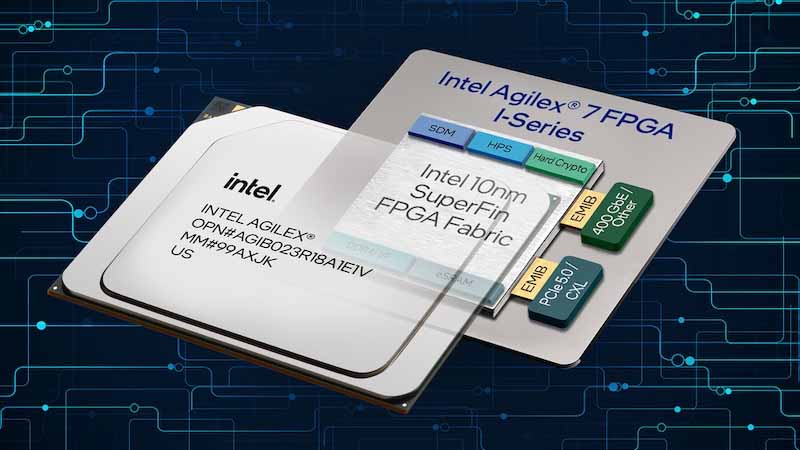
The latest generation of high-end flagship FPGAs, built on Intel 7/10nm process technology. Designed for Data Centers, 5G, AI, and HPC, it supports high-bandwidth transceivers, HBM (High Bandwidth Memory), and low-power architectures, offering the highest performance and integration in the industry.
Stratix Series
The previous generation of high-end FPGAs, primarily represented by Stratix 10. Built on a 14nm process, these devices are geared toward high-density computing, ASIC prototyping, and high-speed communication equipment.
Arria Series
The mid-range workhorse that balances performance and power consumption. The Arria 10 is the standout representative, widely used in telecommunications, industrial automation, video processing, and embedded acceleration.
Cyclone Series
A mainstream series focused on low cost and low power. Primarily consisting of Cyclone V and Cyclone 10, it targets IoT, edge control, consumer electronics, and small-to-medium scale logic applications.
MAX Series
CPLDs and non-volatile logic devices featuring "instant-on" capability. They are typically used for simple control tasks, interface logic, and configuration management.
AMD (Xilinx) FPGA Product Portfolio
Versal ACAP Series
The latest generation of Adaptive Compute Acceleration Platforms (ACAP), built on 7nm technology. More than just an FPGA, it integrates AI Engines, ARM cores, and DSP units. It is designed for AI, data centers, autonomous driving, and high-end communications.
Virtex UltraScale+ Series
The traditional highest-performance FPGA flagship, utilizing a 16nm process. It features ultra-high logic density and high-speed transceivers, primarily used for backbone networks, ASIC prototyping, and supercomputing (HPC).
Kintex UltraScale+ Series
The mid-to-high-end workhorse that offers an excellent balance of performance and cost (high price-performance ratio). It is aimed at wireless base stations, data acceleration, medical applications, and industrial vision.
Artix Series
A low-power, mid-range series including Artix-7 and Artix UltraScale+. It is designed for portable devices, edge computing, drones, and small-form-factor systems.
Spartan Series
An entry-level, low-cost series, primarily represented by Spartan-7. It is focused on simple control, IoT, education, and cost-sensitive embedded projects.
The Best FPGA for Beginners
For beginners, FPGAs are widely used in digital logic learning, embedded systems, signal processing, robotics, and IoT devices. The two main manufacturers are Intel (formerly Altera) and AMD (Xilinx), each providing complete toolchains, development boards, and beginner-friendly product lines such as Intel Cyclone and Xilinx Spartan.
Learning FPGA starts with hardware description languages (HDL), mainly Verilog and VHDL. Beginners do not need advanced electronics knowledge at first-basic logic gates, sequential circuits, and simple HDL coding are enough to begin designing real circuits.
FPGA Price
Both Intel and Xilinx offer comprehensive entry-level FPGA product portfolios. Intel primarily focuses on the Cyclone series, while Xilinx emphasizes the Spartan series. Both product lines are designed for low power consumption, low cost, and strong logic processing capabilities, making them well-suited for complex computing tasks. They are widely used in power- and cost-sensitive applications such as industrial control, automotive electronics, and consumer electronics.
When comparing products with similar logic density and performance levels, Intel FPGAs generally offer more competitive pricing and better cost-performance, especially in the entry-level and mid-range segments. Xilinx high-end products, such as the Versal ACAP and Virtex UltraScale+ series, are priced higher. However, they remain highly competitive in the high-end market due to their more mature software ecosystem, powerful development toolchains, and leading AI acceleration capabilities.
In general, due to their reconfigurability and flexibility, FPGAs tend to be more expensive than ASICs (Application-Specific Integrated Circuits) in high-volume production. However, for low to medium-volume production, rapid prototyping, or applications requiring in-field upgrades, FPGAs offer significant cost advantages.
What Are the Advantages of Altera (Intel )FPGA?
- Configurable Logic Array (LAB/LE): Flexible and reconfigurable logic units that support complex combinational and sequential circuit designs.
- Embedded Memory Blocks (M9K/M20K, MLAB): On-chip high-speed RAM, ROM, and FIFO blocks enable data caching and buffering without external memory.
- High-Speed Serial Transceivers: Support high-bandwidth data transmission and meet high-speed interface protocols such as PCIe, 10G/25G/100G Ethernet.
- Embedded DSP Blocks: Integrated multipliers, adders, and accumulators enable efficient implementation of filtering, FFT, matrix operations, and AI acceleration.
- Phase-Locked Loops (PLL) & Clock Management: Low-jitter clock distribution ensures stable high-speed design performance.
- Dedicated I/O Blocks: Support multiple voltage standards (LVCMOS, LVDS, SSTL, etc.) for various peripheral interfaces.
- Hard Processor System (HPS): Integrated ARM Cortex-A series processor enabling FPGA + CPU heterogeneous computing.
How to Choose the Intel Altera FPGA?
To help users across different application scenarios, performance requirements, and budget constraints quickly select the right FPGA, this guide provides a systematic overview of the positioning, features, and ideal use cases for the entire Altera (Intel) FPGA product.
|
Series |
Process |
Logic Density (LE) |
Core Positioning |
Typical Interfaces |
Key Advantages |
|
Agilex |
10nm/7nm |
25K–4M |
High-end flagship / Data center / AI |
PCIe 5.0, CXL, 116G transceiver |
Heterogeneous integration, HBM, AI tensor DSP |
|
Stratix 10 |
14nm |
500K–2.8M |
Ultra-high performance / ASIC prototyping |
28.05G transceiver, HBM |
Ultra-high density, excellent timing closure |
|
Arria 10 |
28nm |
115K–1.15M |
Mid-to-high end, balanced / Industrial & Communication |
12.5G transceiver, PCIe 3.0 |
Balanced power/performance, SoC integration |
|
Cyclone 10 |
28nm |
15K–265K |
Entry-level / Low power / IoT |
DDR4, LVDS |
Low cost, low power, high cost-performance |
|
MAX 10 |
55nm |
2.2K–50K |
Non-volatile / Control logic |
Single power supply, multi I/O standards |
Instant-on, CPLD features, small package |
When selecting an FPGA, it is essential to plan based on the actual application scenario, resource scale, power constraints, and budget. By comprehensively evaluating performance requirements and development conditions, you can accurately match the FPGA model that best fits your system, ensuring an optimal balance of functionality, cost, and long-term scalability.
- Define the Scenario: Identify the specific field, such as Data Center, Industrial, IoT, or Control.
- Estimate Resources: Evaluate requirements for Logic Elements (LEs), memory, DSP blocks, and interfaces.
- Match the Series: Filter options based on performance, power consumption, and cost.
- Verify Tools and Portability: Ensure robust development support and ease of future upgrades or migrations.
How to Select Intel Altera FPGA Based on Application?
1. High-Performance Computing / Data Center / AI Acceleration
Agilex Series (Intel's next-generation flagship). Selection based on performance tiers:
Agilex 9: The RF-class flagship with integrated high-speed ADC/DACs. Ideal for Radar and Software-Defined Radio (SDR).
Agilex 7: The high-end workhorse. Supports PCIe 5.0/CXL 1.1 and 116Gbps transceivers with over 1Tbps bandwidth. Best for 400GE and AI training/inference.
Agilex 5: Mid-to-high end, optimized for power efficiency. Features AI Tensor DSP acceleration with 42% lower power consumption than previous generations. Ideal for Edge AI and Video Processing.
Agilex 3: Small form factor and low power. Suitable for embedded edge and space-constrained scenarios.
Alternative: Stratix 10 (14nm). Suitable for ASIC prototyping and Supercomputing requiring extreme compute density, though power and cost are higher than the Agilex series.
2. Industrial Control / 5G & Communications / Medical Imaging
Arria 10. Offers an optimal balance between performance and power. Supports multi-channel high-speed interfaces and SoC integration (ARM Cortex-A9). Covers mid-range applications such as wireless, broadcast, and storage.
3. Consumer Electronics / IoT / Automotive Electronics
Cyclone 10. Available in GX (high performance) and LP (low power) variants. Its resource scale is tailored for small-to-medium logic designs with controllable costs. Widely used in motor control, sensor nodes, and Infotainment (IVI).
4. Simple Control / Configuration Logic / Power Management
MAX 10. Features a non-volatile architecture (instant-on) and single-rail power supply. Its small packaging is ideal for embedded control and board-level management, serving as a modern replacement for traditional CPLDs.
Sourcing original Intel FPGA products and development boards through authorized distribution channels is essential to ensure genuine product quality, stable supply, and comprehensive technical support. As an official Intel distributor, Eastech provides customers with genuine FPGA semiconductor components and development kits.
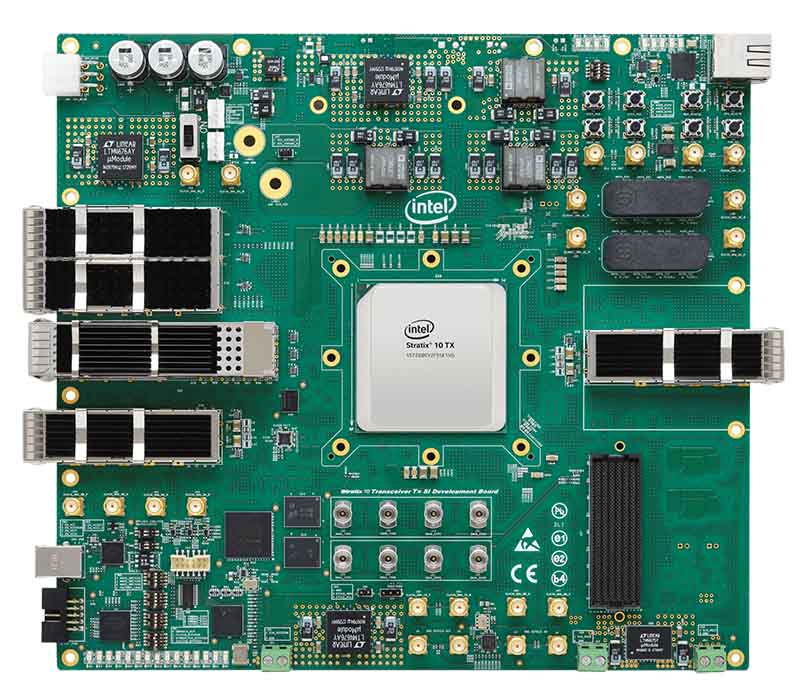
Eastech Electronics is a professional B2B and B2C electronic components distributor, focusing on the procurement needs of both electronic and non-electronic components. In addition to hardware supply, we also provide professional pre-sales selection guidance, after-sales technical support, and system-level design services, helping customers reduce development risks and improve project efficiency in a comprehensive way.
In conclusion, selecting the right FPGA solution depends on performance requirements, cost considerations, and application scenarios. A clear understanding of XILINX FPGA vs ALTERA FPGA helps engineers evaluate architectural differences, development ecosystems, and long-term scalability for different design needs. At Eastech, we support customers with reliable sourcing of FPGA solutions to ensure efficient and optimized electronic system development.