
Available 24/7 at
+86 13632816717

What is Linear and Switching Voltage Regulators?
A voltage regulator is an electronic device or circuit designed to maintain a stable output voltage. It converts an input voltage into a regulated level and keeps the output within a specific range, even when the input voltage fluctuates or the load current changes. In modern power management systems, linear and switching voltage regulators in circuit are widely used across consumer electronics, industrial control systems, communication equipment, automotive electronics, medical devices, and embedded systems, making them essential components for efficient power regulation.
What Do Linear and Switching Voltage Regulators Do?
Provides stable voltage output:
Prevents input voltage fluctuations from affecting circuit operation, ensuring electronic devices receive a consistent and reliable power supply.
Protects electronic components:
Prevents damage or performance degradation of chips, sensors, processors, and other components caused by overvoltage or undervoltage conditions.
Improves system reliability:
Supplies stable power to critical components such as MCUs, FPGAs, CPUs, and memory devices, helping reduce system failures.
Reduces noise and ripple:
Certain voltage regulators, such as LDOs, effectively suppress power supply noise and provide cleaner power for sensitive circuits, including analog and RF applications.
Enhances power conversion efficiency:
Switching regulators can efficiently perform step-down, step-up, or buck-boost voltage conversion, reducing power consumption and heat generation.
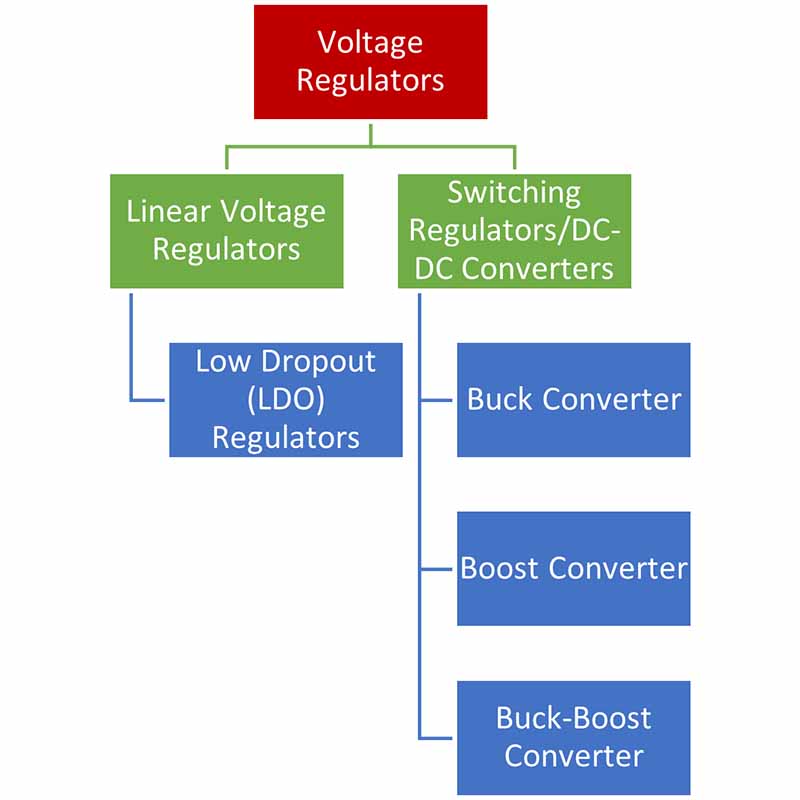
Two Types of Voltage Regulator
Linear Regulators
Switching Regulators
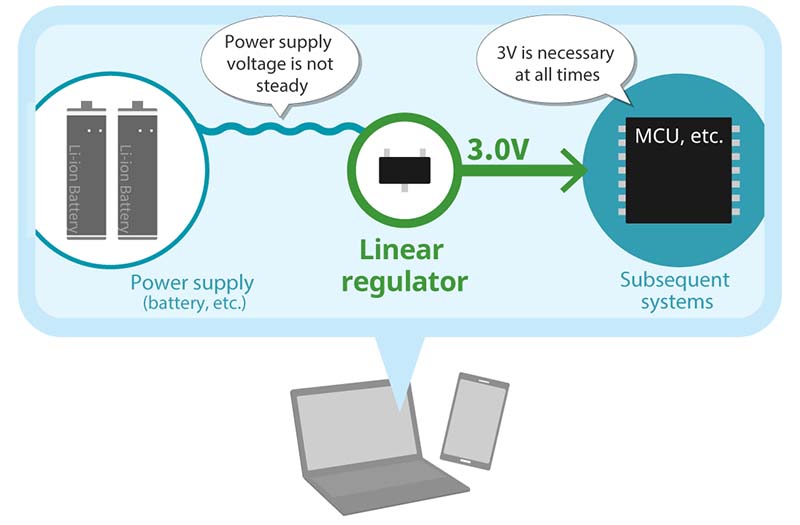
What is a Linear Regulator?
A linear regulator is a power management device that regulates output voltage by controlling an internal power transistor operating in its linear region. It maintains a constant output voltage by converting the excess voltage difference between the input and output into heat.
For example, when the input voltage is 12V and the required output voltage is 5V, the remaining 7V is dissipated as heat. Therefore, linear regulators offer advantages such as simple circuit design, low output noise, low ripple, and fast transient response. They are widely used in applications that require high power quality, including analog circuits, RF modules, audio equipment, ADC/DAC systems, and low-power microcontroller (MCU) applications.
However, because the excess energy is converted into heat, linear regulators generally have lower conversion efficiency, especially when there is a large voltage difference between input and output or when the load current is high. As a result, they are not suitable for high-power applications. Instead, they are commonly used for voltage reference generation, power supply regulation, and MCU power rails.
An LDO (Low Dropout Regulator) is a type of linear regulator designed to operate with a very small voltage difference between the input and output. Unlike traditional linear regulators, which require a larger voltage drop to maintain regulation, LDOs can provide stable output even when the input voltage is only slightly higher than the output voltage.
This feature makes LDOs more efficient than conventional linear regulators in low-voltage applications and especially suitable for battery-powered devices, low-noise circuits, portable electronics, and sensitive analog systems.
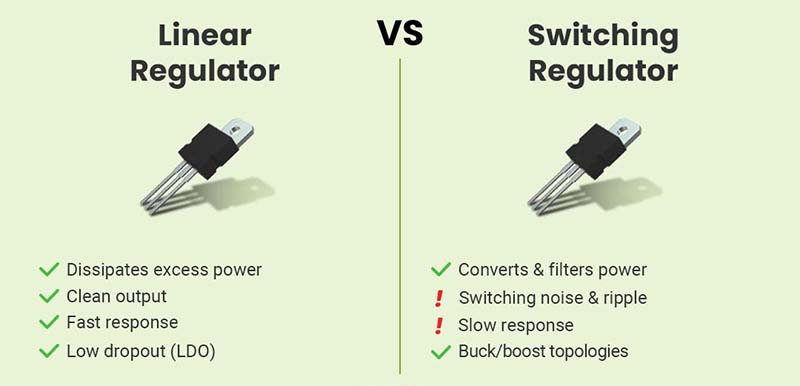
What is a Switching Regulator?
A switching regulator is a power management device that efficiently converts and regulates voltage. Also known as a DC-DC converter, it completes energy conversion through high-speed MOSFET switching, inductor energy storage, and capacitor filtering. Unlike traditional regulators, it does not dissipate excess energy as heat. Instead, it transfers energy through high-frequency switching to provide a stable output voltage with minimal power loss.
What Does a Switching Regulator Do?
By rapidly switching transistors on and off, along with energy storage and filtering through inductors and capacitors, a switching regulator converts the input voltage into a stable and adjustable DC output voltage, enabling step-up, step-down, and buck-boost voltage regulation.
Buck (Step-Down): Reduces the output voltage
Boost (Step-Up): Increases the output voltage
Buck-Boost: Maintains stable operation when the input voltage is either higher or lower than the output voltage
Compared with linear regulators, switching regulators can typically achieve 80% to over 95% conversion efficiency, generate less heat, and are more suitable for high-power applications such as CPUs, GPUs, FPGAs, AI accelerators, industrial control equipment, communication systems, and automotive electronics. However, due to their high-frequency switching operation, they may generate output ripple and electromagnetic interference (EMI), requiring proper PCB layout and filtering design.
Due to higher energy losses, linear regulators generally have lower conversion efficiency. Especially when there is a large voltage difference between the input and output or when the load current is high, they can generate significant heat, making them unsuitable for high-power applications.
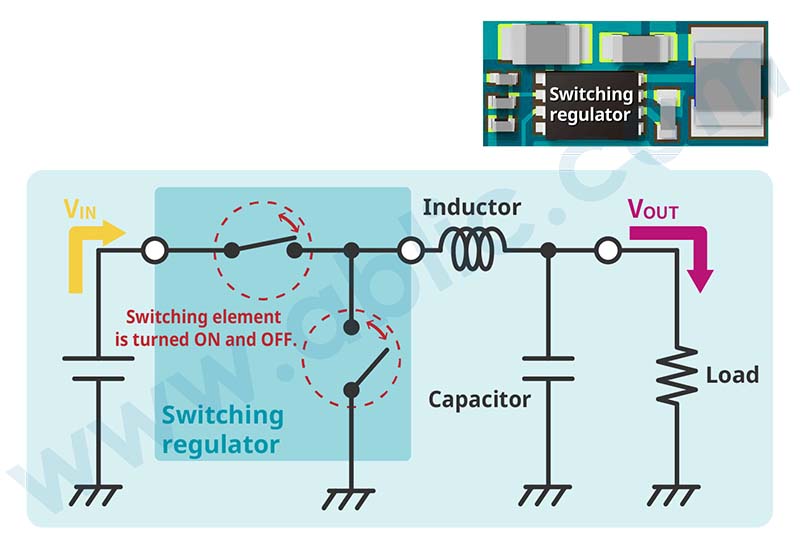
How Do Switching Regulators Work?
Unlike linear regulators, switching regulators do not dissipate excess voltage as heat. Instead, they regulate output voltage by rapidly switching a power transistor on and off at high frequency, typically ranging from hundreds of kilohertz to several megahertz.
During the ON state, electrical energy is stored in an inductor or transformer. When the switch turns OFF, the stored energy is released to the output through a diode or synchronous MOSFET, while capacitors smooth the voltage to provide a stable DC output. By continuously adjusting the switching frequency or duty cycle, the regulator maintains a constant output voltage even when the input voltage or load current changes.
The basic operating process includes:
Switch ON: The power switch conducts, allowing current to flow and storing energy in the inductor.
Switch OFF: The stored energy is transferred from the inductor to the load, maintaining the output voltage.
Feedback Control: A feedback circuit continuously monitors the output voltage and adjusts the switch duty cycle to compensate for changes in input voltage or load conditions.
This high-frequency switching technique allows switching regulators to efficiently perform step-down (Buck), step-up (Boost), and buck-boost voltage conversion while minimizing power loss and heat generation.
Linear and Switching Voltage Regulators in Circuit
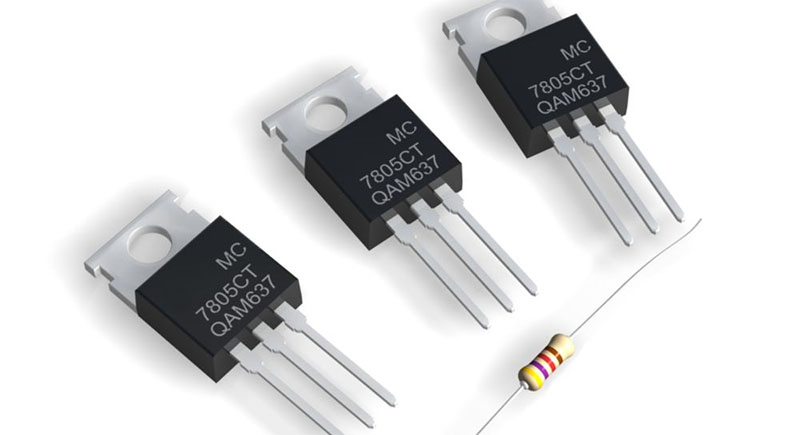
A linear regulator maintains a stable output voltage by continuously adjusting the conduction state of an internal power device and converting excess electrical energy into heat. Its structure is usually simple, consisting of three pins: input, output, and ground, with input and output capacitors used for filtering and stable power delivery.
Since it does not require high-frequency switching operation, a linear regulator can provide low-noise and low-ripple power output, making it ideal for applications with strict power quality requirements, such as analog circuits, sensors, audio equipment, and precision measurement instruments. However, its efficiency decreases when there is a large voltage difference between input and output or when the load current is high, requiring careful thermal management.
A switching regulator uses high-frequency switching control technology to convert voltage by periodically storing and releasing energy through energy storage components such as inductors and capacitors. Depending on the topology, it can perform various power conversion functions, including step-down (Buck), step-up (Boost), and buck-boost conversion.
These regulators are commonly known as DC-DC converters, switching-mode power supplies (SMPS), or switching converters. Their core operating principle is to regulate output voltage by rapidly turning switching devices such as MOSFETs on and off.
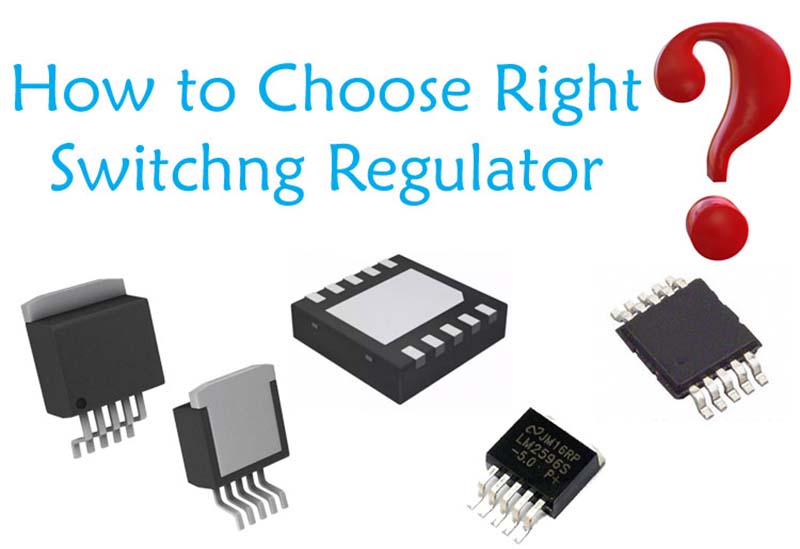
How to Choose the Linear Regulators and Switching Regulators?
When selecting a voltage regulator, several factors should be considered, including input voltage range, output voltage, current requirements, efficiency, noise performance, size limitations, and application environment. Linear regulators and switching regulators each offer distinct advantages and are suitable for different power design scenarios.
|
Items |
Linear Regulator |
Switching Regulator |
|
Operating Principle |
Reduces voltage by adjusting the resistance of internal transistors |
Converts energy through high-speed switching control |
|
Conversion Efficiency |
Lower, typically 50%-70% |
Higher, typically 80%-95%+ |
|
Output Noise |
Low noise and low ripple |
Generates switching ripple and requires filtering design |
|
Heat Generation |
Significant heat generation when there is a large input-output voltage difference |
Lower heat generation, suitable for high-power applications |
|
Circuit Design |
Simple circuit design with fewer external components |
More complex design requiring components such as inductors and capacitors |
|
PCB Space |
Requires less board space |
Requires more space for external components |
|
Cost |
Lower cost |
Relatively higher cost |
|
Suitable Applications |
Analog circuits, sensors, low-power devices |
CPUs, GPUs, battery-powered devices, industrial equipment |
Linear Voltage Regulators
Linear regulators are suitable for applications with small input-output voltage differences, low load currents, and strict noise requirements.
Input Voltage Range (VIN): Ensure that the input voltage is higher than the required output voltage and within the maximum input voltage rating.
Output Voltage (VOUT): Select either a fixed-output or adjustable-output version according to application requirements.
Maximum Output Current (IOUT): Ensure the regulator can meet the peak load current requirements.
Dropout Voltage: Low-dropout regulators (LDOs) are suitable for battery-powered devices where the input voltage is close to the output voltage.
|
Model |
Brand |
Type |
Output Voltage |
Maximum Output Current |
Applications |
|
LM7805 |
Texas Instruments (TI) |
Linear Regulator |
5V Fixed Output |
1A |
Industrial control, power modules, embedded systems |
|
AMS1117-3.3 |
Monolithic Power Systems(MPS) |
LDO Low-Dropout Regulator |
3.3V Fixed Output |
1A |
Arduino, MCUs, communication modules |
|
LM1117 |
Texas Instruments (TI) |
LDO Low-Dropout Regulator |
Adjustable 1.2V-5V |
800mA |
FPGAs, microcontrollers, consumer electronics |
|
LT3042 |
Analog Devices (ADI) |
Ultra-Low-Noise LDO |
Adjustable Output |
200mA |
RF equipment, precision analog circuits, test instruments |
|
TPS7A02 |
Texas Instruments (TI) |
Ultra-Low-Power LDO |
Adjustable 0.8V-5V |
200mA |
IoT devices, wearable devices, low-power systems |
DC DC Switching Regulators
Switching regulators are suitable for applications with large input-output voltage differences, high efficiency requirements, or high output power demands.
Conversion Types:
Buck (Step-Down): Reduces the output voltage, such as converting 12V to 5V.
Boost (Step-Up): Increases the output voltage, such as boosting a 3.7V battery voltage to 5V.
Buck-Boost: Provides stable output when the input voltage may be either higher or lower than the output voltage, such as in battery-powered applications with varying voltage levels.
Switching Frequency: Affects conversion efficiency, component size, and EMI performance.
Output Current Capability: Select according to the power consumption requirements of the system.
Efficiency Requirements: High-efficiency solutions are usually preferred for battery-powered applications.
|
Model |
Brand |
Type |
Output Voltage |
Maximum Output Current |
Applications |
|
LM2596 |
Texas Instruments (TI) |
Buck Step-Down Regulator |
Adjustable 1.23V-37V |
3A |
Power modules, embedded devices, industrial control |
|
MP1584 |
Monolithic Power Systems (MPS) |
Buck Step-Down Regulator |
Adjustable 0.8V-25V |
3A |
Consumer electronics, compact power modules |
|
TPS5430 |
Texas Instruments (TI) |
Buck Step-Down Regulator |
Adjustable 1.2V-31V |
3A |
Industrial equipment, communication systems |
|
LM2577 |
Texas Instruments (TI) |
Boost Step-Up Regulator |
Adjustable Output |
3A Switch Peak Current |
Battery voltage boosting, power conversion |
|
TPS63070 |
Texas Instruments (TI) |
Buck-Boost Regulator |
Adjustable 2.5V-9V |
2A |
Portable devices, battery-powered systems |
|
LT8640 |
Analog Devices (ADI) |
High-Efficiency Synchronous Buck Regulator |
Adjustable Output |
5A |
Automotive electronics, industrial control |
|
LTM4615 |
Analog Devices (ADI) |
µModule Buck Regulator |
Adjustable 0.8V-5V |
15A |
FPGA, DSP, ASIC power supply, communication equipment, industrial control, high-performance embedded systems |
If an electronic system prioritizes low noise, simple design, and cost control, a linear regulator is usually the preferred choice. If the system requires high efficiency, high power capability, and flexible voltage conversion, a switching regulator is typically a more suitable solution. In practical circuit designs, many high-performance devices combine both approaches, such as using a switching regulator for efficient voltage step-down conversion first, followed by an LDO for low-noise voltage regulation.
We provide a wide range of power management ICs, including linear regulators, LDO regulators, switching regulators, DC-DC converters, and other voltage regulation solutions from global semiconductor manufacturers. We provide flexible sourcing solutions for engineers, manufacturers, and distributors, supporting applications ranging from low-power embedded devices to industrial and high-performance electronic systems.
At eastechic.com, you can find a wide selection of voltage regulator ICs from leading semiconductor manufacturers. Visit Eastech to explore available models and product information. Contact us for real-time inventory, pricing, and sourcing support, or submit your BOM list for a sourcing solution.
Conclusion, voltage regulators are essential components for maintaining stable and efficient power management in modern electronic systems. While linear regulators provide simple and low-noise voltage regulation, switching solutions offer higher efficiency for power-demanding designs. Knowing what does a switching regulator do and how it manages energy conversion allows designers to make better decisions when developing advanced power management systems. By evaluating the specific needs of each application, the right voltage regulator can improve overall system performance and reliability.