
Available 24/7 at
+86 13632816717

What is the Best RAM for a Serve?
Server systems require a different level of performance and reliability compared to everyday computers, which is why understanding what is server memory is so important. Server memory is specifically designed to support heavy workloads, continuous operation, and large-scale data processing without compromising stability. In this article, we will explore how server memory works, its key classifications, and how to choose the right memory module for different business and computing.
What is RAM for Server?
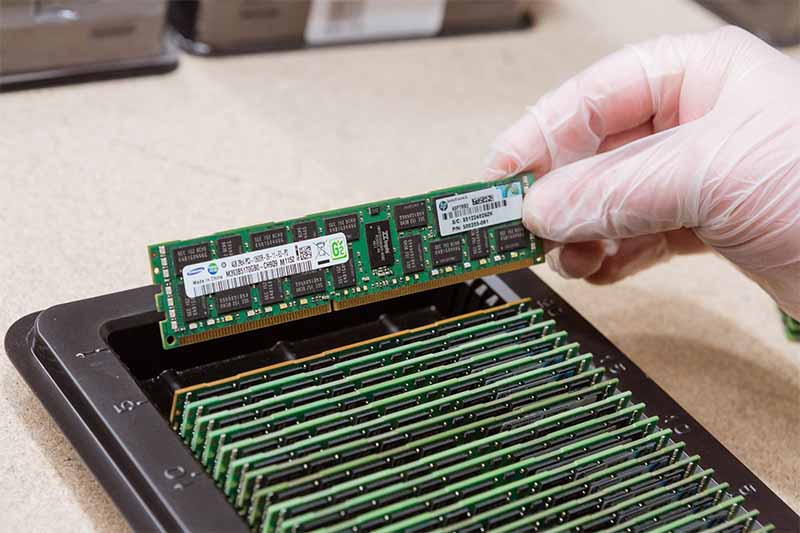
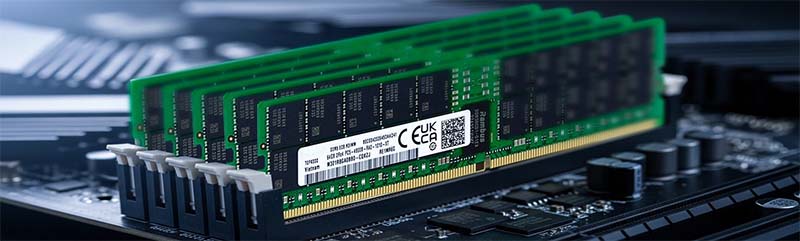
Server memory, also known as server RAM (Random Access Memory), is high-performance volatile memory specially designed for servers. It temporarily stores data and program instructions that the server's CPU needs to access instantly, supporting continuous, stable operation of multi-user, high-load business tasks.
Server RAM is a critical component that directly affects a server's speed, responsiveness, and ability to handle demanding workloads. Choosing the right type and capacity of server memory ensures reliable performance for applications ranging from web hosting and databases to virtualization and AI computing.
How Server RAM Works?
Server memory is volatile memory, which can store data temporarily and loses all stored data once the power is turned off. RAM is mounted on the motherboard in DIMM (Dual In-line Memory Module) form, or as RAM sticks, so when a server receives requests, the CPU loads frequently used data and programs into RAM from SSD or HDD. Therefore, the role of RAM is to store information according to instructions given by the CPU, making the data accessible at any time without hassle or interruptions.
Functions of Server Memory Modules
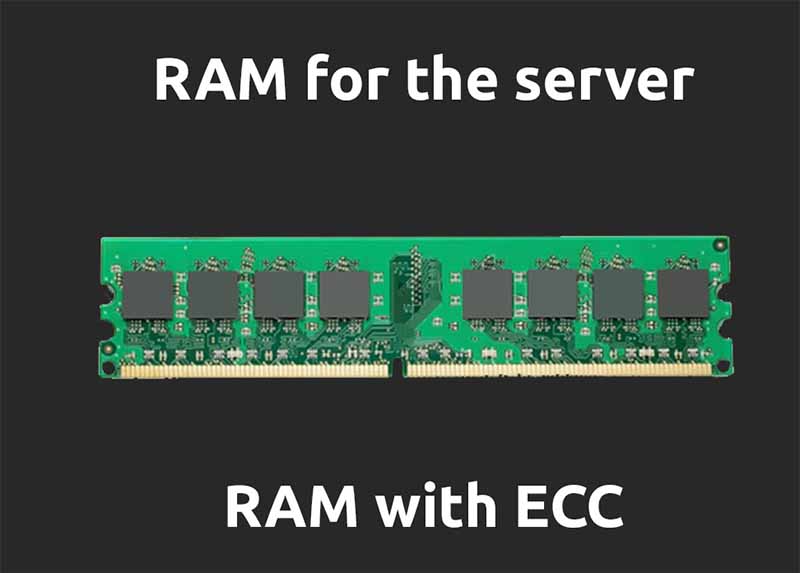
Error correction capability (ECC)
Most server memory uses ECC (Error-Correcting Code) technology. It automatically detects and fixes single-bit data errors to avoid system crashes, data corruption caused by memory bit flips, which is critical for long-running servers.
Higher stability & endurance
Built to run 24/7 under constant heavy load, with stricter manufacturing standards, better heat resistance and anti-interference performance.
Large capacity support
Supports multi-channel expansion and ultra-large single stick capacities, meeting demands of databases, virtualization, cloud computing and AI computing that require massive concurrent data caching.
Special specifications
Includes registered (RDIMM), load-reduced (LRDIMM) memory modules, which reduce signal load to realize hundreds of gigabytes of total memory on one server motherboard.
Types of Server RAM
DDR4 Server RAM – Widely used in enterprise servers with good performance and efficiency.
DDR5 Server RAM – Offers higher bandwidth, greater capacity, and improved power efficiency for modern data centers.
ECC (Error-Correcting Code) Memory – Detects and corrects memory errors to improve server reliability and data integrity.
Registered (RDIMM) and Load-Reduced (LRDIMM) Memory – Designed for servers requiring large memory capacities and stable performance.
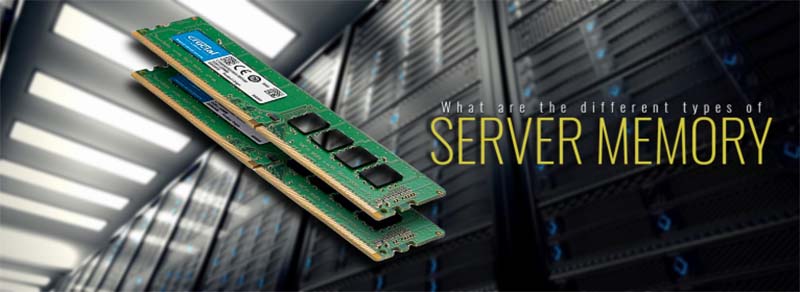
Different Types of Server Memory Modules
Group 1: Memory Generation
DDR4 Server RAM
The previous generation of server memory, operating at 1.2V with mature and stable performance.
Compatible with older Intel and AMD server platforms, especially most servers launched before 2023.
Offers a cost-effective upgrade option for existing infrastructure.
Suitable for general workloads such as web hosting, databases, file servers, and virtualization.
DDR5 Server RAM
The latest mainstream server memory generation, operating at 1.1V with significantly higher bandwidth and faster data transfer speeds.
Designed for the newest Intel and AMD server platforms.
Provides better performance for data-intensive applications and multi-core processors.
Widely used in AI computing servers, cloud infrastructure, virtualization clusters, and modern data centers.
DDR4 and DDR5 use different slots and are not physically compatible. A DDR4 server cannot use DDR5 memory. Higher speed, larger memory capacities, and improved power efficiency compared with DDR4.
DDR6 Server RAM
The next-generation server memory standard currently under development and early industry adoption. DDR6 is expected to deliver significantly higher bandwidth, improved power efficiency, and larger memory capacities than DDR5.
Designed to support future AI training, high-performance computing (HPC), and large-scale cloud data centers.
Expected to provide much faster data transfer speeds for increasingly data-intensive workloads.
Will enable servers to handle larger datasets and more demanding applications with improved efficiency.
DDR6 is not yet widely available in commercial servers. Most enterprise servers today still use DDR5, and DDR6 platforms will require new processors and motherboards, meaning DDR5 and DDR6 will not be interchangeable.
Group 2: ECC Function
(Stability – The biggest difference between server memory and desktop memory)
ECC Memory (Error-Correcting Code)
ECC memory is the standard choice for professional servers. It can automatically detect and correct small memory errors during operation. Helps prevent system crashes, data corruption, and unexpected downtime.
Recommended for databases, websites, virtualization, cloud services, ERP systems, and mission-critical applications.
Non-ECC Memory
Non-ECC memory does not include error-correction capabilities and works similarly to standard desktop RAM.
Lower cost but less reliable for continuous workloads. Suitable only for light-duty entry-level servers or non-critical applications.
Non-ECC memory may save money initially, but it carries a higher risk of system errors and instability during long-term operation.
Group 3: Module Type
UDIMM (Unbuffered Memory)
Entry-level server memory without a register buffer.
Supports fewer memory modules and lower maximum capacities.
Typically used in single-socket mini servers, NAS systems, and small office servers. UDIMM is suitable for basic servers with limited memory requirements.
RDIMM (Registered DIMM)
The most common and versatile type of server memory.
Provides a good balance between cost, performance, and expandability.
Supports larger memory capacities than desktop memory while maintaining excellent stability. Ideal for most enterprise applications, including web servers, databases, ERP systems, and virtualization environments.
LRDIMM (Load-Reduced DIMM)
Designed for servers that require extremely large memory capacities. Supports hundreds of gigabytes or even several terabytes of RAM in a single server.
Reduces the electrical load on the memory controller, allowing significantly higher memory expansion. Best suited for big data analytics, in-memory databases, AI training, high-performance computing, and large virtualization clusters.
Simple Example Memory Specification: DDR5 ECC RDIMM
DDR5 = Latest generation, faster speed and higher efficiency.
ECC = Automatically corrects memory errors for reliable 24/7 operation.
RDIMM = Standard enterprise server module with balanced capacity and cost.
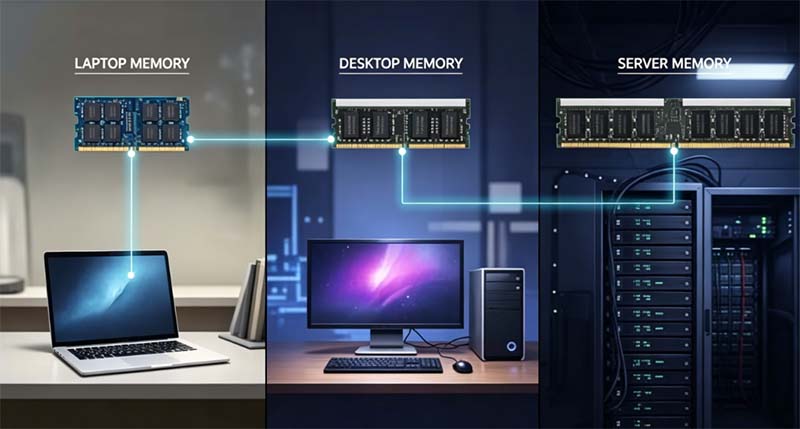
Can Server Memory be Used in Desktop?
The answer is sometimes, but not always. Whether server memory works in a desktop depends on the memory type and whether your motherboard and CPU support it.
1. UDIMM (Unbuffered DIMM)
Some ECC UDIMM modules can work in desktop systems if the motherboard and processor support ECC memory.
Generally compatible in physical size with desktop DIMM slots. Requires chipset and BIOS support for ECC functions. Some ECC UDIMM modules can be used in desktops, but compatibility must be verified.
2. RDIMM (Registered DIMM)
RDIMM is generally not compatible with desktop PCs. Requires server-grade memory controllers. Most consumer motherboards and CPUs do not support registered memory.
3. LRDIMM (Load-Reduced DIMM)
LRDIMM is also incompatible with standard desktop systems.
Designed for high-capacity enterprise servers. Requires specialized server processors and motherboards. Not supported by consumer platforms. LRDIMM is strictly for servers and high-end enterprise systems.
|
Memory Type |
Used in a Desktop |
|
Non-ECC UDIMM |
✅ Yes |
|
ECC UDIMM |
Sometimes, if supported |
|
RDIMM |
❌ No |
|
LRDIMM |
❌ No |
Most server memory modules cannot be used in regular desktop PCs. ECC UDIMM may work on certain workstation or ECC-capable desktop platforms, but RDIMM and LRDIMM require server-grade hardware and are generally incompatible with consumer desktops.
How to Choose Server Memory for Enterprises & Data Centers
Server memory (RAM) directly determines virtualization density, database throughput, AI computing efficiency, and business stability. Enterprise & data center memory selection must balance workload type, capacity, performance, reliability, scalability, TCO, and hardware compatibility.
1. Core Workloads
Different business scenarios have drastically different memory requirements.
(1) Virtualization / Cloud Hosts (VMware, KVM, OpenStack)
Demand: High total memory capacity, high density, consistent memory bandwidth for multi-VM concurrency
Allocation rule: Allocate 2–4GB minimum per light VM; 8–16GB for business VMs; 32GB+ for heavy application VMs
Memory recommendation:
Use RDIMM/LRDIMM for high-capacity expansion; LRDIMM preferred for >1TB total server RAM
(2) Databases (MySQL, PostgreSQL, Oracle, SQL Server)
Demand: Large memory cache to reduce disk I/O, stable latency, error correction.
OLTP (transactional): 50%–70% of server RAM allocated to database buffer pool.
OLAP/data warehouse: Larger memory for parallel aggregation, sorting.
Memory recommendation:
Enterprise-grade ECC memory mandatory; Oracle large deployments prefer LRDIMM for >512GB.
Higher frequency (3200MT/s / 3600MT/s) for join & index queries.
(3) AI / GPU Computing / HPC
Demand: Ultra-high memory bandwidth, large capacity for model loading, high parallel throughput.
GPU onboard HBM/HBM3
Memory recommendation:
DDR5 high-speed RDIMM/LRDIMM (4800/5600MT/s)
Quad/octa-rank modules for maximum memory bandwidth
(4) Web/Application Servers (Java/.NET microservices)
Demand: Moderate capacity, low latency, cost control
Memory recommendation:
DDR4/DDR5 RDIMM ECC, single/dual rank sufficient.
128GB–512GB per 2-socket node, horizontal scaling preferred over single-node oversized memory.
2. ECC support
Enterprise memory must support ECC (Error Correcting Code).
3. Memory speed (MT/s matters, but is CPU-limited)
Memory speed must match CPU supported frequency.
Example:
DDR4: 2133–3200 MT/s typical
DDR5: 4800–6400+ MT/s typical
Before purchasing, confirm:
✔ CPU model (Intel Xeon / AMD EPYC generation)
✔ DDR4 or DDR5 support
✔ RDIMM / LRDIMM / UDIMM compatibility
✔ Required ECC support
✔ Number of DIMM slots per CPU
✔ Target capacity per server
✔ Required memory speed (MT/s)
✔ Expansion plan
What is the Best RAM for a Serve?
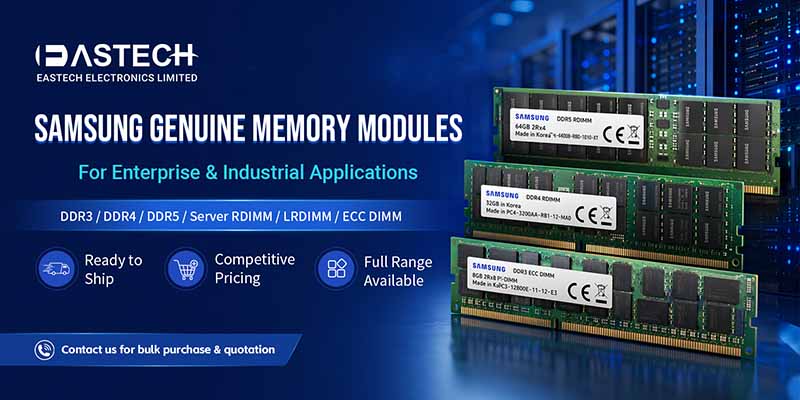
In data center and enterprise computing environments, the choice of memory directly determines system stability and overall performance. The following provides a selection of popular server memory models, covering different generations of DDR4 and DDR5 products, and spanning the core product lines from the three major original manufacturers-Micron, Samsung, and SK hynix. It includes mainstream DIMM types such as standard RDIMM for general-purpose workloads and high-density LRDIMM for capacity expansion, offering full compatibility with both new and previous-generation Xeon and EPYC server platforms. It covers most data center workloads, including virtualization, databases, storage clusters, and AI computing workloads. Of course, there are many more models that cannot all be listed here. If you have any requirements, please leave a message on the website.
|
|
DDR4 |
DIMM Type |
DDR5 |
DIMM Type |
|
Micron |
MTA36ASF1G72PZ-1G3 |
RDIMM ECC |
MTA16ASF4G64AZ-64B |
ECC UDIMM |
|
MTA36ASF2G72PZ-1G3 |
RDIMM ECC |
MTA36ASF2G72PZ-48B |
RDIMM ECC |
|
|
MTA36ASF4G72PZ-1G3 |
RDIMM ECC |
MTA36ASF4G72PZ-48B |
RDIMM ECC |
|
|
MTA36ASF8G72PZ-1G3 |
RDIMM ECC |
MTA36ASF8G72PZ-48B |
RDIMM ECC |
|
|
MTA36ASF2G72PZ-1G5 |
RDIMM ECC |
MTA36ASF2G72PZ-56B |
RDIMM ECC |
|
|
MTA36ASF4G72PZ-1G5 |
RDIMM ECC |
MTA36ASF4G72PZ-56B |
RDIMM ECC |
|
|
MTA36ASF8G72PZ-1G5 |
RDIMM ECC |
MTA36ASF8G72PZ-56B |
RDIMM ECC |
|
|
MT16KTF1G64HZ-1G3 |
ECC UDIMM |
MTA36ASF16G72PZ-56B |
RDIMM ECC |
|
|
MT16KTF1G64HZ-1G5 |
ECC UDIMM |
MTA36ASF4G72PZ-64B |
RDIMM ECC |
|
|
MT16KTF2G64HZ-1G5 |
ECC UDIMM |
MTA36ASF8G72PZ-64B |
RDIMM ECC |
|
|
Samsung |
M393A1K40BB1-CTD |
RDIMM ECC |
M321R1GA3EB2-CCP |
RDIMM ECC |
|
M393A2K40BB1-CTD |
RDIMM ECC |
M321R2GA3EB2-CCP |
RDIMM ECC |
|
|
M393A4K40BB1-CTD |
RDIMM ECC |
M321R4GA3EB2-CCP |
RDIMM ECC |
|
|
M393A8K40BB1-CTD |
RDIMM ECC |
M321R8GA0EB2-CCP |
RDIMM ECC |
|
|
M393A1K40BB1-CWE |
RDIMM ECC |
M321RAJA0MB2-CCP |
RDIMM ECC |
|
|
M393A2K40BB1-CWE |
RDIMM ECC |
M322R4GA0LB2-CWM |
RDIMM ECC |
|
|
M393A4K40BB1-CWE |
RDIMM ECC |
M322R8GA0LB2-CWM |
RDIMM ECC |
|
|
M393A8K40BB1-CWE |
RDIMM ECC |
M322R16GA0LB2-CWM |
RDIMM ECC |
|
|
M386A4K40BB1-CTD |
LRDIMM ECC |
M322R8GA0LB2-CCP |
RDIMM ECC |
|
|
M386A8K40BB1-CTD |
LRDIMM ECC |
M322R16GA0LB2-CCP |
RDIMM ECC |
|
|
M386A16K40BB1-CTD |
LRDIMM ECC |
M435R1GB4AB0-CWM |
RDIMM ECC |
|
|
SK hynix |
HMA84GR7DJR4N-VKT8 |
RDIMM ECC |
HMCT04MEERA135N |
RDIMM ECC |
|
HMA84GR7CJR4N-UHT2 |
RDIMM ECC |
HMCT04MEERA129N |
RDIMM ECC |
|
|
HMA84GR7CJR4N-UHTN |
RDIMM ECC |
HMCT04MEERA133N |
RDIMM ECC |
|
|
HMA84GR7CJR4N-UHTD |
RDIMM ECC |
HMCG94MEBQA109N |
RDIMM ECC |
|
|
HMAG78EXNRA084N |
LRDIMM ECC |
HMCG94MEBRA109N |
RDIMM ECC |
|
|
HMAG78EXNRA086N |
LRDIMM ECC |
HMCG94MEBRA123N |
RDIMM ECC |
|
|
HMA82GR7CJR8N-XNT4 |
RDIMM ECC |
HMCG94MEBQA112N |
RDIMM ECC |
|
|
HMAG78EXNRA199N |
LRDIMM ECC |
HMCG94MEBRA121N |
RDIMM ECC |
|
|
HMA82GS7DJR8N-XNT0 |
RDIMM ECC |
HMCG94MEBQA123N |
RDIMM ECC |
|
|
HMA82GR7CJR8N-XNT8 |
RDIMM ECC |
HMCG78MEBRA107N |
RDIMM ECC |
|
|
HMA82GU7DJR8N-XNT0 |
RDIMM ECC |
HMCG78MEBRA113N |
RDIMM ECC |
Looking for the best server memory for data centers and cloud computing? Find the best memory at eastechic.com Eastech focuses on the supply and supporting services of enterprise-grade memory and electronic components, and has long provided stable and reliable product solutions for global servers, data centers, and industrial computing customers. Relying on a well-established supply chain system and a strict quality screening mechanism, we are able to offer storage products from globally renowned brands such as Samsung, Micron, and SK hynix, including ECC RDIMM, LRDIMM memory, as well as one-stop supply support for SSD storage and chip products.
In conclusion, choosing the best RAM for a server depends on workload requirements, system compatibility, and long-term reliability needs. Understanding what is server memory helps clarify why servers use specialized memory designed for stability, error correction, and continuous operation. By comparing different types of server memory modules, users can better match memory specifications to specific applications, whether for small business servers or large-scale data centers.