

Available 24/7 at
+86 13632816717

Where to Buy the Best Memory Chips?
Memory chips are semiconductor integrated circuits designed to store data and programs, widely used in computers, servers, smartphones, automotive electronics, industrial control systems, communication equipment, and artificial intelligence (AI) applications. Based on storage methods and application requirements, memory chips can be divided into different types. This article discusses different memory types and guides readers on where to buy memory chips.
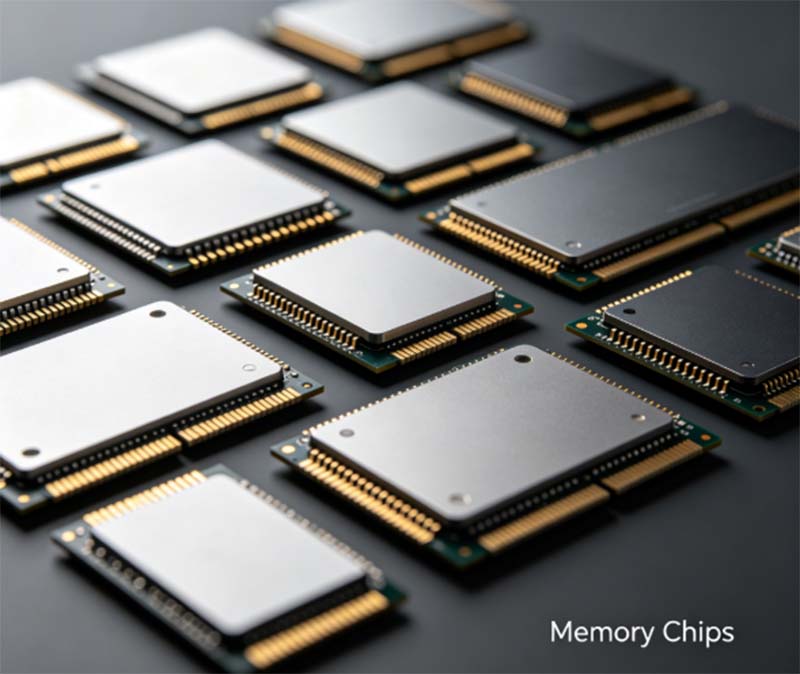
Two Types Memory Chips
Volatile memory requires continuous power to keep stored data. When the power is turned off, the data is lost. It is mainly used for temporary data storage and fast access, such as DRAM and SRAM in computers and other electronic devices.
Non-volatile memory can retain data even without power. It is used for long-term data storage, such as NAND Flash and NOR Flash in SSD, memory card, and embedded system.
What are Memory Chips?
Memory chips are key components in electronic devices responsible for storing data. They can temporarily store data being processed or permanently retain operating systems, applications, and user files. With the development of AI, high-performance computing (HPC), cloud computing, and data centers, the demand for high-speed and high-capacity memory chips continues to grow.
Silicon serves as the core raw material for all storage chips, and this substance can be extracted from sand. Production melt sand to isolate pure silicon elements at the initial stage. After melting, the silicon liquid undergoes controlled cooling to form solid silicon ingots. These ingots are then cut, polished and finely ground to get smooth silicon wafers that meet production standards. These finished wafers are manufactured into integrated circuits, which are the basic components for assembling memory chips.
How Does a Memory Chip Work?
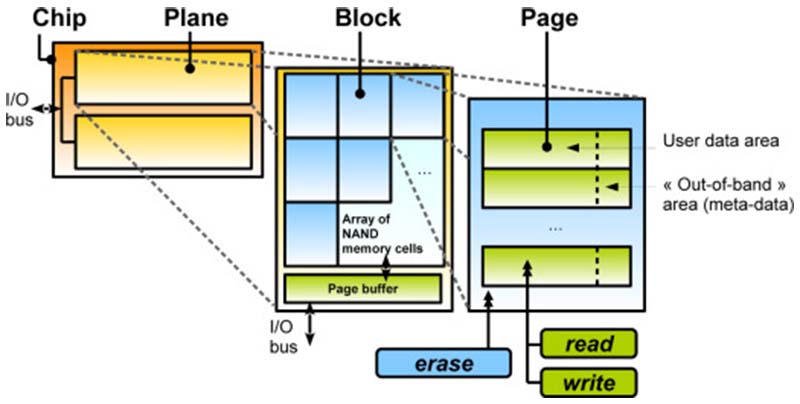
Memory chips store data in tiny electronic circuits called memory cells. Each memory cell uses one or more transistors to represent a binary value-either 0 or 1. Billions of these cells are integrated onto a single chip to store digital information.
When the processor needs specific data, it sends a unique memory address to the chip. The memory chip locates the corresponding memory cell, reads the stored binary data, and quickly returns it to the processor. Likewise, when new data needs to be stored, the processor sends both the memory address and the data, allowing the chip to update the selected memory cell.
What are the Different Types of Memory Chips?
Memory chips can be broadly categorized into several types based on their function, performance, and data retention capabilities. Each type is designed for specific applications, ranging from high-speed computing to long-term data storage.
DRAM (Dynamic Random Access Memory)
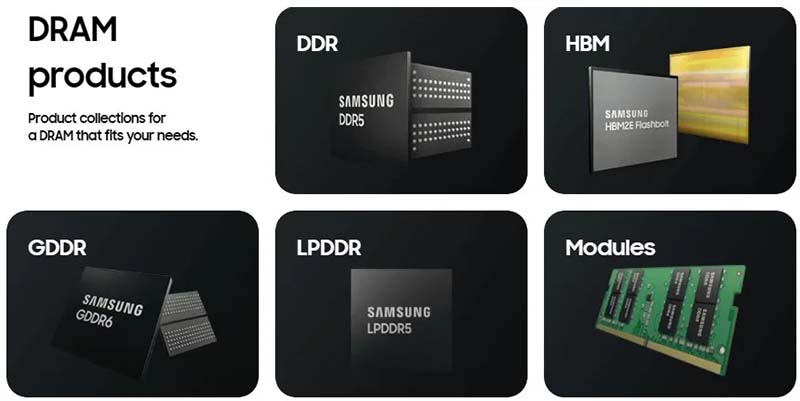
DRAM is the most widely used volatile memory in computers, servers, and mobile devices. It temporarily stores data that the processor needs while applications are running, providing fast read and write performance for everyday computing tasks. Modern DRAM technologies include DDR4, DDR5, LPDDR for mobile devices, GDDR for graphics cards, and HBM for AI and high-performance computing. As system memory, DRAM plays a critical role in overall system responsiveness and multitasking performance.
SRAM (Static Random Access Memory)
SRAM is a high-speed volatile memory that offers lower latency and faster access than DRAM because it does not require periodic refreshing. Although it is more expensive and has lower storage density, SRAM is ideal for applications where speed is critical.
NAND Flash Memory
NAND Flash is the dominant non-volatile memory technology for data storage. Unlike DRAM, it retains information even when power is removed, making it ideal for storing operating systems, applications, and user files. Thanks to its high storage density, low power consumption, and cost-effectiveness, NAND Flash is widely used in SSDs, smartphones, USB flash drives, memory cards, and embedded storage systems.
NOR Flash Memory
NOR Flash is another type of non-volatile memory designed for applications that require fast random read access and reliable code execution. It is commonly used to store firmware, BIOS, bootloaders, and embedded software in industrial equipment, automotive electronics, networking devices, and IoT products. Although it offers lower storage density than NAND Flash, its ability to execute code directly from memory makes it the preferred choice for embedded systems.
ROM (Read-Only Memory)
ROM stores permanent instructions that rarely change. Traditional ROM is programmed during manufacturing, while modern versions are programmable or erasable.
EEPROM (Electrically Erasable Programmable Read-Only Memory)
EEPROM is a non-volatile memory that can be electrically erased and rewritten multiple times, typically in small amounts.
HBM (High Bandwidth Memory)
HBM is an advanced DRAM technology that stacks multiple memory dies vertically using Through-Silicon Vias (TSVs), delivering extremely high bandwidth with improved power efficiency.
GDDR (Graphics Double Data Rate Memory)
GDDR is specialized DRAM designed specifically for graphics processors, providing high bandwidth for rendering graphics and accelerating AI workloads.
Comparison of Different Types of Memory Chips
|
Memory Type |
Types |
Speed |
Primary Use |
|
DRAM |
DDR4, DDR5, LPDDR5, HBM |
High |
System memory for PCs, servers, AI workstations, and cloud computing |
|
SRAM |
Asynchronous SRAM, Synchronous SRAM, QDR SRAM |
Very High |
CPU/GPU cache, networking equipment, and high-speed buffering |
|
NAND Flash |
SLC, MLC, TLC, QLC |
Moderate |
SSDs, smartphones, memory cards, USB drives, and embedded storage |
|
NOR Flash |
Parallel NOR, Serial NOR |
Moderate |
Firmware storage, BIOS/UEFI, embedded systems, automotive ECUs, and IoT devices |
|
ROM |
Mask ROM, PROM |
Moderate |
Permanent firmware and factory-programmed embedded applications |
|
EEPROM |
Serial EEPROM, Parallel EEPROM |
Moderate |
Device configuration, calibration data, BIOS settings, and microcontroller parameter storage |
|
HBM |
HBM2, HBM2E, HBM3, HBM3E |
Extremely High |
AI accelerators, HPC systems, GPUs, and data center workloads requiring ultra-high bandwidth |
|
GDDR |
GDDR5, GDDR6, GDDR6X, GDDR7 |
Very High |
Graphics cards, AI inference GPUs, professional visualization, and gaming systems |
What are Memory Chips Used For?
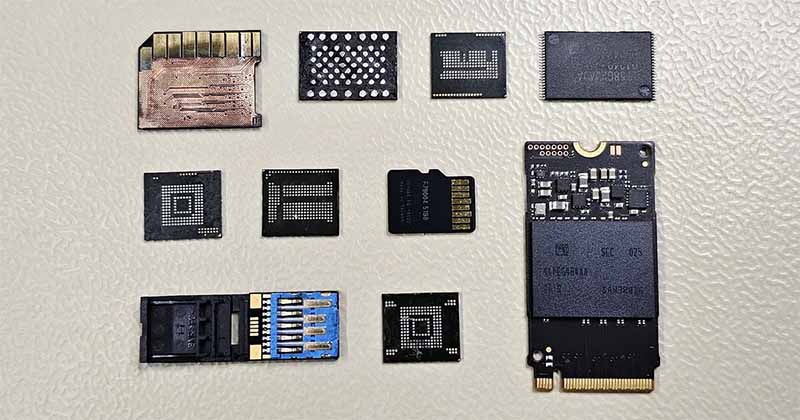
Memory chips function as core semiconductor components for digital data storage and access in all electronic hardware. They deliver temporary operating space and long-term storage capacity, empowering electronic systems to execute program operations, compute data, and retain user files steadily.
Computers and servers
Volatile DRAM chips serve as the main system memory, holding real-time data and program instructions that the CPU requires for instant application execution and system operation.
Smartphones and tablets
Embedded memory chips store the device operating system, installed applications, multimedia files and personal user data to support daily device operation and local data access.
Data centers and AI systems
High-bandwidth memory solutions including HBM and advanced DDR chips provide ultra-fast data transmission and throughput, supporting massive data computing, AI model training and cloud service processing.
Storage devices
Non-volatile NAND Flash chips act as the core storage medium for SSD, flash USB drives and memory cards, preserving stored data permanently without continuous power supply.
Automotive electronics
Specialized automotive-grade memory chips embed control firmware and operational data for vehicle infotainment systems, advanced driver assistance systems and autonomous driving modules.
Industrial and IoT devices
Compact memory chips provide local data storage and lightweight data processing capabilities for intelligent sensors, industrial terminals and IoT endpoint devices.
What is the Difference Between Memory Chips and Hard Drives, Storage?
Memory chips rely on tiny transistor storage cells to temporarily hold data with power supply, featuring extremely fast read-write speeds but losing all stored information once power cuts off. They mainly work to cache real-time data and program instructions for processors to run tasks instantly.
Hard drives are long-term storage hardware that saves data on magnetic disks or flash particles. They retain all files without electricity, offer much larger storage capacity, yet run slower than memory chips, and are used for permanently storing systems, videos and various files.
Memory Chips for Storage
Memory chips are used in hard drives, but primarily in solid-state drive (SSD), not traditional hard disk drive (HDD).
Solid-state drives use NAND flash memory chips as their core storage medium to permanently store all files, systems, and user data without a power supply. Meanwhile, most SSDs are also equipped with independent DRAM memory chips to store mapping tables for fast address lookup, drastically boosting random read and write efficiency. Unlike mechanical hard drives, SSDs complete all data access operations purely through semiconductor memory chips.
Memory Chips for Manufacturers in the AI Wave
In the era of AI, cloud computing and intelligent hardware, memory chips are the core profit engine, technical competitive barrier and business expansion foundation for semiconductor and electronic manufacturers.
Core source of revenue and profit
Driven by explosive demand for AI servers, HBM and high-speed DDR products, memory chips maintain high market prices and gross margins. Memory manufacturers gain massive revenue growth by adjusting wafer capacity to prioritize high-value storage chips, while electronic device makers rely on matched memory configurations to stabilize product gross profit margins.
Core technical competitive moat
Advanced memory products like stacked HBM and automotive-grade chips require exclusive wafer thinning, multi-layer stacking and precise circuit manufacturing technologies. Mastering memory chip R&D and production lets manufacturers form unique technical advantages, and enables deep cooperation with GPU, cloud computing and automotive chip developers to lock long-term bulk orders.
Key support for full-product line iteration
All terminal equipment including servers, smartphones, auto electronics and IoT devices rely on matched memory chips to run systems, process real-time data and store firmware. Stable self-supplied or customized memory chips help manufacturers launch higher-performance new products faster and improve product competitiveness against rivals.
Core carrier for industrial transformation and layout
Memory chips are the essential hardware foundation of digital infrastructure. Investing in memory R&D and production helps manufacturers seize growth opportunities in AI computing, intelligent vehicles and data center markets, realize industrial upgrading, and expand market share in high-growth emerging tracks.
Challenge of Global Memory Shortage
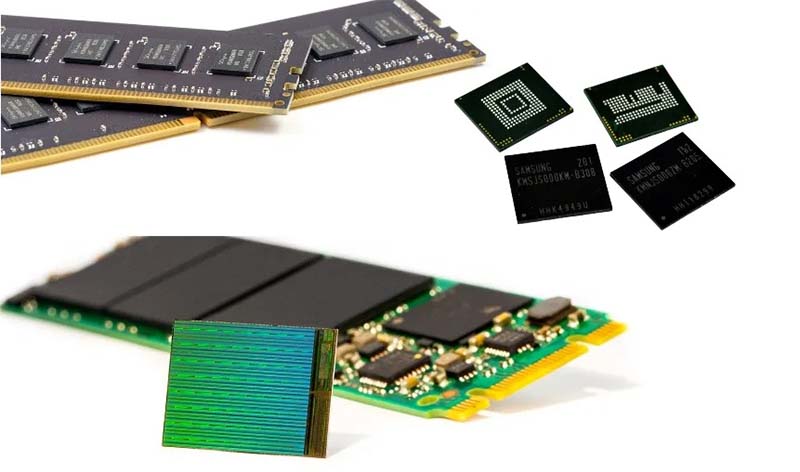
The global memory chip market is currently facing supply constraints and rising prices, driven primarily by the rapid growth of AI computing demand. The expansion of AI applications has significantly increased demand for high-performance memory solutions, including HBM and DDR5. Meanwhile, major memory manufacturers are optimizing production capacity and prioritizing supply to leading cloud service providers, resulting in tighter availability of standard DRAM and NAND Flash products for industries such as servers, consumer electronics, automotive, and industrial applications.
Where to Buy the Best Memory Chips?
Combined with increasing costs for wafers and raw materials, many companies are experiencing longer lead times, higher procurement costs, and potential production risks due to unstable memory supply.
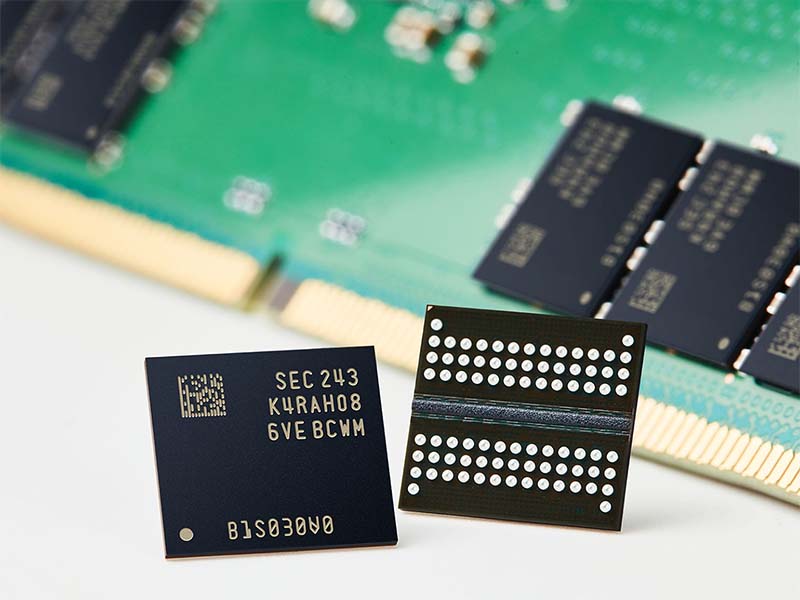
As the best memory chips distributor, we maintain long-term partnerships with leading memory manufacturers, including Samsung, Micron, and SK hynix. With reliable supply channels and a global inventory sourcing network, we provide stable access to standard, shortage, discontinued, industrial-grade, and automotive-grade memory.
Our product covers a wide range of memory chips, for more information on memory chip models, stock, and pricing, please feel free to contact us.
DDR4 / DDR5 Memory
HBM (High Bandwidth Memory)
eMMC
UFS
NAND Flash Memory
One-Stop Memory Chip Supply Solutions
|
Mfr Part |
Mfr |
Description |
Memory Format |
|
KLM8G1GEUF-B04P |
Samsung |
8GB Automotive-Grade Memory |
eMMC 5.1 |
|
KLM8G1GEUF-B04Q |
Samsung |
8GB Automotive-Grade Memory |
eMMC 5.1 |
|
KLMCG4JEUD-B04Q |
Samsung |
64GB Industrial-Grade Memory |
eMMC 5.1 |
|
SDINBDA6-64-XI1 |
Sandisk |
8GB Industrial-Grade Memory |
eMMC |
|
K4UBE3D4AB-MGCL |
Samsung |
4GB Commercial-Grade Memory |
LPDDR4 Mobile DRAM |
|
K4F6E3S4HM-THCL |
Samsung |
2GB Automotive-Grade Memory |
LPDDR4/LPDDR4X DRAM |
|
K4FBE3D4HM-THCL |
Samsung |
4GB Automotive-Grade Memory |
LPDDR4X DRAM |
|
K4FBE3D4HM-TFCL |
Samsung |
4GB Automotive-Grade Memory |
LPDDR4X DRAM |
|
K4UCE3Q4AB-KHCL |
Samsung |
8GB Automotive-Grade Memory |
LPDDR4X DRAM |
|
K4UCE3Q4AB-KFCL |
Samsung |
8GB Automotive-Grade Memory |
LPDDR4X DRAM |
|
K3KL9L90QM-MFCT |
Samsung |
4GB |
Mobile DRAM (LPDDR) |
|
THGJFGT0T25BAB8 |
TOSHIBA |
16GB |
eMMC |
Our technical team can provide BOM optimization and component replacement solutions, helping customers identify compatible memory alternatives with comparable performance while reducing material costs.
Reliable Memory Solutions for Automotive and Industrial Applications
During periods of market shortages and price fluctuations, we help customers maintain stable production through reliable sourcing, supply chain management, and technical support.
With strong supply capabilities, competitive pricing strategies, and extensive experience in memory components, we are committed to becoming a trusted memory chip distribution partner for manufacturers, OEMs, and system integrators worldwide.
Last but not least, as AI, IoT, and data-driven applications continue to grow, the demand for high-performance and reliable memory solutions is increasing. Choosing a trusted memory authorized distributor ensures genuine products, stable supply, and professional support, helping customers build efficient solutions for next-generation computing and intelligent devices.
Related information
- 2026.06.16 What is the Best RAM for a Serve?
- 2026.06.07 What Are NVIDIA Professional Gpus?