
Available 24/7 at
+86 13632816717

IMU Sensors for Automated Systems: Applications in Intelligent Robotics
IMU sensors are important in intelligent robots and automated systems by providing accurate motion tracking, orientation measurement, and real-time movement data. From humanoid robots and autonomous mobile robots (AMRs) to industrial robotic arms and precision automation equipment, these sensors support stable operation, precise motion control, and reliable navigation. As automation technologies continue to advance, selecting the best IMU for automated systems has become increasingly important for achieving high performance, improving operational accuracy, and ensuring consistent system reliability.
What Are IMU Sensors?
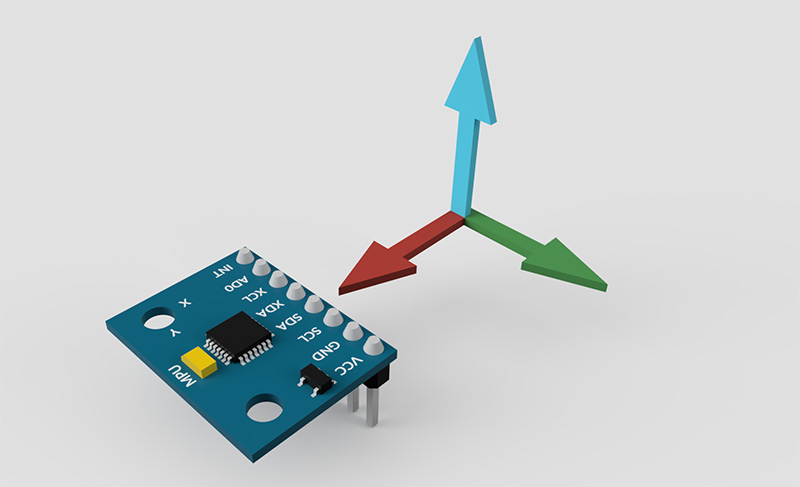
An Inertial Measurement Unit (IMU) is an electronic sensor module designed to measure an object's motion, orientation, and acceleration in three-dimensional space. It typically integrates three-axis accelerometers and three-axis gyroscopes, while some advanced IMUs also include a three-axis magnetometer to provide additional directional information. By collecting and processing inertial data, IMU sensors can detect linear acceleration, angular velocity, rotational movement, and changes in orientation.
IMU sensors are widely used in intelligent robots, autonomous mobile robots (AMRs), drones, industrial automation equipment, and other motion-sensitive systems. In these applications, they provide real-time motion feedback that helps controllers monitor movement, estimate position and orientation, maintain balance, and execute precise movements. As a result, IMU sensors for automated systems have become essential that require accurate motion detection and stable operation.
Modern MEMS-based IMU sensors offer compact dimensions, low power consumption, and reliable measurement performance, making them suitable for space-constrained embedded designs and battery-powered robotic devices.
How IMU Sensors Improve Motion Control and Navigation in Robots?
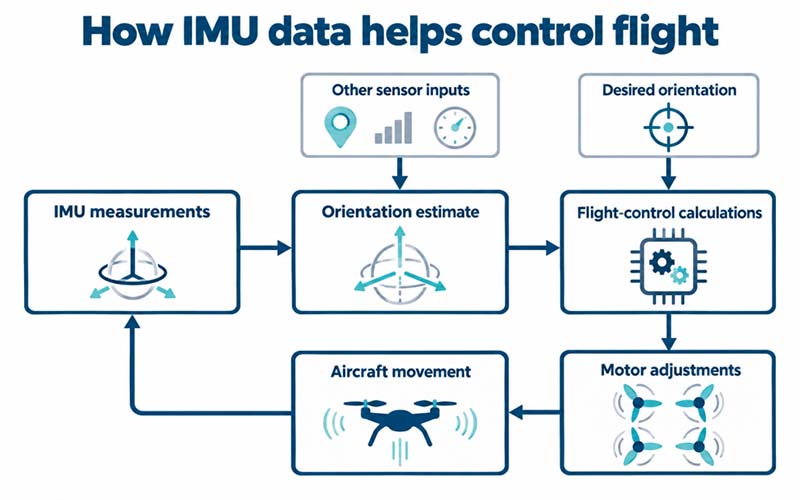
IMU sensors are fundamental components in robotic motion control and navigation systems, providing real-time inertial data for accurate movement measurement and orientation estimation. Built around MEMS (Micro-Electro-Mechanical Systems) technology, these sensor devices integrate miniature accelerometers and gyroscopes to detect linear acceleration and angular velocity across three axes.
By converting physical movement into measurable electrical signals and digital data, IMU sensor chips provide essential inputs for embedded processors and motion control circuits. This information allows robotic systems to monitor movement, calculate orientation changes, and make timely adjustments to motor operations. In practical applications, IMU sensors improve robotic performance in several key areas.
1. Real-Time Motion Detection and Feedback
MEMS accelerometer chips measure linear acceleration, while gyroscope chips detect rotational speed along the X, Y, and Z axes. These measurements help robotic controllers identify changes in speed, direction, tilt, and vibration. The resulting motion data can be used by embedded control systems to adjust motor speed and movement trajectories, supporting more responsive and precise robotic operations.
2. Orientation Estimation and Dynamic Stability
IMU sensors provide continuous data for estimating a robot's roll, pitch, and yaw. By processing accelerometer and gyroscope outputs through sensor fusion algorithms, the control system can detect posture changes, instability, and unexpected movements.
3. Navigation and Positioning Assistance
For autonomous mobile robots and automated guided vehicles (AGVs), IMU chips provide motion and orientation information that supports navigation and localization. By combining inertial measurements with data from LiDAR, cameras, wheel encoders, or GPS receivers, robotic systems can improve movement estimation and maintain navigation performance in environments where external positioning signals are limited.
4. Sensor Integration in Embedded Control Systems
From a microelectronics perspective, MEMS IMU chips are designed for integration into compact electronic control boards and embedded processing platforms. Depending on the device architecture, an IMU may incorporate multi-axis sensing elements, signal conditioning circuits, analog-to-digital converters (ADCs), and digital communication interfaces such as SPI or I²C. These integrated functions simplify hardware design and enable efficient data communication between the sensor and the robot's main controller.
IMU sensors are essential components in modern robotic control and automated systems, providing continuous inertial data for precise motion tracking, stable operation, and intelligent movement control.
Technical Specifications of Inertial Measurement Units
1. Bias Stability
Bias stability describes the consistency of a sensor's output offset over time. Lower gyroscope bias instability generally means less accumulated angular measurement error, making this parameter important for robotic navigation, orientation estimation, and autonomous motion control.
2. Noise Density
Noise density measures the random noise present in the sensor output over a given bandwidth. It is typically expressed in °/s/√Hz for gyroscopes and μg/√Hz for accelerometers. Lower noise density helps detect smaller movements and improves measurement quality.
3. Measurement Range
Measurement range defines the maximum acceleration or angular velocity an IMU can measure.
Typical ranges include:
- Gyroscope: ±125, ±250, ±500, ±1000, and ±2000 °/s.
- Accelerometer: ±2g, ±4g, ±8g, and ±16g.
The appropriate range depends on the robot's movement speed, acceleration, and expected mechanical impact.
4. Sampling Rate and Output Data Rate (ODR)
Sampling rate determines how frequently the sensor captures motion data, while ODR specifies how frequently measurement data is output. Higher data rates help capture rapid movement changes, making them important for drones, robotic arms, and dynamic balance control systems.
5. Operating Temperature
Operating temperature specifies the environmental temperature range within which the IMU is designed to function. It is particularly important for industrial robots and outdoor automated equipment exposed to temperature fluctuations.
Common ranges include -40°C to +85°C and -40°C to +105°C, depending on the device.
6. Bandwidth
Bandwidth indicates the frequency range over which the IMU can respond to acceleration and rotational movement. Wider bandwidth supports faster motion detection and vibration monitoring, although it may also allow more noise into the signal.
7. Communication Interface
The communication interface determines how the IMU exchanges data with the main controller or processor. Common options include:
- I²C: Suitable for simple embedded sensor communication.
- SPI: Supports higher-speed data communication and is widely used in robotic control systems.
- UART: Available in certain IMU modules and integrated sensing solutions.
8. Package Type and Dimensions
Package dimensions, pin configuration, and mounting requirements determine how easily an IMU chip can be integrated into a PCB. Compact MEMS packages are particularly useful for drones, mobile robots, and space-constrained embedded electronic designs.
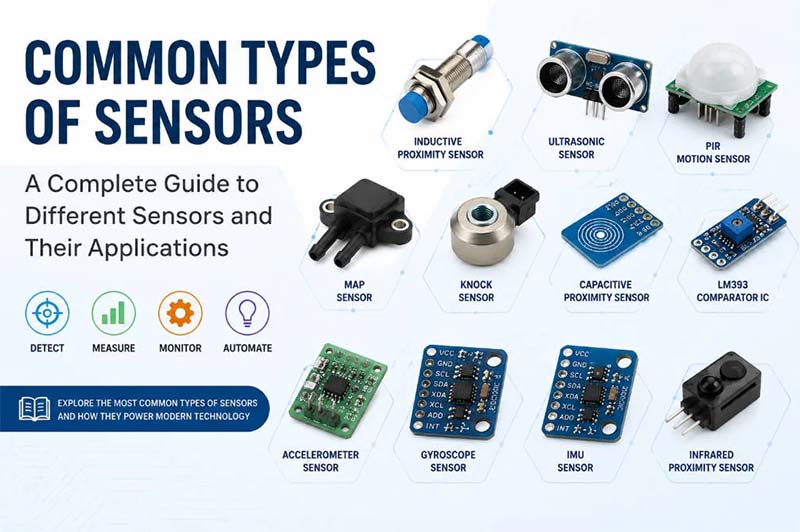
Different Types of IMU Sensors for Automated Robot
From compact MEMS IMU chips for lightweight mobile robots to high-precision inertial measurement units for advanced industrial and autonomous systems, the choice of IMU depends on measurement accuracy, sensing axes, operating conditions, power consumption, and system integration requirements.
1. 6-Axis IMU Sensors
A 6-axis IMU integrates a three-axis accelerometer and a three-axis gyroscope in a single sensor package. The accelerometer measures linear acceleration along the X, Y, and Z axes, while the gyroscope detects angular velocity around these axes.
6-axis MEMS IMUs are widely used in robotic motion tracking, posture estimation, vibration monitoring, and balance control. Their compact design and relatively low power consumption make them suitable for humanoid robots, robotic arms, drones, and autonomous mobile robots.
2. 9-Axis IMU Sensors
A 9-axis IMU combines a three-axis accelerometer, a three-axis gyroscope, and a three-axis magnetometer. In addition to measuring acceleration and rotation, the magnetometer detects the surrounding magnetic field to provide heading information.
By combining data from all three sensing elements through sensor fusion algorithms, 9-axis IMUs can support more comprehensive orientation tracking.
3. MEMS IMU Sensors
MEMS IMUs use micro-electromechanical structures fabricated through semiconductor manufacturing processes to detect physical movement. These devices integrate microscopic mechanical sensing elements with electronic circuits for signal processing and data output.
MEMS IMU chips are particularly suitable for modern automated robots because of their small footprint, low power consumption, and ease of integration into embedded electronic systems.
4. Industrial-Grade IMU Sensors
Industrial-grade IMUs are designed to operate in demanding environments where temperature variations, mechanical vibration, and continuous operation can affect measurement performance. Compared with general-purpose motion sensors, these devices may offer improved bias stability, lower noise, wider operating temperature ranges, and enhanced resistance to mechanical shock.
In automated robotic systems, industrial-grade IMUs are suitable for AGVs, heavy-duty robotic equipment, industrial manipulators, and precision motion control systems.
5. High-Precision IMU Sensors
High-precision IMUs are developed for applications that require more accurate inertial measurements and lower measurement drift. Depending on the technology and performance class, these devices can provide improved gyroscope stability, lower noise levels, and more accurate acceleration measurements.
They are commonly considered for advanced autonomous robots, precision navigation systems, aerospace robotics, and industrial equipment requiring reliable orientation and motion estimation.
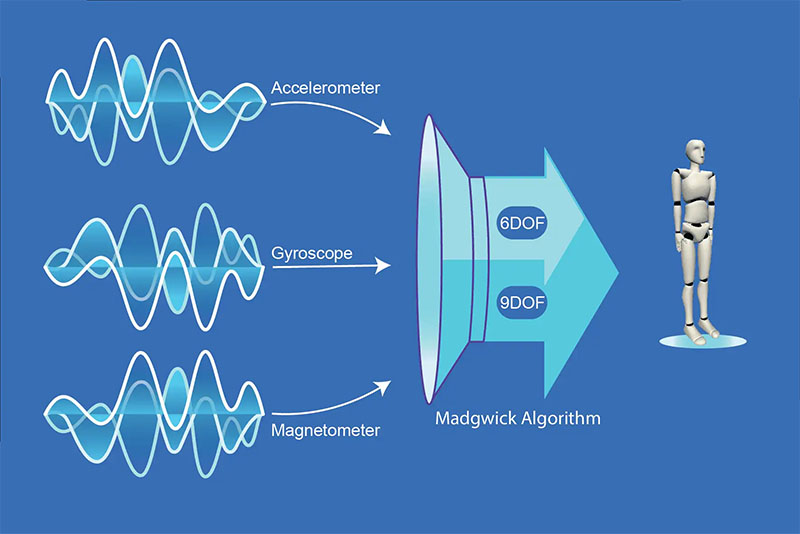
IMU for Drones & Robotics, LiDAR, GPS, and Vision Sensors Application
IMU sensors play an important role in drones and intelligent robotic systems by providing real-time acceleration and angular velocity measurements. To improve navigation and motion estimation, IMU chips are often integrated with other sensing technologies, including LiDAR, GPS, cameras, and optical vision sensors.
From a microelectronics perspective, this integration relies on multiple sensor ICs working together with embedded processors and data fusion algorithms. Each sensor provides different types of measurement data, allowing drones and robots to achieve more reliable navigation, positioning, and motion control.
1. IMU and LiDAR Integration
LiDAR sensors use laser pulses to measure distances and generate three-dimensional information about surrounding environments. When combined with IMU measurements, LiDAR provides environmental mapping data while the IMU tracks the device's acceleration and rotational movement.
This combination is widely used in autonomous mobile robots (AMRs), warehouse robots, and drones equipped with LiDAR-based navigation systems. IMU data helps estimate movement between LiDAR measurements, while LiDAR observations can correct accumulated inertial estimation errors. Together, they support simultaneous localization and mapping (SLAM), obstacle detection, and navigation.
2. IMU and GPS Integration
GPS provides global positioning information, while an IMU measures acceleration and rotational movement. Combining these technologies allows drones and outdoor autonomous robots to estimate their position, velocity, and orientation more continuously.
This combination is particularly useful in UAV navigation, autonomous ground vehicles, agricultural robots, and outdoor inspection systems.
3. IMU and Vision Sensor Integration
Cameras and vision sensors capture visual information about the surrounding environment, including objects, landmarks, and movement patterns. When integrated with an IMU, visual data can be combined with inertial measurements to improve motion tracking and positioning.
This approach is commonly used in indoor mobile robots, autonomous drones, humanoid robots, and vision-guided robotic systems, especially where GPS signals are unavailable or unreliable.
4. Multi-Sensor Fusion in Intelligent Robotic Systems
In advanced automated systems, IMUs may work alongside LiDAR, GPS, cameras, wheel encoders, and other electronic sensors. Each device contributes different measurement information to the embedded processing platform.
For example:
- IMU chips: Provide acceleration and angular velocity measurements for motion and orientation estimation.
- LiDAR sensors: Deliver distance measurements and environmental mapping data.
- GPS receivers: Supply global positioning and timing information.
- Vision sensors: Capture visual information for object recognition and visual motion tracking.
- Wheel encoders: Measure wheel rotation and provide odometry data.
5. The Role of MEMS IMU Chips in Multi-Sensor Systems
As drones and intelligent robots become smaller and more sophisticated, compact MEMS IMU chips are increasingly important in multi-sensor electronic designs. These semiconductor-based devices integrate miniature accelerometers and gyroscopes with signal conditioning and digital interface circuits, providing inertial measurements in a compact package.
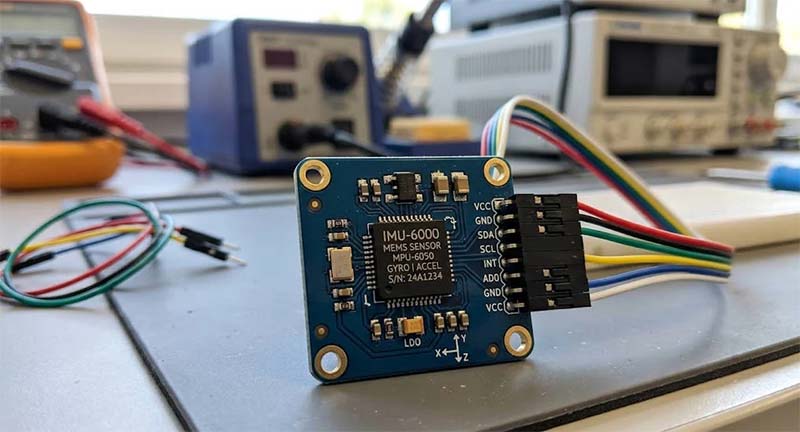
Leading IMU Sensor Manufacturers and Suppliers
The global IMU sensor market includes several established semiconductor manufacturers offering MEMS-based inertial measurement units for intelligent robotics, drones, industrial automation, agricultural automation and embedded electronic systems. These manufacturers develop different IMU technologies and product families, covering applications ranging from compact motion sensing to high-precision inertial measurement.
1. Bosch (Bosch Sensortec) - Established MEMS Sensor Solutions
Bosch Sensortec develops MEMS-based motion sensors, including accelerometers, gyroscopes, magnetometers, and integrated IMU solutions. Its products are used in robotics, drones, consumer electronics, and industrial applications.
Notable IMU product families and models include:
- BMI088 – High-performance IMU designed for drone and robotics applications.
- BMI270 – Low-power 6-axis IMU for motion sensing.
- BMI323 – 6-axis IMU for compact embedded applications.
- BMI563 – High-performance IMU featuring advanced motion sensing capabilities.
Bosch's portfolio includes compact MEMS IMUs with different performance characteristics, allowing designers to select devices for motion tracking, orientation estimation, and robotic control.
STMicroelectronics offers a broad range of MEMS motion sensors, including 6-axis IMUs that combine three-axis accelerometers and three-axis gyroscopes. Its products feature integrated digital processor, machine learning capabilities, and sensor fusion technologies in selected devices.
Representative IMU models include:
- LSM6DSOX – 6-axis IMU with an embedded machine learning core.
- LSM6DSV – 6-axis IMU with sensor fusion and digital interfaces.
- ISM330DHCX – Industrial-grade IMU with machine learning core and finite state machine.
- ISM330IS – 6-axis IMU with an intelligent sensor processing unit.
- ASM330LHHX – High-accuracy automotive-grade 6-axis IMU.
STMicroelectronics provides IMU solutions for industrial equipment, motion tracking, robotics-related applications, and other embedded systems requiring integrated sensing and processing capabilities.
3. TDK InvenSense - Professional IMU and Motion Sensing Solutions
TDK InvenSense specializes in MEMS motion sensing technologies, offering accelerometers, gyroscopes, and integrated IMUs for consumer electronics, industrial applications, and embedded systems.
High-Performance and Advanced IMU Series
- ICM-40609-D
- ICM-42688-P
- ICM-45686
- ICM-42670-P
General-Purpose and Classic IMU Series
- ICM-20602
- ICM-20948
- ICM-20689
- ICM-42605
- ICM-42607-P
- ICM-42607-C
These IMU chips offer different combinations of sensing performance, power consumption, and integration features. They can be considered for robotic platforms, drones, motion tracking equipment, and other embedded systems requiring multi-axis inertial measurements.
4. Analog Devices (ADI)
Analog Devices provides precision inertial measurement units combining MEMS gyroscopes and accelerometers. Its IMU portfolio is designed for applications requiring reliable motion measurement, orientation estimation, and inertial navigation.
Representative product models include:
- ADIS16470 – Compact precision 6-axis MEMS IMU.
- ADIS16500 – Precision MEMS IMU.
- ADIS16505 – Precision MEMS IMU.
- ADIS16507 – Precision miniature MEMS IMU.
- ADIS16577 – Precision MEMS IMU module.
These products are suitable for demanding applications such as industrial automation, navigation equipment, robotics, and precision motion control systems.
Sourcing IMU Sensors from Reliable Suppliers
EASTECH provides one-stop electronic component sourcing solutions for customers developing intelligent robots, drones, industrial automation equipment, and embedded control systems. Beyond IMU sensors, we support the procurement of a wide range of semiconductor devices and electronic components from multiple manufacturers, helping customers consolidate sourcing requirements through a single supplier.
With access to diverse component sourcing channels and multiple manufacturer product portfolios, EASTECH offers competitive pricing, flexible procurement options, and sourcing support for both standard and hard-to-find electronic components. Our services also help customers simplify supplier management, coordinate purchasing requirements, reduce procurement complexity, and improve supply chain efficiency.
Whether you need MEMS IMU sensors, microcontrollers, FPGAs, power management ICs, memory devices, or other semiconductor components, EASTECH provides responsive quotation support and tailored sourcing solutions to meet your project and production requirements.
Related information
- 2026.11.10 What is a Power Semiconductors?
- 2026.11.03 What Are RF Amplifiers?
- 2026.10.25 What is a Quartz Crystal Oscillator?